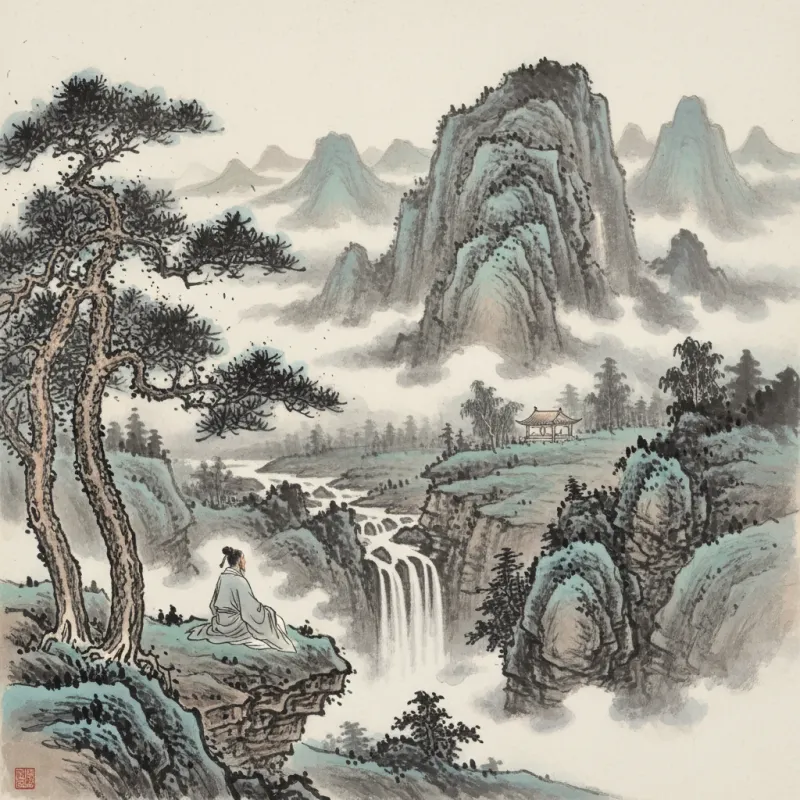
A monk asks his master: "What is Buddha?" The master replies: "Three pounds of flax." You read this exchange, your rational mind scrambles for meaning, and in that moment of confusion — right there, in the gap between question and nonsense — that's where Zen poetry does its work.
Zen poetry (禅诗 chánshī) emerged from Chan Buddhism as a deliberate assault on logical thinking. These aren't verses meant to be understood through careful analysis or scholarly interpretation. They're spiritual grenades designed to explode your conceptual frameworks and leave you standing in direct, unmediated experience of reality. The Tang and Song dynasties produced thousands of these poems, and the best ones still have the power to stop your mind mid-thought.
The Impossible Koan in Verse Form
Chan Buddhism developed in China during the Tang Dynasty as a radical simplification of Buddhist practice. While other schools accumulated elaborate philosophies and ritual systems, Chan masters insisted that enlightenment couldn't be transmitted through words or concepts. Yet paradoxically, they used language constantly — particularly poetry — to point beyond language itself.
The technique mirrors the famous koan (公案 gōng'àn) tradition. A koan like "What is the sound of one hand clapping?" isn't a riddle with a clever answer. It's a cognitive trap. Your rational mind tries to solve it, fails, tries again, fails harder, and eventually — if you're lucky — gives up entirely. In that moment of surrender, something else becomes possible.
Zen poetry works the same way, but with more aesthetic grace. Consider this verse by the Tang monk Qingjiang (青江):
The moon in the water, grasped at but never caught
The flower in the mirror, seen but never plucked
Your first instinct is to interpret: "Ah, it's about the illusory nature of phenomena!" But that interpretation is just another concept, another layer of mental furniture between you and direct experience. The poem wants you to actually see the moon's reflection rippling in water, to feel the impossibility of grasping it, to rest in that impossibility without needing to explain it.
Wang Wei and the Poetry of Emptiness
Wang Wei (王维, 699-759) stands as perhaps the greatest master of Zen-influenced poetry in the Tang Dynasty. A devout Buddhist who spent his later years in semi-monastic retreat, Wang Wei perfected a style of verse that seems almost transparent — simple observations of nature that somehow contain infinite depth.
His famous quatrain "Deer Park" (鹿柴 Lùzhài) demonstrates the technique:
Empty mountain, no one in sight
Yet I hear human voices echoing
Returning sunlight enters the deep forest
Shining again on the green moss
On the surface: a nature scene. But notice what Wang Wei does. The mountain is empty, yet voices echo. Light returns to illuminate what was already there. The poem presents contradictions without resolving them, observations without commentary. There's no "I think" or "I feel" — just phenomena arising and passing. The poet's ego has dissolved into the landscape.
This connects directly to the Buddhist concept of emptiness (空 kōng) — not nihilistic void, but the recognition that all phenomena lack inherent, independent existence. Wang Wei's poetry doesn't explain emptiness; it enacts it. The verses themselves are empty of fixed meaning, allowing readers to encounter them freshly each time.
The Song Dynasty's Philosophical Turn
By the Song Dynasty (960-1279), Chan Buddhism had become deeply integrated into Chinese intellectual culture. Literati poets like Su Shi (苏轼, 1037-1101) and Huang Tingjian (黄庭坚, 1045-1105) wrote verses that blended Chan insights with Confucian ethics and Daoist naturalism. The poetry became more explicitly philosophical, sometimes losing the immediate punch of earlier Tang verses.
Su Shi's poem "Written on the Wall at West Forest Temple" captures this Song Dynasty style:
Viewed horizontally, a mountain range; sideways, a single peak
Far, near, high, low — no two views the same
I cannot see Mount Lu's true face
Because I myself am within the mountain
Here the Zen insight is spelled out more clearly: our perspective shapes what we see, and we cannot step outside our own position to gain an "objective" view. It's philosophically sophisticated, but it explains rather than demonstrates. Compare this to Wang Wei's "Deer Park," which simply shows you the thing itself without commentary.
This tension between showing and telling runs through all Zen poetry. The most effective verses resist interpretation while simultaneously inviting it. They're like those optical illusions that flip between two images — you can see the vase or the faces, but not both simultaneously. The poem exists in the flipping itself.
Seventeen Syllables and the Japanese Refinement
When Chan Buddhism traveled to Japan and became Zen, the poetic tradition evolved into haiku — the famous seventeen-syllable form (5-7-5 in Japanese). Matsuo Bashō (松尾芭蕉, 1644-1694) brought Zen principles to haiku with devastating effectiveness:
An old pond
A frog jumps in
The sound of water
That's it. No metaphor, no symbolism, no hidden meaning. Just a moment of experience captured with absolute precision. The genius lies in what Bashō leaves out — there's no "I" observing, no judgment about whether the moment is beautiful or mundane, no attempt to extract a lesson. The poem is pure presentation.
Chinese Zen poetry tends toward more elaborate construction, but the best examples share haiku's commitment to direct experience. The difference is partly linguistic — Chinese characters carry more semantic weight than Japanese syllables, allowing for denser meaning in fewer words. A four-line Chinese quatrain can contain as much as a much longer Japanese verse.
Reading Zen Poetry Wrong (Which Is Right)
Here's the secret: you're probably reading Zen poetry wrong, and that's exactly how you should read it. If you approach these verses looking for hidden meanings, symbolic interpretations, or philosophical lessons, you'll find them — and miss the point entirely.
Try this instead: read the poem once, quickly. Notice your immediate reaction — confusion, curiosity, maybe irritation. Don't try to figure it out. Read it again, slower. Let the images arise in your mind without analyzing them. If you find yourself thinking "this means that," gently set the interpretation aside and return to the words themselves.
The poem isn't a code to crack. It's more like a tuning fork that resonates at a frequency your rational mind can't quite process. The meaning isn't hidden in the words; it emerges in the space between the words and your direct experience of reading them.
This connects to the broader Chan Buddhist practice of "just sitting" (只管打坐 zhǐguǎn dǎzuò) — meditation without goal or technique, just the bare fact of sitting. Zen poetry asks for "just reading" — encountering the words without agenda, without the need to extract meaning or achieve understanding.
The Paradox That Keeps on Giving
The ultimate paradox of Zen poetry is that it uses language to point beyond language, concepts to destroy concepts, meaning to transcend meaning. It's a self-destructing message, a ladder you climb and then kick away.
Modern readers sometimes dismiss Zen poetry as deliberately obscure or pretentious. And yes, there's plenty of bad Zen poetry that's just obscure for obscurity's sake. But the genuine article — Wang Wei's luminous landscapes, the sharp koans of Tang masters, Bashō's perfect moments — these verses remain powerful precisely because they refuse to be domesticated by interpretation.
They're not trying to communicate information. They're trying to create an experience. The difference is everything. When you read "three pounds of flax" as an answer to "What is Buddha?", your mind stops. In that stopping, something else becomes possible — not understanding, but a direct encounter with the question itself, with the asking, with the space where questions arise.
That's what Zen poetry offers: not answers, but better questions. Not meaning, but the experience of meaning dissolving. Not enlightenment in seventeen syllables, but seventeen syllables that might, if you're lucky, get out of enlightenment's way.
The poems are still there, waiting. They've been waiting for centuries. They'll wait for you to stop trying to understand them and simply read them, again and again, until the reading itself becomes the point. Until the moon in the water is just the moon in the water, and that's enough.
Related Reading
- Daoist Poetry: Finding the Way Through Nature
- Daoist Poetry: The Art of Doing Nothing
- The Timeless Elegance of Chinese Classical Poetry: Tang, Song, and Yuan Eras
- Confucian Values in Classical Chinese Poetry: Duty, Loyalty, and the Weight of the World
- Poetry as Philosophy: How Chinese Poets Think
- Lost in Translation: Famous Challenges in Translating Chinese Poetry
- Buddhist Impermanence in Tang Poetry: Everything You Love Will Disappear
- What Is Song Ci? A Guide to China's Other Great Poetry Tradition
Explore Chinese Culture
- Explore the Tang dynasty's golden age
- Explore Daoist themes in classical poetry
- Explore Chinese literary traditions