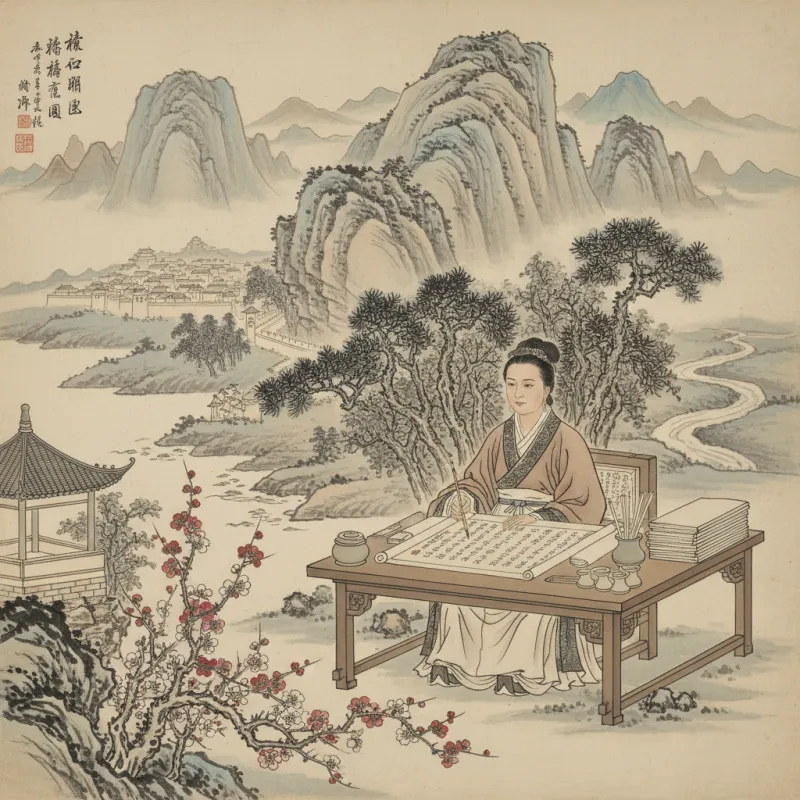
When Ban Zhao picked up her brother's unfinished manuscript in 92 CE, she wasn't just completing a history book — she was about to become the only woman in Chinese history officially recognized as a court historian. The Book of Han, that massive chronicle of the Western Han dynasty, had defeated her father Ban Biao and outlived her brother Ban Gu. Now it fell to their daughter and sister to finish what two generations of men could not.
And she did it. She didn't just patch together the remaining chapters — she wrote the crucial "Tables" (表, biǎo) and "Treatise on Astronomy" (天文志, Tiānwén Zhì), some of the most technically demanding sections of the entire work. When Emperor He's court needed someone to teach the imperial women classical texts, they called Ban Zhao. When the empress dowager needed political advice, she consulted Ban Zhao. This wasn't tokenism. This was recognition of genuine intellectual authority in a world that rarely granted it to women.
The Family Business of History
Ban Zhao came from what we might call China's first family of historiography. Her father Ban Biao had begun compiling materials to continue Sima Qian's Records of the Grand Historian (史记, Shǐjì), extending the narrative through the Western Han dynasty (206 BCE–9 CE). When he died, her twin brother Ban Gu took over the project, working on it for decades until he was imprisoned and died in 92 CE — the victim of political intrigue that had nothing to do with his historical work.
The Book of Han was nearly complete, but "nearly" doesn't count in historiography. The tables that cross-referenced events, dates, and genealogies were unfinished. The treatise on astronomy — crucial for a dynastic history, since celestial phenomena were interpreted as signs of Heaven's favor or displeasure — was incomplete. The court needed someone who understood the project's scope, had access to the materials, and possessed the intellectual capacity to complete it.
They turned to Ban Zhao. She was probably in her forties by then, widowed, and had already established a reputation for learning. The decision was pragmatic, not progressive — but it was still extraordinary. The Book of Han became one of the Twenty-Four Histories (二十四史, Èrshísì Shǐ), the official historical records of Chinese dynasties. Ban Zhao's name appears in its preface. For nearly two millennia, every educated person in China who read that history read Ban Zhao's work.
The Court Intellectual
Ban Zhao's role at court extended far beyond finishing her brother's manuscript. Emperor He appointed her to teach the women of the imperial household, including the empress and consorts. This wasn't elementary education — she was teaching them classical texts, poetry, history, and the literary arts. Think of her as something between a court philosopher and a private tutor to the most powerful women in the empire.
Her students included Empress Deng Sui, who would later serve as regent and specifically sought Ban Zhao's counsel on political matters. When the empress dowager needed advice on complex policy questions, Ban Zhao wrote memorials — formal policy documents — that were taken seriously by the court. One of her memorials successfully argued for the return of the Dou family to the capital after they had been exiled. This wasn't ceremonial influence; this was real political power exercised through intellectual authority.
She also had male students. The historian Ma Rong, who would become one of the most important classical scholars of the Eastern Han, studied under Ban Zhao. A woman teaching men classical texts was virtually unprecedented, but Ban Zhao's reputation was such that ambitious scholars sought her instruction.
Her poetry, though little survives, shows the same intellectual confidence. "Traveling Eastward" (东征赋, Dōngzhēng Fù), a rhapsody describing a journey, demonstrates her command of the fu (赋) form — that elaborate, allusive style of poetry that was the mark of serious literary culture. Like Cai Yan, another Han dynasty woman who refused to let gender limit her literary ambitions, Ban Zhao wrote in forms that were considered the domain of male scholars.
The Paradox of Lessons for Women
And then there's Lessons for Women (女诫, Nǚ Jiè), the text that has defined Ban Zhao's legacy more than anything else she wrote. Composed as instructions for her daughters, it became the most influential conduct manual for women in Chinese history, reprinted and studied for nearly two thousand years.
The content is exactly what you'd expect from a Confucian conduct manual: women should be humble, submissive, industrious, and deferential to their husbands and in-laws. They should speak softly, avoid jealousy, and accept their subordinate position in the family hierarchy. "Let a woman modestly yield to others," Ban Zhao writes. "Let her respect others; let her put others first, herself last."
The irony is crushing. Here is a woman who held a position no other woman in Chinese history would hold, who taught empresses and male scholars, who completed one of China's most important historical works — and she's telling other women to be quiet and submissive.
Modern readers tend to react in one of two ways. Some dismiss Ban Zhao as a collaborator in patriarchy, a woman who pulled the ladder up behind her. Others try to read Lessons for Women as subversive, finding hidden feminist messages in the text. Both approaches miss something important.
Reading Ban Zhao in Context
First, we need to understand what Lessons for Women actually says — and what it doesn't say. Yes, it counsels submission and humility. But it also insists, repeatedly and forcefully, that women must be educated. Ban Zhao argues that the ancient practice of educating girls had been abandoned, and this was a serious mistake. Women need to study the classics, understand ritual propriety, and develop their moral and intellectual capacities.
This might seem like a small point, but it wasn't. The dominant view in Han dynasty China was that women needed minimal education — just enough to manage household tasks. Ban Zhao argued that women needed the same classical education as men, even if the purpose of that education was different. She was working within Confucian ideology, not against it, but she was pushing its boundaries.
Second, Ban Zhao's advice needs to be read as strategic counsel for survival in a patriarchal system, not as her personal vision of an ideal world. She was writing for her daughters, who would have to navigate marriage, in-laws, and a social structure that gave them
Related Reading
- Rediscovering Women Poets of the Tang, Song, and Yuan Dynasties
- Women Poets of China: The Voices That Were Almost Lost
- Zhuo Wenjun: The Woman Who Wrote Her Own Love Story
- Women Poets of China: The Voices That History Almost Silenced
- The Banana Garden Poetry Club: When Women Took Over Chinese Poetry
- Wine Poetry: The Chinese Tradition of Drinking and Writing
- The Spiritual Depth of Chinese Classical Poetry: Insights from Tang, Song, and Yuan Poets
- Discovering the Rich Legacy of Tang, Song, and Yuan Poetry
Explore Chinese Culture
- Explore the Tang dynasty's golden age
- Explore Daoist themes in classical poetry
- Explore Chinese literary traditions