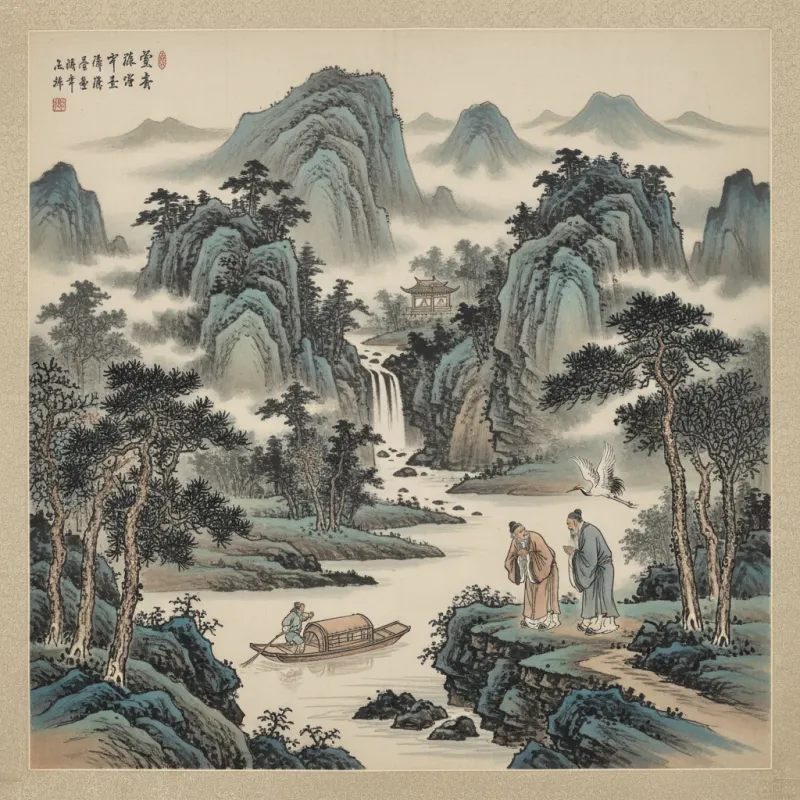
The willow branch breaks with a soft crack. Your friend tucks it into his traveling bag, a green promise that you'll meet again. But you both know the odds. The road to Sichuan crosses five mountain ranges. The posting to the Western Regions means three years minimum, if he survives the desert. You're standing at a pavilion outside Chang'an's walls, and this might be the last time you see each other alive.
This is the emotional reality behind farewell poetry (送别诗 sòngbié shī), one of the most developed genres in classical Chinese literature. These poems weren't sentimental indulgences. They were psychological technology for managing genuine grief.
The Geography of Goodbye
Tang Dynasty China was enormous — roughly the size of modern China, but without planes, trains, or paved highways. A journey from the capital Chang'an to the southern port of Guangzhou took two months under good conditions. Posting to the frontier garrisons in Xinjiang or Mongolia meant crossing deserts where entire caravans disappeared. The Yangtze River, despite being a major trade route, drowned hundreds of travelers annually.
When Li Bai (李白) wrote his famous farewell to Meng Haoran, he wasn't being dramatic: "The lonely sail's distant shadow vanishes in the blue void / I see only the Yangtze flowing to the horizon's edge" (孤帆远影碧空尽,唯见长江天际流). That boat really might sink. Meng Haoran really might die of illness in Yangzhou. The uncertainty was built into every goodbye.
This geographical reality shaped the entire genre. Farewell poems obsessively catalog distances, routes, and landmarks. They mention specific mountains, rivers, and border towns. Wang Wei (王维) sends off Yuan Er with precise details: "Morning rain dampens the dust of Weicheng / The guesthouse willows are fresh and green" (渭城朝雨浥轻尘,客舍青青柳色新). These aren't decorative images. They're a mental map for the friend to carry, a way of saying "I know where you're going, I'm imagining your journey."
The Willow Branch Code
Almost every Tang farewell poem mentions willows (柳 liǔ). This isn't coincidental. Breaking off a willow branch and giving it to a departing friend was the standard ritual gesture, so common that "breaking willows" (折柳 zhéliǔ) became synonymous with saying goodbye.
The symbolism worked on multiple levels. Willows grow near water, marking the spots where travelers would naturally pause. They're resilient — you can break off a branch and it'll sprout roots if you plant it. And crucially, the word for willow (柳 liǔ) sounds like the word for "stay" (留 liú), creating a pun that every educated person would catch. Giving someone a willow branch was literally saying "stay" while acknowledging they had to leave.
Li Bai pushes this symbolism to its limit in "Spring Night in Luoyang Hearing a Flute": "In what house tonight does the jade flute sound? / Its notes scatter with the spring wind, filling Luoyang / In this nocturne I hear 'Breaking Willows' / Who doesn't think of their old garden?" (谁家玉笛暗飞声,散入春风满洛城。此夜曲中闻折柳,何人不起故园情). The flute plays a tune called "Breaking Willows," and suddenly everyone in the city is homesick. The willow has become pure emotional trigger.
Pavilions and Thresholds
Farewell poems are obsessed with specific locations. The most common is the pavilion (亭 tíng) — small structures built along roads specifically for travelers to rest and for friends to say goodbye. These weren't casual architectural choices. The government maintained an extensive network of pavilions, typically spaced about five miles apart. They marked the boundary between the familiar and the unknown.
Wang Wei's "Seeing Off" captures this threshold moment: "I dismount and offer you wine / I ask where you're going / You say you haven't succeeded, you're returning to rest at the foot of Zhongnan Mountain" (下马饮君酒,问君何所之。君言不得意,归卧南山陲). The dismounting, the shared wine, the question about destination — these are ritual actions performed at a ritual space. The pavilion is where normal social life ends and the dangerous journey begins.
River crossings worked the same way. The Yangtze, the Yellow River, the Wei River — these were natural farewell points because they required ferries or boats. You couldn't casually follow your friend across. The water created a clean break. Bai Juyi (白居易) uses this in "Seeing Off a Friend": "The grass on the plain stretches to the horizon / With each season it withers and grows again / Wildfire cannot burn it all / Spring wind blows and it lives once more" (离离原上草,一岁一枯荣。野火烧不尽,春风吹又生). The grass survives separation and return, but the human friendship might not.
The Economics of Emotion
Here's what's rarely discussed: farewell poetry was a social obligation for the educated class. If you were a scholar-official, you were expected to write farewell poems for colleagues, friends, and even acquaintances. Not writing one was a social failure. This created a strange economy where genuine emotion had to be produced on demand.
The result is a genre with enormous range. Some farewell poems are clearly pro forma — competent but emotionally flat. Others are devastating. Du Fu (杜甫) seeing off his friend Yan Wu: "This parting should not be taken lightly / I'm old and sick, you're going far away / I fear we'll never meet again in this life / The autumn wind blows my white hair" (此别不须轻,老病远相送。恐是今生别,秋风吹白发). That's not polite convention. That's a man confronting mortality.
The best poets found ways to make the conventions feel fresh. Wang Changling (王昌龄) wrote: "If relatives and friends in Luoyang ask about me / Say my heart is like ice in a jade pot" (洛阳亲友如相问,一片冰心在玉壶). The image is so specific — not just pure, but cold and preserved, like something frozen in time. It transforms a standard reassurance ("tell them I'm doing well") into something strange and memorable.
What Farewell Poetry Shares with Love Poetry
The emotional structure of farewell poetry closely resembles romantic love poetry. Both deal with separation, longing, and uncertainty about reunion. Both use natural imagery — moons, rivers, mountains — to externalize internal states. Both obsess over specific moments and gestures.
The main difference is that farewell poetry between friends was socially acceptable for men to write, while explicit romantic poetry was more constrained. This meant that some of the most emotionally intense poetry in the Chinese tradition appears in the farewell genre. Male poets could express vulnerability, longing, and grief to other men in ways that would have seemed excessive in other contexts.
Li Bai's farewell to Wang Lun is almost embarrassingly emotional: "Li Bai was about to leave in his boat / When suddenly he heard singing on the shore / Peach Blossom Pool is a thousand feet deep / But it's not as deep as Wang Lun's love for me" (李白乘舟将欲行,忽闻岸上踏歌声。桃花潭水深千尺,不及汪伦送我情). That last line — comparing a friend's affection to a famous deep pool — would fit perfectly in a love poem. The farewell genre gave poets permission to be emotionally unguarded.
The Survival Rate of Friendships
Here's a grim fact: most of these friendships probably didn't survive. The distances were too great, the communication too slow. Letters took months to arrive, if they arrived at all. People changed postings, changed careers, died of illness. The farewell poem was often the last real communication between friends.
This explains the genre's obsession with memory and recognition. Poets constantly worry about being forgotten. Wang Wei writes: "I urge you to drink one more cup of wine / West of Yang Pass there are no old friends" (劝君更尽一杯酒,西出阳关无故人). The anxiety is explicit — once you cross that border, you're among strangers. Our friendship exists only in this moment, in this cup of wine.
The poems themselves became a way of preserving the friendship. If the person died, you still had the poem. If you never saw them again, the poem was proof that the relationship had mattered. This is why farewell poems often include specific details — the date, the location, the weather, what was said. They're creating a record, a memorial in advance.
Why This Genre Matters Now
We don't write farewell poems anymore. We text "safe travels" and track flights on our phones. We assume we'll see people again because we usually do. The existential weight of goodbye has been engineered out of modern life.
But the emotional technology of farewell poetry still works. The Tang poets figured out how to transform grief into art, how to make separation bearable by making it beautiful. They understood that saying goodbye well — with attention, with ritual, with words that matter — is a way of honoring what you're losing.
Reading these poems now, what strikes me is their refusal to minimize the pain. They don't say "it's not that far" or "we'll video chat." They say: this hurts, this matters, I will remember this moment. In a culture that increasingly treats all relationships as casual and replaceable, that kind of emotional seriousness feels almost radical.
The next time you're at an airport, watching someone disappear through security, think about Li Bai watching that sail vanish into the blue void. The technology has changed. The feeling hasn't.
Related Reading
- Love and Longing in Chinese Classical Poetry: Tang, Song, and Yuan Dynasties Explored
- Love Poetry in Classical Chinese: The Art of Saying Everything by Saying Almost Nothing
- Exploring Love in Chinese Classical Poetry: Tang, Song, and Yuan Poets’ Romantic Artistry
- Li Qingzhao: China's Greatest Female Poet
- Love Poetry in Chinese Literature: The Art of Saying Everything by Saying Nothing
- Modern Chinese Poetry: From Classical Forms to Free Verse
- Song Ci: The Lyrics That Broke Poetry's Rules
- Exile and Homesickness: The Wanderer's Lament
Explore Chinese Culture
- Explore the Tang dynasty's golden age
- Explore Daoist themes in classical poetry
- Explore Chinese literary traditions