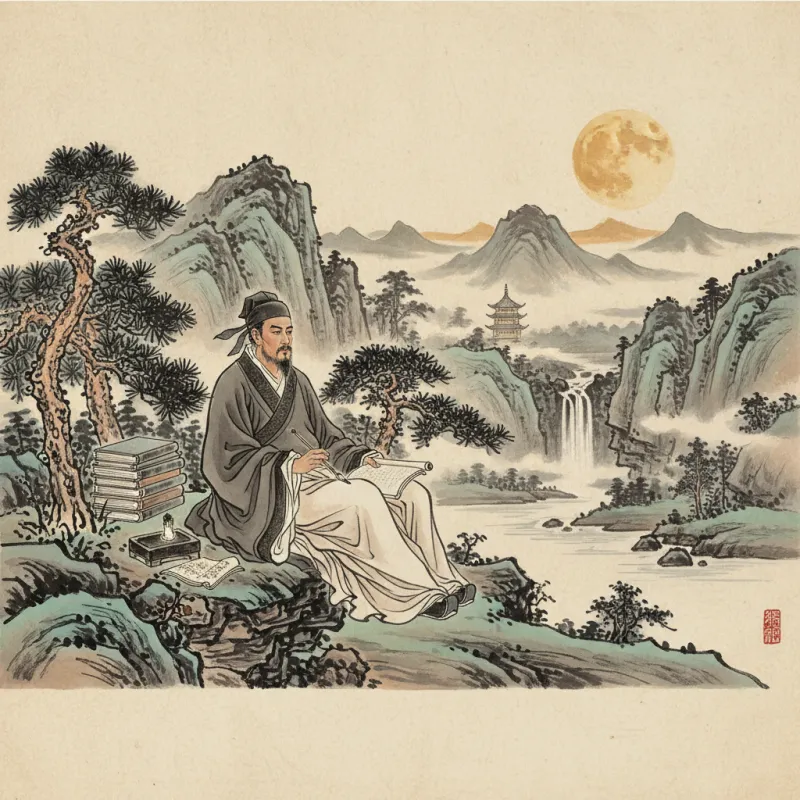
Picture this: A disgraced official stands on a rain-soaked hillside in Huangzhou, watching farmers work the fields below. He's been exiled for writing poetry that mocked the emperor's reforms. Most men would despair. Su Shi picks up his brush and writes "Red Cliff Rhapsody" — one of the greatest works in Chinese literature. Then he goes home and invents a new way to cook pork.
This is Su Shi (苏轼 Sū Shì, 1037–1101), and he's impossible to categorize. Call him China's Renaissance man and you're still underselling it. Leonardo painted the Mona Lisa; Su Shi wrote poetry that changed the ci form forever, painted bamboo that influenced centuries of artists, pioneered a calligraphy style, governed provinces, built infrastructure projects, and yes — created a dish (东坡肉 Dōngpō Ròu, Dongpo pork) that you can order in Chinese restaurants worldwide. The difference? Leonardo never got exiled three times for his art.
The Prodigy Who Couldn't Keep Quiet
Su Shi passed the imperial examinations at twenty-one, impressing the chief examiner so thoroughly that the man told the emperor: "I have secured a prime minister for Your Majesty's reign." He was half right. Su Shi would serve in government for decades, but his mouth kept getting in the way of his career.
The trouble started with Wang Anshi's New Policies in the 1070s. Wang, the prime minister, wanted to revolutionize Song dynasty governance through aggressive reforms — state monopolies, new taxes, forced loans. Su Shi thought the reforms hurt ordinary people and said so. Loudly. In memorials to the emperor. In poems that circulated through the capital. When you're that talented and that outspoken, you make enemies.
In 1079, those enemies struck. They compiled Su Shi's poems, found lines that could be read as criticizing the emperor, and charged him with treason. The "Crow Terrace Poetry Case" (乌台诗案 Wūtái Shī'àn) nearly cost him his life. He spent months in prison, writing farewell poems to his brother, certain he'd be executed. Instead, he was exiled to Huangzhou, a backwater town in modern Hubei province.
Most officials would have seen this as career death. Su Shi saw it as liberation.
Exile as Artistic Breakthrough
Huangzhou transformed Su Shi's art. Stripped of official duties and social obligations, he had time to think, write, and experiment. He took the literary name Dongpo Jushi (东坡居士 Dōngpō Jūshì, "Layman of the Eastern Slope") after the hillside plot he farmed. He studied Buddhism and Daoism seriously. He drank with local farmers and wrote about it.
The ci poems from this period are revolutionary. Before Su Shi, ci were mostly delicate love songs — the domain of courtesans and romantic poets like Liu Yong. Su Shi took the form and made it philosophical, political, personal. His "Prelude to Water Melody" (水调歌头 Shuǐdiào Gētóu), written during the Mid-Autumn Festival while thinking of his brother, asks: "When will the moon be clear and bright? / With a cup of wine in my hand, I ask the blue sky." Then it pivots to one of the most famous lines in Chinese literature: "People have sorrow and joy; they part and meet again. / The moon dims or shines; it waxes or wanes. / Nothing is perfect, not even in the olden days."
This is what Su Shi does — he takes a drinking song format and uses it to express Buddhist acceptance of impermanence. He makes the ci form grow up.
His "Red Cliff Rhapsody" (赤壁赋 Chìbì Fù) goes further. It's technically prose, not poetry, but it reads like a philosophical meditation disguised as a boat trip. Su Shi visits the site where Cao Cao's fleet burned during the Three Kingdoms period, reflects on the transience of glory, and concludes that the only things that last are the wind and the moon — which belong to everyone and no one. The piece influenced every writer who came after him.
The Calligrapher Who Broke the Rules
If Su Shi had only written poetry, he'd still be remembered. But he was equally revolutionary in calligraphy. The Song dynasty was obsessed with calligraphy — it was how educated men expressed their cultivation and competed for status. The dominant styles were elegant, controlled, refined.
Su Shi's calligraphy was none of those things. His style, which he called "stone-press calligraphy" (石压蛤蟆 shí yā hámá, literally "stone pressing a toad"), was thick, bold, and deliberately awkward. Characters sprawled across the page. Strokes were heavy and uneven. It looked like he was breaking every rule — because he was.
"My calligraphy is like a stone pressing down a toad," he wrote. "It has form but no beauty." This was false modesty — his calligraphy had tremendous beauty, just not the conventional kind. He was arguing that genuine expression mattered more than technical perfection. His "Cold Food Festival Poem" (寒食帖 Hánshí Tiè), written during his second exile, is considered one of the greatest calligraphic works in Chinese history. The characters seem to stagger across the page, drunk with emotion.
The Painter Who Saw Differently
Su Shi's painting philosophy was equally radical. He didn't paint to create realistic representations — he painted to express the essential spirit of things. His bamboo paintings, done in quick, confident brushstrokes, captured the resilience and flexibility of bamboo without fussing over botanical accuracy.
"When I paint bamboo, I don't think about bamboo," he wrote. "I become the bamboo." This idea — that the artist should merge with the subject — influenced literati painting for centuries. Su Shi argued that painting, like calligraphy and poetry, was fundamentally about expressing the artist's inner cultivation. Technical skill mattered less than spiritual authenticity.
He also had opinions about everyone else's art. When he looked at Wang Wei's paintings, he said: "In his poetry there is painting; in his painting there is poetry." This became the standard for evaluating literati art — the best work transcended its medium.
The Governor Who Actually Governed
Between exiles, Su Shi held real administrative positions, and he was surprisingly good at them. As governor of Hangzhou (1089–1091), he tackled the city's flooding problems by dredging West Lake and using the excavated mud to build a causeway. The Su Causeway (苏堤 Sū Dī) still exists, still prevents flooding, and is still one of Hangzhou's most famous landmarks.
He also reformed local agricultural policy, reduced taxes on farmers, and built hospitals. When famine struck, he organized relief efforts. When disease spread, he distributed medicine. He governed the way he wrote — with attention to real people and real problems, not abstract theories.
This practical competence makes his political failures more frustrating. Su Shi understood governance. He just couldn't stop antagonizing the people in power. When the political winds shifted and the reformers returned to dominance, he was exiled again — first to Huizhou in Guangdong, then to Hainan Island, which in the Song dynasty was basically the end of the earth.
The Final Exile and the Litchi Poems
Hainan nearly killed him. He was sixty years old, in poor health, living in a region with no infrastructure and endemic disease. His friends assumed he'd die there. Instead, he wrote some of his most joyful poetry.
His poems about litchi fruit are famous for their sensory detail and childlike delight: "Three hundred litchis a day, / I'd gladly be a Lingnan man forever." This from a man who'd lost everything — position, wealth, comfort — and found happiness in tropical fruit. It's either the ultimate expression of Daoist acceptance or the world's most elaborate coping mechanism. Probably both.
He also wrote about the indigenous Li people with genuine curiosity and respect, unusual for a Song dynasty official. He learned local customs, tried local food, and treated exile as anthropological fieldwork. When he was finally pardoned and allowed to return north in 1100, he died on the journey. He was sixty-four.
Why Su Shi Still Matters
Su Shi's influence on Chinese culture is hard to overstate. Every major poet after him had to reckon with his expansion of the ci form. Every calligrapher studied his bold, expressive style. Every literati painter absorbed his philosophy of spiritual authenticity over technical perfection. His essays on governance, art theory, and Buddhism remained required reading for educated Chinese for centuries.
But his real legacy is his attitude. Su Shi faced political persecution, exile, poverty, and the constant threat of execution. He responded by writing better poetry, painting more bamboo, cooking better pork, and finding joy in litchi fruit. He refused to let circumstances diminish his curiosity or creativity. He turned every disaster into an opportunity for growth.
Compare him to Li Qingzhao, who channeled personal tragedy into heartbreaking ci about loss and longing. Su Shi experienced similar losses but wrote with acceptance and even humor. Or consider Xin Qiji, who wrote martial ci full of frustrated ambition. Su Shi had plenty of frustrated ambition but chose philosophical detachment instead.
This doesn't make him better than other poets — just different. His particular genius was finding freedom within constraint, joy within suffering, and artistic opportunity in political disaster. He proved that you could be exiled from the capital but not from yourself.
The Song dynasty produced extraordinary poets, but only Su Shi could write a masterpiece, paint a masterpiece, invent a dish, and build a causeway — all while being politically unemployable. That's not just talent. That's a way of being in the world: curious, resilient, and utterly unwilling to be diminished by circumstances.
When you eat Dongpo pork in a restaurant today, you're tasting the legacy of a man who turned exile into art and disaster into dinner. That's the Su Shi way — make something beautiful, make something useful, and never stop being yourself, even when it costs you everything.
Related Reading
- What Is Song Ci? A Guide to China's Other Great Poetry Tradition
- Song Ci: The Lyrics That Broke Poetry's Rules
- Li Qingzhao: The Greatest Female Poet in Chinese History
- How to Read Chinese Poetry: A Guide for English Speakers
- Wang Wei: The Poet-Painter Who Captured Silence
- Love Poetry in Classical Chinese: The Art of Saying Everything by Saying Almost Nothing
Explore Chinese Culture
- Explore the Tang dynasty's golden age
- Explore Daoist themes in classical poetry
- Explore Chinese literary traditions