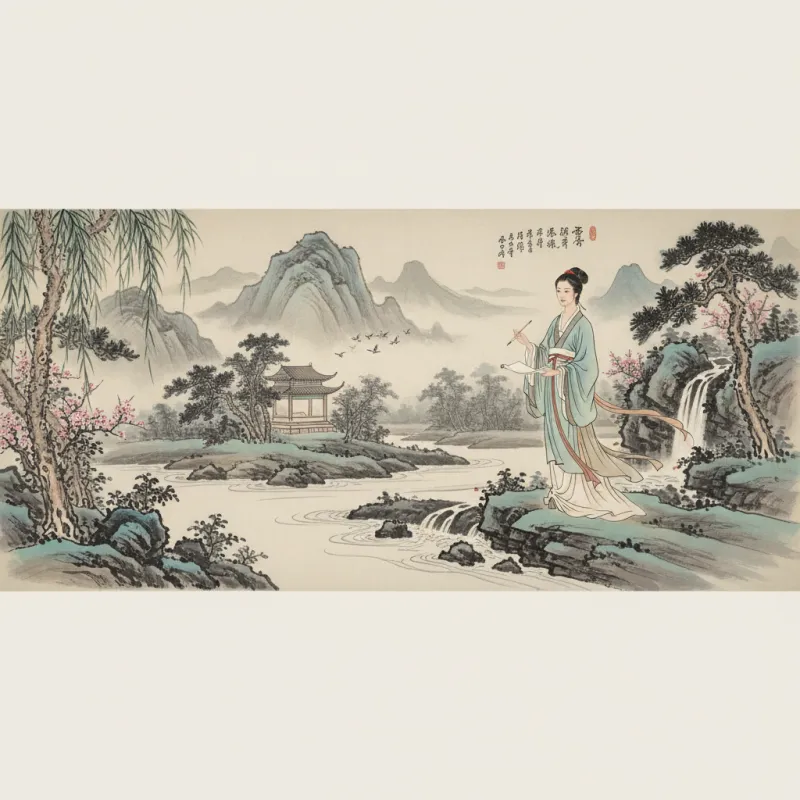
Picture this: a woman in her fifties, recently widowed, fleeing south as the Jin armies sweep through northern China. She's lost her husband, her home, and most of her priceless collection of art and antiquities. She sits down and writes a poem about playing a drinking game alone, and somehow — impossibly — it's funny. That's Li Qingzhao (李清照 Lǐ Qīngzhào, 1084–c. 1155), and that combination of devastating loss and unbreakable spirit is exactly why she stands alone in Chinese literary history.
The Woman Who Rewrote the Rules
Li Qingzhao didn't just write good poetry for a woman. She wrote poetry that made her male contemporaries look clumsy. Her ci (词 cí) — the lyric poetry form set to music that defined Song Dynasty (宋朝 Sòngcháo, 960–1279) literature — achieves something that sounds simple but is actually revolutionary: emotional honesty without melodrama. When she writes about missing her husband, you feel the specific texture of that absence. When she describes getting drunk, you can taste the wine and sense the defiance behind it.
The literary establishment of her time knew exactly what they had. This wasn't a case of posthumous discovery or feminist revisionism. Li Qingzhao was famous while she lived, debated and admired by the leading poets of the era. Her "Discourse on Ci" (词论 Cílùn), a critical essay she wrote about the form, was controversial precisely because people took her seriously enough to argue with her. She claimed that most ci poets — including giants like Su Shi (苏轼 Sū Shì) — didn't really understand the form. That takes confidence, and she had the skill to back it up.
Two Lives, Two Styles
Li Qingzhao's work divides naturally at 1127, the year the Jin Dynasty (金朝 Jīncháo) conquered northern China and her life split in half. Before that watershed, her poetry is playful, sensual, sometimes brazenly erotic. She writes about sneaking wine, flirting with her husband Zhao Mingcheng (赵明诚 Zhào Míngchéng), and the small dramas of domestic happiness. Her early ci "Like a Dream" (如梦令 Rú Mèng Lìng) describes getting so drunk on a pleasure boat that she accidentally rows into a lotus pond and startles the herons. It's charming, yes, but also technically perfect — the repetition of "Do you know? Do you know?" (知否知否 zhī fǒu zhī fǒu) creates a rhythm that mimics both drunkenness and the rocking of the boat.
After 1127, everything changes. Zhao Mingcheng dies in 1129. Li Qingzhao flees south with what remains of their collection, then watches most of it disappear through theft, loss, and the chaos of war. Her later poetry doesn't become maudlin — that's not her style — but it acquires a weight that makes the early work look almost innocent. "Slow Slow Song" (声声慢 Shēng Shēng Màn), written in her widowhood, opens with seven repeated characters that create a sound like sobbing: "Searching, searching, seeking, seeking, cold, cold, clear, clear, dismal, dismal, painful, painful" (寻寻觅觅,冷冷清清,凄凄惨惨戚戚 xún xún mì mì, lěng lěng qīng qīng, qī qī cǎn cǎn qī qī). It's a technical tour de force that also happens to be one of the most emotionally devastating poems in Chinese literature.
What Makes Her Different
Here's what separates Li Qingzhao from almost every other classical Chinese poet: she writes about her own experience without apology or disguise. Male poets of her era — even brilliant ones — typically wrote through layers of convention and allusion. They referenced earlier poems, adopted personas, gestured toward emotions rather than naming them directly. Li Qingzhao does some of that, but she also just tells you what she's feeling. When she's lonely, she says so. When she's drunk, she describes it. When she's angry about the fall of the north, she doesn't hide behind historical parallels.
This directness is especially striking in her love poetry. Before her marriage, she wrote ci that were shockingly frank about physical desire. After her marriage, she wrote about missing her husband with a specificity that male poets rarely attempted. In "A Prune Blossom" (一剪梅 Yī Jiǎn Méi), she describes sending a letter to her absent husband and then waiting for his reply: "The flowers drift, the water flows, one kind of longing, two places of idle sorrow" (花自飘零水自流,一种相思,两处闲愁 huā zì piāo líng shuǐ zì liú, yī zhǒng xiāng sī, liǎng chù xián chóu). That parallel structure — one longing, two locations — captures the geometry of separation more precisely than pages of conventional poetry.
The Scholar-Collector Partnership
Li Qingzhao's marriage to Zhao Mingcheng was unusual for its time: a genuine intellectual partnership. They were both from scholarly families, both passionate about art and antiquities, both serious about literature. They spent their early years together building a collection of ancient texts, bronze vessels, and stone rubbings, often going without new clothes to afford another rare book. Li Qingzhao describes their evenings together: they would make tea, pull out their collection, and quiz each other on which book contained which passage. The loser had to drink first, and often laughed so hard they spilled the tea.
This partnership shaped her poetry in ways that are easy to miss. She had access to the same classical education as male poets, the same libraries, the same literary networks. She wasn't writing from the margins — she was at the center of Song Dynasty literary culture. When she critiques other poets in her "Discourse on Ci," she's not an outsider complaining; she's an insider who knows exactly what she's talking about. Her standards were impossibly high because she had read everything and knew what the form could do.
The loss of Zhao Mingcheng in 1129 wasn't just personal devastation — it was the end of that intellectual world. Most of their collection was lost or stolen in the chaos of the Jin invasion. Li Qingzhao later wrote a postscript to Zhao Mingcheng's "Records of Metal and Stone" (金石录 Jīnshí Lù), describing in painful detail how their life's work disappeared. It's one of the great documents of loss in Chinese literature, and it helps explain why her later poetry has such depth: she's not just mourning a person, but an entire way of life.
Technical Mastery
Li Qingzhao's "Discourse on Ci" makes specific technical arguments about the form that are worth understanding. She believed that ci should be musical above all — that the words should fit the melody perfectly, with attention to tonal patterns and the natural rhythm of speech. She criticized poets like Su Shi for treating ci like shi poetry (诗 shī, the older, more rigid form), arguing that they were ignoring what made ci special. This might sound like academic hairsplitting, but it matters: Li Qingzhao's ci actually sound better when read aloud. The words flow naturally, without the awkward inversions or padding that mar lesser work.
She also understood something about emotional pacing that most poets miss. Her ci typically build through accumulation — small details that gather weight until the final lines hit with unexpected force. "Slow Slow Song" does this perfectly: it starts with that repeated-character opening, moves through images of autumn desolation (withered chrysanthemums, evening wind, migrating geese), and then ends with a simple statement that somehow contains all the grief of the preceding lines: "This time, how can the word 'sorrow' capture it?" (这次第,怎一个愁字了得 zhè cì dì, zěn yī gè chóu zì liǎo dé). The question is rhetorical, but it's also genuine — she's saying that language itself is inadequate, which is a bold claim for a poet to make.
The Later Years and Legacy
Li Qingzhao's life after 1129 is harder to trace. She remarried briefly and disastrously to a man named Zhang Ruzhou (张汝舟 Zhāng Rǔzhōu), who apparently wanted her remaining collection more than he wanted her. She divorced him — a scandalous move that required her to spend time in prison, since women who accused their husbands of crimes were automatically jailed even if the accusation was proven true. She survived that, continued writing, and died sometime around 1155, probably in her early seventies.
Her influence on later Chinese poetry is complicated. She had no direct successors — no school of female ci poets emerged to follow her example. The literary tradition absorbed her work but didn't quite know what to do with it. Male poets praised her but rarely tried to imitate her directness. Female poets who came later often wrote in more conventional styles, perhaps because Li Qingzhao's combination of technical mastery and emotional honesty was simply too difficult to replicate.
But her work survived, and that matters more than immediate influence. Her ci were copied, anthologized, and studied continuously from the Song Dynasty forward. When Chinese poetry was rediscovered by Western readers in the twentieth century, Li Qingzhao was one of the first poets to be translated, precisely because her emotional directness translated well across cultural boundaries. She remains the most famous female poet in Chinese history, and one of the most famous poets of any gender.
Why She Still Matters
Reading Li Qingzhao now, what strikes you is how modern she sounds. Not because she was ahead of her time — that's a lazy critical cliché — but because she wrote about experiences that don't age. Grief, desire, loneliness, the small pleasures of daily life, the larger devastations of war and loss: these are permanent human concerns, and she wrote about them with a clarity that cuts through nine centuries of cultural change.
She also matters because she proved something that shouldn't need proving but apparently does: that women can write at the absolute highest level of literary achievement. She didn't write "good poetry for a woman." She wrote poetry that set the standard for everyone. The Song Dynasty knew it, and we should remember it.
If you want to understand the full range of Song Dynasty literature, you need to read Li Qingzhao alongside the male poets who dominated the era. Her work on ci poetry shows what the form could achieve when handled by a master. And her life — split between the comfortable scholarly world of the Northern Song and the chaos of the Jin invasion — gives you a personal perspective on the historical forces that shaped Song Dynasty culture. She lived through one of the great catastrophes of Chinese history and turned it into art. That's what great poets do.
Related Reading
- Song Ci: The Lyrics That Broke Poetry's Rules
- What Is Song Ci? A Guide to China's Other Great Poetry Tradition
- Xin Qiji: The Warrior Poet Who Never Got His War
- Su Shi: The Renaissance Man of Chinese Literature
- Xin Qiji: The Warrior Poet
- Nature and Seasons in Chinese Poetry
- Du Fu's War Poems: Poetry as Witness to Catastrophe
Explore Chinese Culture
- Explore the Tang dynasty's golden age
- Explore Daoist themes in classical poetry
- Explore Chinese literary traditions