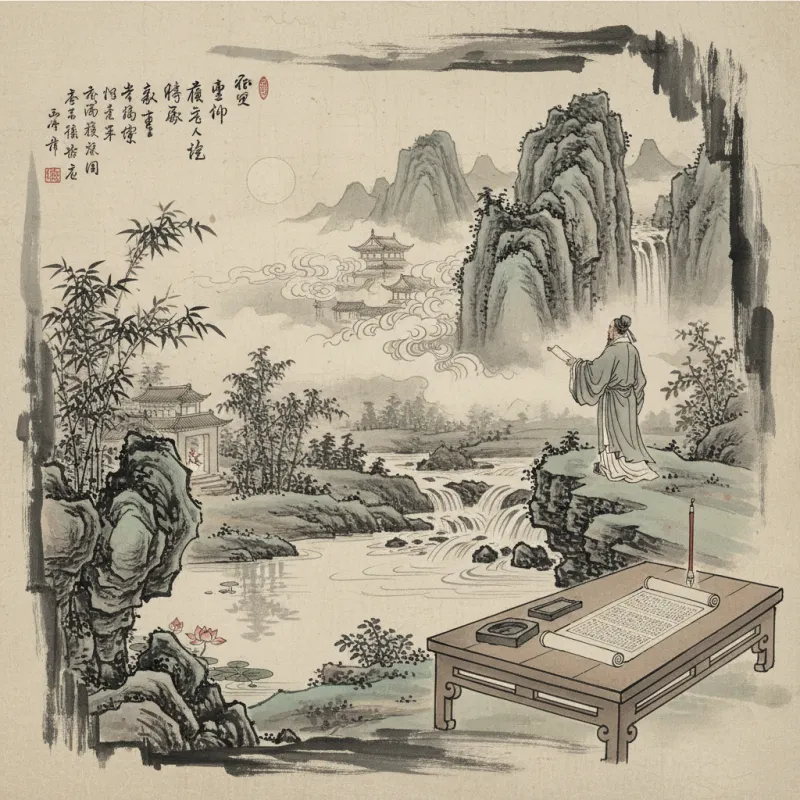
Ask most people about Chinese poetry and they'll mention Li Bai gazing at the moon or Du Fu lamenting war. But there's another tradition that deserves equal billing, one that's more intimate, more musically complex, and arguably more emotionally sophisticated than anything the Tang poets produced. Song ci (宋詞 Sòngcí) — the lyric poetry of the Song Dynasty (960–1279) — remains criminally underappreciated in the West, despite being the form that Chinese poets themselves often consider the pinnacle of their literary tradition.
The DNA of Ci: Music First, Poetry Second
Here's what makes ci fundamentally different from the shi (詩 shī) poetry that came before it: ci poems were written to be sung. Not metaphorically sung, but actually performed to specific melodies with names like "Butterflies Lingering Over Flowers" (蝶戀花 Diéliànhuā) or "The River Is Red" (滿江紅 Mǎnjiānghóng). These weren't just titles — they were tune patterns (詞牌 cípái) that dictated everything about the poem's structure: line lengths, tonal patterns, where rhymes fell, even the emotional mood.
This musical origin gave ci poets a freedom that Tang shi poets never had. While Tang regulated verse locked you into lines of five or seven characters with predictable caesuras, ci could have lines of three characters followed by lines of eleven. You could shift rhythms mid-poem, creating syncopated effects that mirrored the complexity of human emotion. A ci poem might start with short, breathless lines expressing sudden passion, then stretch into longer lines of reflection and regret.
The irony? By the time ci reached its golden age in the Song Dynasty, most of the original melodies had been lost. Poets were writing to the ghost of music, following structural templates whose tunes existed only in memory. Yet the musical skeleton remained, giving ci its distinctive shape and flow.
Two Schools, Two Philosophies
Song ci split into two major camps, and the divide tells you everything about the form's range. The "Graceful School" (婉約派 Wǎnyuēpài) specialized in intimate emotions — romantic longing, separation anxiety, the melancholy of women waiting for absent lovers. Li Qingzhao (李清照 Lǐ Qīngzhào, 1084–1155), the greatest female poet in Chinese history, perfected this style. Her ci poems capture psychological states with surgical precision: the weight of an empty house, the specific quality of autumn light that triggers memory, the way grief physically manifests in the body.
Then came the "Heroic School" (豪放派 Háofàngpài), led by Su Shi (蘇軾 Sū Shì, 1037–1101) and Xin Qiji (辛棄疾 Xīn Qìjí, 1140–1207). These poets took the ci form — originally associated with courtesans and wine houses — and used it to write about war, politics, history, and philosophical ambition. Su Shi's "Remembering the Past at Red Cliff" uses the tune pattern "念奴嬌 Niànnújiāo" (originally a song about a famous courtesan) to meditate on the impermanence of glory and the smallness of human achievement against the backdrop of cosmic time. It's like using a love song melody to write about the fall of empires — and somehow making it work.
The tension between these schools wasn't just aesthetic. It reflected deeper questions about what poetry should do: Should it capture private feeling or public meaning? Should it console or provoke? The best ci poets, like Li Qingzhao, managed to do both.
The Technical Wizardry You Can't See in Translation
Here's the frustrating truth: most of what makes ci brilliant is untranslatable. The form relies on tonal patterns in Classical Chinese — the interplay of level tones (平聲 píngshēng) and oblique tones (仄聲 zèshēng) — that create musical effects impossible to reproduce in English. A skilled ci poet could use tonal patterns to create tension, release, surprise, or inevitability, all operating below the level of semantic meaning.
Line length variation, which I mentioned earlier, also does things in Chinese that English can't match. Because Chinese is a monosyllabic language (mostly), a three-character line and an eleven-character line have radically different rhythmic weights. In English translation, where "autumn" and "chrysanthemum" both count as one word but have different syllable counts, this precision evaporates.
Then there's the allusion density. Ci poets wrote for an educated audience that could catch references to earlier poems, historical events, and philosophical texts. A single image — say, a wild goose flying south — might invoke a dozen previous poems about separation and longing. Reading ci without this cultural context is like watching a movie where you miss half the dialogue.
Why Song Ci Matters Now
So why should modern readers care about a thousand-year-old poetic form that's nearly impossible to translate and was written for musical accompaniment we can no longer hear? Because ci represents something rare: a literary form that achieved perfect maturity before it died.
Unlike shi poetry, which evolved over centuries and continues in various forms today, ci had a relatively brief flowering — roughly 150 years during the Song Dynasty when everything aligned: political stability (at least initially), economic prosperity, a literate urban class with leisure time, and a critical mass of genius-level poets pushing the form to its limits. Then the Mongol invasion of 1279 ended the Song Dynasty, and ci poetry never recovered its vitality. Later dynasties produced ci, but it became an exercise in nostalgia, poets imitating the Song masters without their urgency or innovation.
This means we can see ci whole, in a way we can't with most literary traditions. We know its beginning, its peak, and its decline. We can study it as a complete artistic statement, like Greek tragedy or the Italian sonnet sequence.
The Emotional Precision of Ci
What ci does better than perhaps any other poetic form is capture emotional ambivalence. Tang shi tends toward emotional clarity — the poet is sad, or angry, or joyful, and the poem explores that single emotional state. Ci, with its shifting line lengths and complex tonal patterns, can hold multiple contradictory feelings simultaneously.
Take Li Qingzhao's famous ci to the tune "如夢令 Rúmènglìng" ("Like a Dream"). In just thirty-three characters, she moves from drunken joy to sudden realization to melancholy to a kind of resigned acceptance, all while describing a boat trip where she got lost among lotus flowers. The poem doesn't resolve these feelings into a single emotion — it lets them coexist, the way feelings actually do in human consciousness.
Or consider Xin Qiji's martial ci poems, which often express both patriotic fervor and deep skepticism about war's purpose. He was a military commander who spent decades fighting to reclaim northern China from Jurchen invaders, yet his ci poems about warfare are shot through with doubt, exhaustion, and awareness of futility. This isn't contradiction — it's emotional honesty that the more straightforward shi form struggled to accommodate.
Reading Ci Today: A Practical Approach
If you want to explore ci poetry, start with bilingual editions that provide character-by-character glosses. Kenneth Rexroth and Ling Chung's translations of Li Qingzhao are excellent, as is Burton Watson's work on Su Shi. For a more scholarly approach, try James J.Y. Liu's "Major Lyricists of the Northern Sung," which provides both translations and detailed analysis of how the poems work in Chinese.
Don't expect ci to feel like Western poetry. The aesthetic is different — more compressed, more allusive, more willing to leave things unsaid. A ci poem might give you three vivid images and trust you to understand the emotional connection between them. The pleasure comes from that act of connection, from feeling your way into the poem's emotional logic.
And remember: you're reading the shadow of something that was once sung. The music is gone, but its ghost shapes every line. When you encounter those strange shifts in rhythm and line length, imagine a melody you can't quite hear, a tune that once made these words not just poetry but song.
The relationship between Tang poetry and Song ci is often framed as a competition, but that misses the point. They're different tools for different jobs. Tang shi gives you the world seen clearly, in perfect formal balance. Ci gives you the world felt deeply, in all its messy emotional complexity. Chinese literature needed both, and so do we.
Related Reading
- Xin Qiji: The Warrior Poet Who Never Got His War
- Song Ci: The Lyrics That Broke Poetry's Rules
- Li Qingzhao: The Greatest Female Poet in Chinese History
- Su Shi: The Renaissance Man of Chinese Literature
- Unveiling the Essence of Chinese Classical Poetry: Insights from Tang, Song, and Yuan Poets
- Drinking Poetry: Why Chinese Poets Wrote Their Best Work Drunk
- The Four Seasons in Chinese Poetry: A Seasonal Reading Guide
Explore Chinese Culture
- Explore the Tang dynasty's golden age
- Explore Daoist themes in classical poetry
- Explore Chinese literary traditions