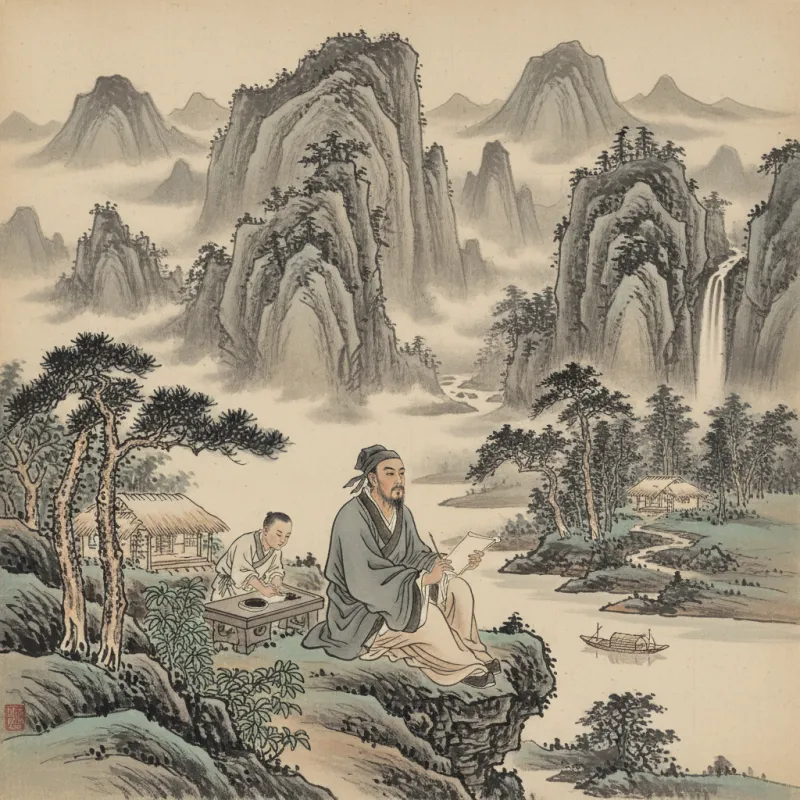
Picture this: a middle-aged official sits alone in a mountain pavilion as autumn rain begins to fall. He doesn't reach for an umbrella or hurry inside. Instead, he watches the way water beads on pine needles, how mist erases the far mountains layer by layer, how silence itself seems to have texture and weight. Then he writes eight lines that will be memorized by Chinese schoolchildren for the next thirteen centuries. This is Wang Wei (王维 Wáng Wéi, 701–761), and if you've never felt the strange power of his poetry, you've been missing one of literature's most radical experiments: the art of saying almost nothing, perfectly.
The Impossible Combination
Wang Wei shouldn't exist. In the brutal, ambitious world of Tang Dynasty (唐朝 Tángcháo) officialdom — where Li Bai was getting drunk and insulting emperors, where Du Fu was documenting human suffering with unflinching precision — Wang Wei somehow managed to be a successful bureaucrat, a devout Buddhist, a master painter, a musician, and a poet whose work feels like it was written by someone who'd already left the world behind. He passed the imperial examinations at twenty-one, served in various government posts for decades, owned a country estate, and wrote poems that read like they were composed by a hermit who'd never seen a city.
The contradiction runs deeper. His poetry is famous for its emptiness, its silence, its refusal to explain or emote. Yet he lived through the An Lushan Rebellion (安史之乱 Ān Shǐ zhī luàn, 755–763), the catastrophic civil war that killed millions and nearly destroyed the Tang Dynasty. He was captured by the rebels, forced to serve in their puppet government, and later had to defend himself against charges of collaboration. Somehow, none of this chaos appears directly in his most famous poems. Instead, we get moonlight on empty mountains, the sound of a stream no one is listening to, autumn colors that exist whether anyone sees them or not.
What His Poems Actually Do
Here's what makes Wang Wei difficult for modern readers: his poems don't build to anything. They don't argue, confess, seduce, or persuade. They present a scene with such precise simplicity that you can miss the artistry entirely. Take his most famous poem, "Deer Park" (鹿柴 Lù zhài):
Empty mountain, no one in sight
Only the sound of someone talking
Returning light enters the deep forest
And shines again on the green moss
That's it. Twenty characters in Chinese, four lines that describe... what exactly? An empty mountain that isn't quite empty, voices without speakers, light that returns (from where?), and moss. The poem doesn't tell you how to feel about any of this. It doesn't explain why the light is "returning" or what the distant voices mean. It just places these elements in relation to each other and trusts you to experience something.
What you're supposed to experience, if you're paying attention, is the Buddhist concept of emptiness (空 kōng) — not as an abstract philosophy but as a direct perception. The mountain is empty of people but full of sound. The light returns but illuminates nothing important, just moss. Human presence (the voices) is reduced to pure sound, disconnected from bodies or meaning. Everything exists, nothing is significant, and somehow this is beautiful rather than nihilistic.
The Painter Who Wrote
Su Shi (苏轼 Sū Shì), the great Song Dynasty poet-official, famously said: "In Wang Wei's poems there are paintings; in Wang Wei's paintings there are poems" (诗中有画,画中有诗 shī zhōng yǒu huà, huà zhōng yǒu shī). This has been quoted so often it's become a cliché, but it's worth unpacking what Su Shi actually meant.
Wang Wei is credited with founding the Southern School of Chinese landscape painting, which emphasized spontaneous brushwork, monochrome ink, and the spiritual essence of nature over decorative detail. None of his paintings survive — we have only copies and descriptions — but his influence on Chinese art is incalculable. The key innovation was treating painting not as representation but as a form of meditation, a way of capturing not what things look like but what it feels like to perceive them.
This approach saturates his poetry. He doesn't describe landscapes the way a Western poet might, building up sensory details to create a vivid picture. Instead, he gives you the minimum information needed to construct the scene yourself, leaving gaps and silences that you have to fill with your own awareness. In "Bamboo Grove House" (竹里馆 Zhú lǐ guǎn), he writes:
Sitting alone in the dark bamboo
Playing the qin and whistling
In the deep forest no one knows
The bright moon comes to shine on me
The poem is almost aggressively simple. But notice what's happening: he's alone but not lonely, making music that no one hears, in darkness that's somehow illuminated. The moon "comes" (来 lái) as if it's a visitor, a companion, the only witness needed. The poem creates a space of perfect solitude that doesn't feel isolating — it feels complete.
The Wang River Estate
After his wife died in 730, Wang Wei bought a country estate in the Zhongnan Mountains (终南山 Zhōngnán shān), about forty miles from the capital Chang'an (长安 Cháng'ān). The estate, called Wang River Villa (辋川别业 Wǎngchuān biéyè), became his refuge and his laboratory. He and his friend Pei Di (裴迪 Péi Dí) wrote a series of twenty poems each, describing twenty scenic spots on the property — pavilions, groves, streams, rocks.
These Wang River poems are Wang Wei at his most characteristic. They're short (usually quatrains), imagistic, and so understated they can seem like nothing is happening. But read together, they create a complete world, a mapped landscape of consciousness. Each poem is a point of stillness, a place where you can stop and simply be present. The estate itself becomes a kind of three-dimensional mandala, a sacred space organized around the practice of attention.
What's remarkable is how these poems avoid the pathetic fallacy — the projection of human emotions onto nature. Wang Wei doesn't tell you the mountains are sad or the streams are joyful. He presents natural phenomena as they are, and trusts that this bare presentation will trigger something in the reader. It's the opposite of Romantic poetry, which uses nature as a mirror for human feeling. Wang Wei's nature doesn't care about you, and that's precisely why it can liberate you.
Buddhism Without Preaching
Wang Wei was a serious Buddhist, possibly a vegetarian, definitely someone who studied sutras and practiced meditation. His courtesy name was Mojie (摩诘 Mójiē), taken from Vimalakirti (维摩诘 Wéimójié), the enlightened layman of Mahayana Buddhism. Yet his poems rarely mention Buddhist doctrine explicitly. There are no sermons, no references to karma or rebirth, no obvious religious content.
Instead, Buddhism appears as a way of seeing. The emptiness in his poems isn't absence — it's the Buddhist śūnyatā (空 kōng), the recognition that phenomena lack inherent existence and arise through interdependence. When he writes about mountains and streams, he's not just describing scenery; he's demonstrating how to perceive without grasping, how to experience beauty without possessing it.
This makes him very different from the explicitly Buddhist poets who came later. Wang Wei doesn't argue for Buddhism or try to convert you. He simply writes from within a Buddhist consciousness, and if you can enter that consciousness through his poems, you'll understand something that can't be explained discursively. It's teaching by demonstration, enlightenment by aesthetic experience.
The Rebellion and After
In 755, everything fell apart. An Lushan (安禄山 Ān Lùshān), a general of Sogdian-Turkic descent, rebelled against Emperor Xuanzong (唐玄宗 Táng Xuánzōng). The emperor fled the capital. Wang Wei, now in his fifties and serving as a high official, was captured by the rebels and forced to accept a position in their puppet government.
When the rebellion was finally crushed in 763, officials who had served the rebels faced execution or exile. Wang Wei survived, partly because his brother Wang Jin (王缙 Wáng Jìn) offered to sacrifice his own rank to save him, partly because he'd written a poem while imprisoned expressing loyalty to the legitimate emperor. He was demoted but allowed to continue serving.
Here's what's strange: this traumatic period — capture, collaboration, trial, near-execution — barely registers in his poetry. There are a few poems that might allude to the chaos, but they're oblique, coded, almost impossible to read as political commentary. His response to catastrophe was to retreat further into the aesthetic-spiritual practice he'd been developing all along. The world could burn; the moonlight on moss remained perfect.
Why He Matters Now
Wang Wei is having a moment in contemporary poetry, especially among poets interested in ecopoetics, minimalism, and what we might call "post-expressive" writing. His refusal to foreground the self, his attention to non-human phenomena, his trust in silence and space — these feel surprisingly contemporary.
But he's also challenging for modern readers trained on confessional poetry, on the idea that poems should express emotion or tell stories or make arguments. Wang Wei does none of these things. His poems are closer to meditation instructions than to self-expression. They teach you how to look, how to listen, how to be present without commentary.
The poet Gary Snyder, who translated some of Wang Wei's work, understood this. Snyder saw Wang Wei as a predecessor to his own bioregional poetics, his attention to place and ecosystem. But where Snyder is often explicitly political, using poetry to advocate for environmental consciousness, Wang Wei is purely phenomenological. He shows you the world as it is, without telling you what to do about it.
The Silence That Speaks
Su Shi said Wang Wei's poems contain paintings, but maybe it's more accurate to say they contain silence. Not the absence of sound, but silence as a positive presence, something you can hear and feel. In "Bird Call Valley" (鸟鸣涧 Niǎo míng jiàn), he writes:
People idle, osmanthus flowers fall
Night quiet, spring mountain empty
Moon rises, startles mountain birds
They cry now and then in the spring valley
The poem is structured around stillness and interruption. The flowers fall in silence. The mountain is empty. Then the moon rises and startles the birds into momentary sound, which only emphasizes the surrounding quiet. The human observer is "idle" (闲 xián) — not busy, not productive, just present. And in that idleness, the whole world becomes perceptible.
This is Wang Wei's gift: he teaches you that attention itself is a form of action, that witnessing is enough, that you don't have to do anything with beauty except let it exist. In our age of constant stimulation and compulsive productivity, this might be the most radical message possible. Sit still. Watch the light change. Listen to the silence. That's the poem. That's everything.
Related Reading
- Tao Yuanming: The Recluse Who Found Paradise
- Women Poets of China: Voices Across Three Millennia
- Bai Juyi: The Song of Everlasting Sorrow
- The Great Poets of China: Li Bai, Du Fu, and the Rivalry That Never Was
- Unraveling Themes in Chinese Classical Poetry: Insights from Tang, Song, and Yuan Dynasties
- Wang Wei: The Poet-Painter of Nature
- Exploring Love in Chinese Classical Poetry: Tang, Song, and Yuan Poets’ Romantic Artistry
Explore Chinese Culture
- Explore the Tang dynasty's golden age
- Explore Daoist themes in classical poetry
- Explore Chinese literary traditions