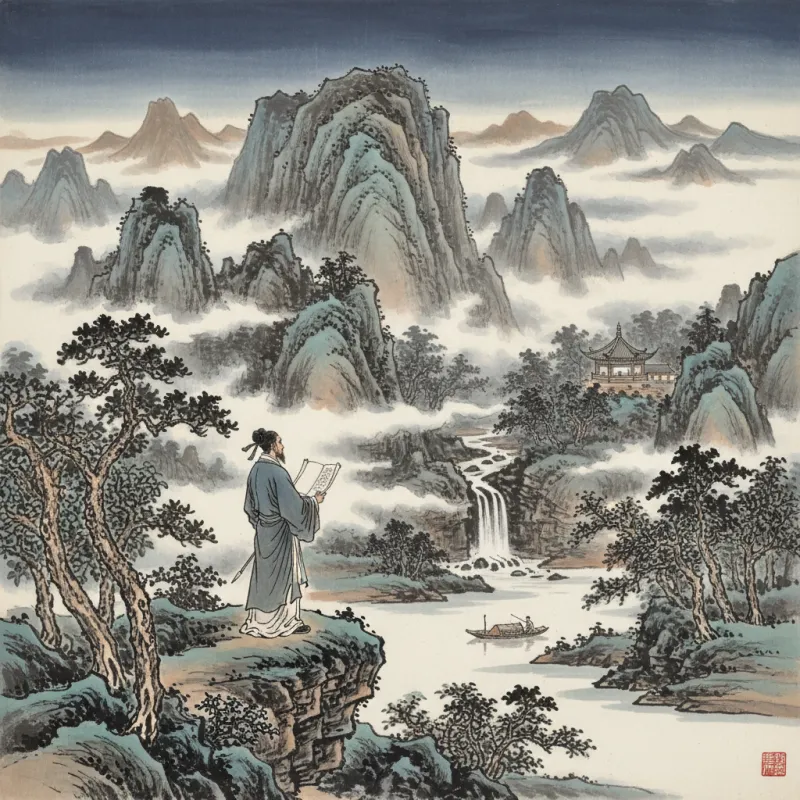
Picture a Song Dynasty poet, wine cup in hand, watching courtesans perform at a banquet. The music swells, and suddenly he's scribbling verses on his sleeve — not the rigid eight-line poems his Tang predecessors perfected, but something looser, wilder, shaped entirely by the melody filling the room. This is ci (詞, cí), and it rewrote the rules of Chinese poetry.
The Cage of Perfection
By the late Tang Dynasty, regulated verse had become a beautiful prison. The lüshi (律詩, lǜshī) — those perfectly balanced eight-line poems with their strict tonal patterns and mandatory parallelism — had been mastered to death. Every ambitious scholar could write one. Every examination candidate had to. The form that once challenged poets like Du Fu to create miracles now churned out competent, forgettable verses by the thousands.
The problem wasn't the rules themselves. Constraints can spark creativity. But when a form becomes the only acceptable way to write serious poetry, when every line must be exactly five or seven characters, when the tones must alternate in predetermined patterns, when lines three and four must mirror each other perfectly — the form stops serving the poet and starts serving itself.
Poets needed an escape hatch. They found it in the wine houses and entertainment quarters, in the popular songs that had been circulating for decades, dismissed by the literary establishment as mere entertainment.
Music Made the Form
Here's what made ci revolutionary: the melody came first. Unlike Tang poetry, where poets chose their form and then filled it with meaning, ci writers started with a tune pattern (詞牌, cípái) — an existing melody with a specific structure. "Butterflies Love Flowers" (蝶戀花, Diéliànhuā) demanded sixty characters arranged in a particular way. "Ripples Sifting Sand" (浣溪沙, Huànxīshā) required forty-two. "Slow Song of Eternal Longing" (長相思, Chángxiāngsī) needed just thirty-six.
This wasn't laziness — it was liberation. With over 800 tune patterns to choose from, poets could match form to feeling. Writing about sudden heartbreak? Pick a short, sharp pattern. Exploring complex philosophical ideas? Choose one of the longer patterns that allowed over a hundred characters. The melody's rhythm determined where the lines broke, which meant ci could have lines of three characters, four, five, seven, even eleven — whatever the music demanded.
Li Qingzhao (李清照, Lǐ Qīngzhào, 1084-1155), perhaps the greatest ci poet, understood this instinctively. Her famous "Slow Slow Song" (聲聲慢, Shēngshēngmàn) opens with seven consecutive two-character phrases: "尋尋覓覓,冷冷清清,淒淒慘慘戚戚" (xúnxún-mìmì, lěnglěng-qīngqīng, qīqī-cǎncǎn-qīqī) — "seeking, seeking, cold, cold, clear, clear, mournful, mournful, wretched, wretched." Try writing that in regulated verse. The form would reject it. But the tune pattern welcomed it, and the result is one of the most emotionally devastating openings in Chinese literature.
The Subject Matter Revolution
Ci didn't just break formal rules — it broke content rules too. Tang regulated verse, especially after it became an examination requirement, gravitated toward "serious" subjects: political loyalty, friendship, the hardships of frontier service, the beauty of nature as moral metaphor. Personal feelings appeared, but filtered through layers of classical allusion and restraint.
Ci said: forget that. The form emerged from entertainment culture, and it never fully shed that origin. Ci poets wrote about romantic love — not the chaste, distant admiration acceptable in regulated verse, but actual desire, jealousy, longing, regret. They wrote about hangovers, about watching dancers, about the specific texture of loneliness at 3 AM. Liu Yong (柳永, Liǔ Yǒng, 987-1053) built his entire reputation on ci about courtesans and the emotional landscape of the pleasure quarters. The literary establishment sneered. The public loved it.
This wasn't just about being risqué. It was about emotional honesty. When Su Shi (蘇軾, Sū Shì, 1037-1101) wrote his famous ci "Remembering the Past at Red Cliff" (念奴嬌·赤壁懷古, Niànnújiāo·Chìbì Huáigǔ), he could blend grand historical meditation with personal disappointment in ways regulated verse wouldn't accommodate. The longer form, the flexible line lengths, the breathing room between sections — all of it served the complexity of real thought and feeling.
Two Styles, One Form
By the mid-Song Dynasty, ci had split into two camps. The "delicate and restrained" style (婉約派, wǎnyuēpài) continued the tradition of writing about love, beauty, and personal emotion. Li Qingzhao perfected this approach, creating ci of devastating intimacy. Her poem about missing her husband uses the image of a lotus root broken but still connected by threads — the kind of specific, domestic detail that would seem trivial in regulated verse but becomes profound in ci.
The "bold and unrestrained" style (豪放派, háofàngpài) pushed ci toward bigger subjects. Su Shi led this movement, writing ci about history, philosophy, and politics. His contemporary Xin Qiji (辛棄疾, Xīn Qìjí, 1140-1207) took it further, creating ci that read almost like manifestos, full of martial imagery and frustrated patriotism. These weren't just Song Dynasty poems — they were arguments, declarations, cries of rage against political impotence.
The remarkable thing? Both styles used the same tune patterns. "Butterflies Love Flowers" could frame either a delicate love poem or a meditation on mortality. The form was genuinely flexible.
Why It Mattered
Ci's influence extended far beyond the Song Dynasty. It proved that poetic forms could evolve, that the rules weren't sacred, that popular culture could produce high art. When the Yuan Dynasty came, bringing with it the dramatic form of qu (曲, qǔ), it built directly on ci's innovations. The flexibility ci introduced never left Chinese poetry.
More importantly, ci changed what poetry could talk about and how it could sound. It brought the rhythms of actual speech and song into literary verse. It made room for the full range of human experience — not just the elevated emotions deemed suitable for art, but the messy, complicated, sometimes embarrassing reality of being alive.
The Tang poets had perfected a form. The Song poets broke it open and found something more human inside. That's not rebellion for its own sake — that's evolution. And Chinese literature has been richer for it ever since.
Related Reading
- Li Qingzhao: The Greatest Female Poet in Chinese History
- Xin Qiji: The Warrior Poet Who Never Got His War
- Su Shi: The Renaissance Man of Chinese Literature
- What Is Song Ci? A Guide to China's Other Great Poetry Tradition
- Love and Longing in Chinese Classical Poetry: Tang, Song, and Yuan Dynasties Explored
- Bai Juyi: The Song of Everlasting Sorrow
- The Art of Nature in Tang, Song, and Yuan Dynasty Poetry: A Literary Exploration
Explore Chinese Culture
- Explore the Tang dynasty's golden age
- Explore Daoist themes in classical poetry
- Explore Chinese literary traditions