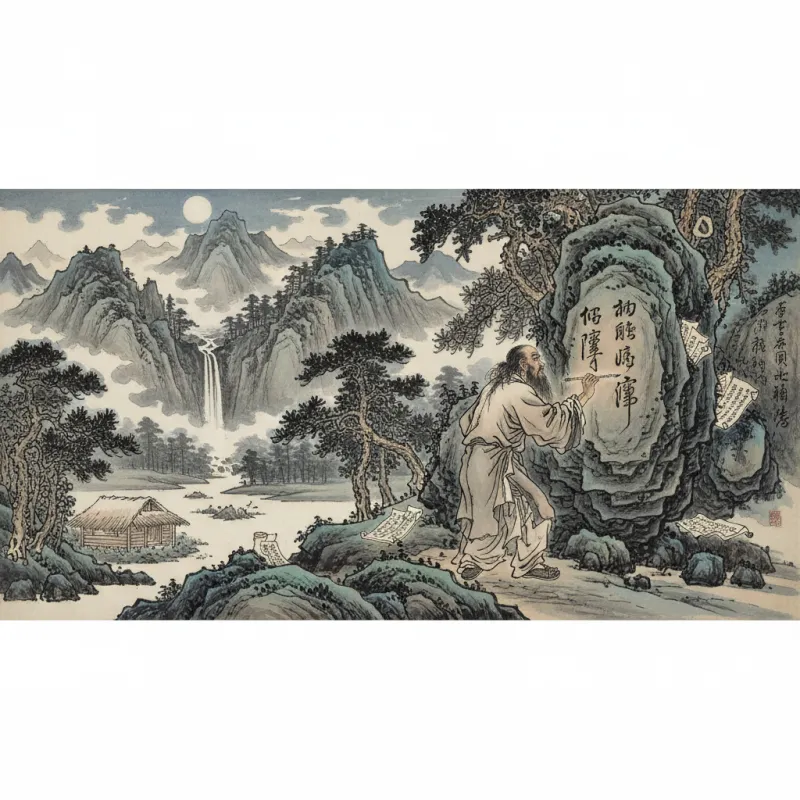
Picture a madman in bark clothing, scribbling verses on cliff faces with charcoal, then vanishing into the mist before anyone can ask his name. That's Hanshan (寒山, Hánshān) — or at least, that's the legend. The truth is slipperier. We don't know when he was born. We don't know when he died. We're not even certain he was one person rather than a composite of several eccentric poets who found it convenient to write under the same pseudonym. What survives are roughly 300 poems attributed to "Cold Mountain," a name that doubles as both pen name and geographic location — the peak in the Tiantai range (天台山, Tiāntái Shān) where this figure supposedly lived in a cave, subsisting on scraps and mocking the pretensions of establishment Buddhism.
The Poems That Appeared from Nowhere
The standard origin story comes from Lüqiu Yin (闾丘胤, Lǘqiū Yìn), a Tang dynasty official who wrote a preface claiming he'd sought out Hanshan at Guoqing Temple (国清寺, Guóqīng Sì) on the recommendation of a Chan master. When Lüqiu Yin arrived with his retinue, expecting perhaps a dignified hermit sage, Hanshan and his companion Shide (拾得, Shídé) — whose name literally means "Foundling" — took one look at the official party and burst out laughing. Then they ran into the mountains. The poems were discovered afterward, scrawled on rocks, tree bark, temple walls, and cliff faces throughout the Tiantai region.
This story has all the hallmarks of Chan Buddhist theater: the pompous official, the irreverent holy fools, the sudden disappearance that leaves only traces of wisdom behind. It's almost too perfect, which is why scholars have spent centuries arguing about whether any of it actually happened. The poems themselves offer few biographical clues. They're written in colloquial language, sometimes crude, often funny, occasionally profound. They mock Confucian scholars, Buddhist monks, Daoist alchemists, and pretty much everyone who takes themselves too seriously. They also contain moments of startling beauty and genuine spiritual insight.
The Voice Behind the Verses
What makes Hanshan's poetry distinctive isn't just the hermit persona — Chinese literature is full of recluses writing about mountains. It's the tone. These poems sound like they were written by someone who'd genuinely given up on conventional society, not someone performing withdrawal as a literary gesture. Consider this famous verse:
"My home is on Cold Mountain / Where no one ever comes to visit / White clouds gather and scatter / Birds cry out, then fall silent"
There's no romanticization here, no suggestion that mountain solitude is particularly pleasant or spiritually elevating. It's just what it is: isolated, repetitive, occasionally punctuated by bird calls. The poem doesn't argue for this lifestyle or against it. It simply reports.
Other poems are more caustic. Hanshan frequently ridicules people who study Buddhist sutras without understanding them, who perform elaborate rituals while missing the point entirely. "You read the sutras but don't understand them / Like a donkey looking at a well," goes one verse. This isn't the gentle correction of a patient teacher. It's the exasperated mockery of someone who's watched too many people mistake the finger pointing at the moon for the moon itself.
The language throughout is deliberately plain, sometimes grammatically loose, occasionally vulgar. This was unusual for Tang dynasty poetry, which typically prized technical sophistication and classical allusion. Hanshan's poems read more like graffiti than literature — which, given that many were supposedly found written on rocks, makes a certain sense. The effect is immediacy. These don't feel like poems composed at a desk and polished for publication. They feel scrawled in the moment, then abandoned.
Buddhism Without the Buddhism
What's fascinating about Hanshan's Buddhist poetry is how little explicit Buddhism it contains. There are references to karma, to the illusory nature of phenomena, to the futility of attachment. But there are no lengthy expositions of doctrine, no systematic presentations of Chan teaching, no name-dropping of famous masters or sacred texts. The Buddhism in these poems is atmospheric rather than doctrinal. It's in the attitude — the refusal to take social hierarchies seriously, the insistence on direct experience over received wisdom, the humor about human pretension.
This aligns with the Chan Buddhist tradition that was flourishing during the Tang dynasty, particularly the iconoclastic strain associated with figures like Mazu Daoyi (马祖道一, Mǎzǔ Dàoyī) and Linji Yixuan (临济义玄, Línjì Yìxuán). These teachers were famous for shocking their students out of conventional thinking — hitting them with sticks, shouting at them, giving paradoxical answers to sincere questions. Hanshan's poetry operates in a similar register. It doesn't explain enlightenment. It tries to jolt you into a different way of seeing.
The poems also share Chan Buddhism's suspicion of language itself. Many verses circle around the inadequacy of words to capture reality, the way concepts and categories distort direct perception. Yet Hanshan keeps writing poems, keeps using language, which creates a productive tension. The poems acknowledge their own limitations while continuing to exist. This is very different from the approach in Buddhist-influenced regulated verse, where poets like Wang Wei integrated Buddhist themes into formally perfect compositions. Hanshan's poems are deliberately rough, as if formal perfection would itself be a kind of delusion.
The Shide Connection
Hanshan is almost always mentioned alongside Shide, his companion at Guoqing Temple. According to legend, Shide was a foundling raised by monks who worked in the temple kitchen. He and Hanshan would meet to talk, laugh, and share scraps of food. Some sources claim Shide also wrote poetry, though the attributions are even murkier than Hanshan's. In later Chinese and Japanese art, the two appear together as a pair of laughing madmen, representing the freedom that comes from abandoning social convention.
The relationship between them is never explicitly defined in the poems or the biographical fragments. They're not presented as master and disciple, or as fellow monks, or even as friends in any conventional sense. They're just two people who recognize something in each other, who share a perspective that sets them apart from everyone else at the temple. This ambiguity has made them endlessly fascinating to later interpreters. Are they historical figures? Allegorical representations? The same person split into two characters?
What matters more than the historical question is what the pairing represents: a model of spiritual companionship that exists outside institutional structures. Neither Hanshan nor Shide holds rank in the monastic hierarchy. Neither is a recognized teacher. They're marginal figures who've found each other on the margins. The poems suggest that this kind of connection — unmediated by authority, unstructured by rules — might be more valuable than any official religious relationship.
The Authenticity Problem
Modern scholarship has thoroughly complicated the traditional Hanshan narrative. The poems attributed to him show evidence of multiple authors writing across different time periods. Some use Tang dynasty colloquialisms; others contain linguistic features from later eras. Some demonstrate sophisticated knowledge of Buddhist philosophy; others seem written by someone with only passing familiarity with the tradition. The collection as we have it was likely assembled over centuries, with various poets contributing verses under the Hanshan pseudonym.
This doesn't necessarily diminish the poems' value, but it does change how we read them. Instead of a single hermit's spiritual autobiography, we're looking at something more like a collaborative project — a literary persona that multiple writers inhabited and developed over time. The "Hanshan" of the poems becomes less a historical individual and more a type: the enlightened madman, the holy fool, the one who sees through social pretense because he's positioned himself outside society entirely.
Some scholars argue that the earliest poems in the collection date to the late 7th or early 8th century, while others were added as late as the Song dynasty. The preface by Lüqiu Yin, which provides most of our biographical information, may itself be a later fabrication designed to give the collection a coherent origin story. We're left with poems of uncertain authorship, uncertain date, and uncertain provenance — which, ironically, seems entirely appropriate for a figure who supposedly refused to claim any fixed identity.
Cold Mountain's Afterlife
Hanshan's influence extends far beyond Chinese literature. In the 1950s and 60s, American Beat poets discovered his work through translations and were immediately captivated. Gary Snyder, who'd studied Chinese and spent time in Japanese Zen monasteries, translated several Hanshan poems and wrote extensively about him. The appeal was obvious: here was an ancient Chinese poet who sounded remarkably contemporary, who rejected materialism and social climbing, who lived close to nature and wrote in plain language about direct experience.
This cross-cultural transmission created its own distortions. The Beat poets tended to emphasize Hanshan's countercultural aspects while downplaying the specifically Buddhist elements of his work. They made him into a proto-hippie, a dropout from Tang dynasty society who'd found enlightenment in the mountains. This wasn't entirely wrong, but it flattened the complexity of the poems, which are as much about the difficulty of spiritual practice as they are about the freedom of mountain life.
In China and Japan, Hanshan became a popular subject for painters and calligraphers, usually depicted as a laughing figure in ragged clothes, sometimes alone, sometimes with Shide. These images emphasize his joy and freedom, the liberation that comes from having nothing to lose. They're less interested in the darker aspects of the poems — the loneliness, the cold, the sense of being fundamentally separate from human society. The artistic tradition tends to romanticize what the poems themselves present more ambivalently.
Reading Hanshan Now
What do we do with these poems today, knowing they're probably not the work of a single hermit, that the biographical frame is likely fictional, that the collection was assembled and edited by unknown hands across unknown spans of time? We read them as we'd read any pseudonymous or collaborative work — for what they say, not for who said it.
And what they say remains striking. They insist that spiritual understanding can't be achieved through study alone, that institutional religion often obscures more than it reveals, that the trappings of civilization are mostly delusion. They suggest that real freedom requires genuine renunciation, not the aesthetic performance of simplicity. They're funny, bitter, occasionally tender, and consistently skeptical of anyone who claims to have figured things out.
The poems also remind us that the hermit tradition in Chinese literature isn't just about escaping to mountains and writing pretty verses about clouds. It's about what happens when you actually try to live outside social structures, when you give up the comforts and certainties that most people depend on. Hanshan's poems don't make this sound particularly appealing. They make it sound hard, lonely, and occasionally absurd. But they also suggest it might be necessary — not for everyone, but for anyone who wants to see clearly rather than through the distorting lens of convention.
The comparison with other Buddhist poets of the Tang dynasty is instructive. Where court poets integrated Buddhist themes into elegant compositions, Hanshan's work feels genuinely marginal, written from a position outside the literary establishment. This gives the poems a different kind of authority — not the authority of learning or position, but the authority of someone who's actually tried to live according to principles that most people only discuss.
Whether or not there was a historical Hanshan living in a cave on Cold Mountain doesn't finally matter. What matters is that someone — or several someones — wrote these poems, and they've survived because they capture something true about the difficulty and necessity of questioning everything you've been taught to value. They're not comfortable poems. They don't offer easy wisdom or reassuring platitudes. They're the literary equivalent of a Chan master hitting you with a stick — not to hurt you, but to wake you up.
Related Reading
- Wang Wei's Buddhist Nature Poems: Silence as Spiritual Practice
- The Spiritual Depth of Chinese Classical Poetry: Insights from Tang, Song, and Yuan Poets
- Buddhist Poetry in Chinese Literature: Enlightenment in Twenty Characters
- Buddhist Impermanence in Tang Poetry: Everything You Love Will Disappear
- Zen Koans in Poetry Form: When Chinese Verse Became a Riddle
- Xin Qiji: The Warrior Poet
- How to Read Chinese Poetry: A Guide for English Speakers
- Bai Juyi: The People's Poet
Explore Chinese Culture
- Explore the Tang dynasty's golden age
- Explore Daoist themes in classical poetry
- Explore Chinese literary traditions