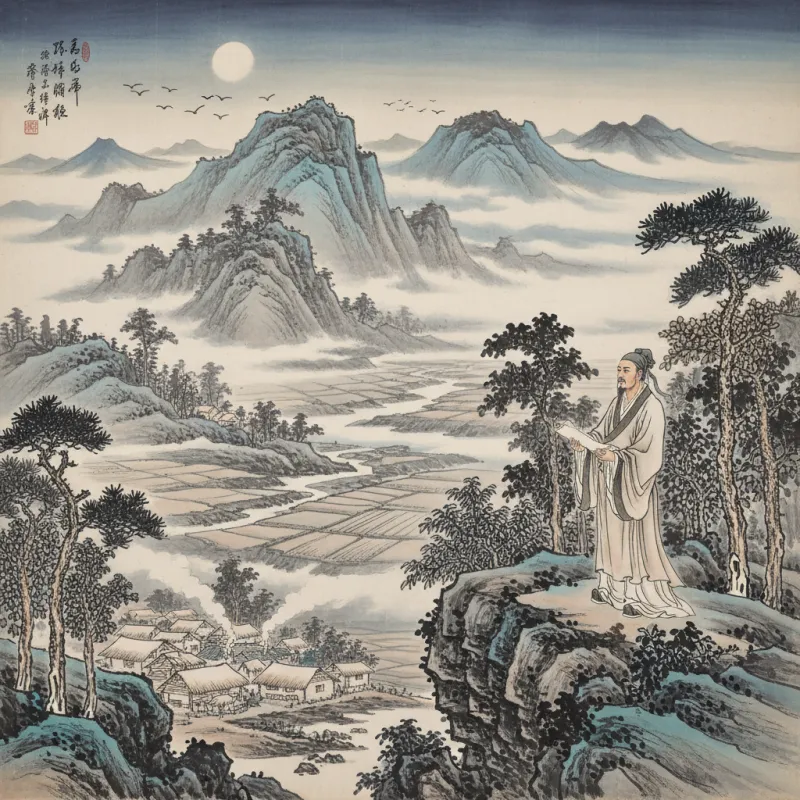
Picture an elderly woman in ninth-century Chang'an, listening to her employer recite verses about government corruption and social injustice. When she furrows her brow, confused by a classical allusion, the poet — one of the most celebrated literary figures of his age — picks up his brush and rewrites the line. This wasn't some apocryphal tale of humility. Bai Juyi (白居易 Bái Jūyì, 772-846 CE) genuinely tested his poems on his housekeeper, and if she couldn't grasp them, he considered them failures.
In an era when poets competed to pack their verses with obscure references to ancient texts, when literary sophistication meant layers of allusion that only the educated elite could decode, Bai Juyi chose clarity. While Li Bai was channeling wine-soaked transcendence and Du Fu was crafting intricate meditations on war and displacement, Bai Juyi was writing poems that a farmer could understand — and that's exactly what made him dangerous.
The Revolutionary Choice of Simplicity
Let's be clear: writing simply is not the same as writing simplistically. Bai Juyi's decision to use accessible language wasn't a limitation of his talent — the man passed the imperial examinations at age twenty-nine and served in some of the highest literary positions in the Tang bureaucracy. He could write in the ornate, allusion-heavy style that impressed examination graders. He chose not to.
This choice had teeth. When Bai wrote "The Old Charcoal Seller" (卖炭翁 Màitànwēng), he wasn't crafting an aesthetic exercise. He described an elderly man who spent months making charcoal, only to have palace eunuchs confiscate it for a pittance. The poem named names, pointed fingers, and made the imperial court deeply uncomfortable. You can't dismiss a poem as the ranting of an out-of-touch intellectual when it's written so clearly that the charcoal seller himself could understand it.
The literary establishment didn't know what to do with him. Some critics, then and now, have called his work "prosaic" or "lacking in artistic refinement." They're missing the point. Bai Juyi was doing something harder than writing beautiful obscurity — he was writing beautiful clarity. Try it sometime. Try writing a poem about social injustice that's both genuinely moving and comprehensible to someone without a classical education. It's brutally difficult.
The New Yuefu Movement
Bai Juyi didn't work alone. He and his friend Yuan Zhen (元稹 Yuán Zhěn) spearheaded what they called the New Yuefu (新乐府 xīn yuèfǔ) movement, reviving and transforming an ancient folk song tradition. The original yuefu were Han dynasty ballads — direct, narrative, often dealing with the lives of common people. Bai and Yuan brought this approach into Tang poetry, but with a contemporary edge.
The New Yuefu poems were explicitly political. Bai wrote about tax collectors, about women forced into palace service, about soldiers dying in pointless border wars. He wrote "Song of Everlasting Sorrow" (长恨歌 Chánghèngē), a 840-line narrative poem about Emperor Xuanzong's disastrous infatuation with Yang Guifei — a poem that's essentially a 1,200-year-old critique of how personal obsession can destroy an empire. It became one of the most famous poems in Chinese literary history, memorized by generations of students who might not have been able to parse a single line of some of Bai's more "sophisticated" contemporaries.
The Price of Speaking Plainly
Clarity has consequences. In 815 CE, Prime Minister Wu Yuanheng was assassinated by military rebels. Bai Juyi, then serving as a court official, immediately submitted a memorial demanding an investigation. This was proper — except that Bai's position didn't technically give him the authority to comment on such matters. His enemies at court, who'd been waiting for an opportunity, pounced. They dredged up some of his poems, claimed they were immoral, and had him demoted to a minor post in Jiangzhou (modern Jiujiang), far from the capital.
The exile lasted three years, but it changed Bai's poetry. He'd always written about suffering, but now he'd experienced a version of it himself — not the grinding poverty of the charcoal seller, certainly, but the bitter taste of political disgrace. His poems from this period have a different quality, more introspective, though no less clear. "Pipa Song" (琵琶行 Pípáxíng), written during his exile, describes meeting a former court musician reduced to playing for merchants on a river boat. The poem's famous line — "We are both fallen people at the edge of the world" (同是天涯沦落人 tóng shì tiānyá lúnluò rén) — resonated because it was true. Bai understood what it meant to fall.
The Buddhist Turn
After his exile, Bai Juyi increasingly turned to Buddhism, particularly Chan (禅 Chán, Zen) Buddhism. This wasn't a retreat from the world — Bai continued to serve in various official positions, eventually becoming mayor of Hangzhou and Suzhou, where he built infrastructure projects that benefited thousands. But his poetry took on a more philosophical cast, exploring themes of impermanence, detachment, and the nature of suffering.
Here's where Bai's commitment to clarity became almost subversive in a different way. Buddhist philosophy can be maddeningly abstract, full of paradoxes and negations. Bai wrote Buddhist poems that actually made sense. He described meditation not as some mystical transcendence but as sitting quietly and watching your thoughts. He wrote about impermanence by describing specific, concrete things — flowers wilting, hair turning gray, friends dying. The philosophy was sophisticated, but the language remained accessible.
The Japanese Connection
While Chinese literati were busy debating whether Bai Juyi was too simple, the Japanese were copying out his poems by hand and shipping them across the sea. Bai became wildly popular in Heian Japan, influencing writers like Murasaki Shikibu, author of "The Tale of Genji." When Genji's characters wanted to show their literary sophistication, they quoted Bai Juyi. His poems appear throughout the novel, woven into the narrative as cultural touchstones.
This Japanese appreciation wasn't accidental. Bai's clarity made his work translatable — not just linguistically, but culturally. You didn't need to be steeped in the specific political intrigues of the Tang court to understand a poem about an old man losing his charcoal. The emotions were universal, even if the details were Chinese. This is what great accessible art does: it's specific enough to be real and clear enough to be universal.
The Legacy of Clarity
Bai Juyi wrote nearly 3,000 poems, more than any other major Tang poet. Many have been lost, but what survives is staggering in its range — social criticism, love poems, Buddhist meditations, drinking songs, poems about his garden, poems about his illnesses, poems about his friends. He wrote about everything, and he wrote about it clearly.
The literary establishment eventually came around, more or less. Bai is now firmly ensconced in the canon of great Tang poets, usually ranked just below Li Bai and Du Fu but above almost everyone else. What's interesting is that his popular reputation never needed rehabilitation — ordinary readers never stopped loving him. While scholars debated his artistic merit, people kept reading "Song of Everlasting Sorrow" and "Pipa Song," kept memorizing his verses, kept finding in his clear language a mirror for their own experiences.
There's a lesson here about the relationship between accessibility and profundity. We often assume that difficult art is deep and simple art is shallow. Bai Juyi spent his career proving this false. His poems are simple in the way a mountain stream is simple — clear enough to see the bottom, but that doesn't mean there's nothing there. The depth is visible precisely because the water is clear.
Reading Bai Juyi Today
If you're coming to Bai Juyi for the first time, start with "Song of Everlasting Sorrow" or "Pipa Song" — they're long narrative poems that showcase his storytelling ability and emotional range. Then try some of his shorter social criticism poems like "The Old Charcoal Seller" or "The Elderly Man of Xinfeng with the Broken Arm." You'll notice something: even in translation, even across 1,200 years, they're remarkably clear. You don't need footnotes to understand what Bai is saying, though footnotes help with historical context.
This clarity is Bai's gift and his challenge to us. He proved that poetry doesn't need to be obscure to be profound, that accessibility isn't the enemy of art. In our own age of literary obscurity and deliberate difficulty, when poets sometimes seem to be writing only for other poets, Bai Juyi's housekeeper test feels almost radical again. Would an ordinary person understand this? If not, is that because the idea is genuinely complex, or because the writer is hiding behind complexity?
Bai Juyi chose not to hide. He wrote clearly, directly, about things that mattered — injustice, love, loss, the small pleasures of daily life, the big questions of existence. For this, some critics called him simple. For this, hundreds of millions of readers across twelve centuries have called him great. The people's poet, indeed.
Related Reading
- Du Fu's War Poems: Witnessing the An Lushan Rebellion
- The Complete Guide to Chinese Classical Poetry: From Tang Poems to Song Ci
- What Is Tang Poetry? A Complete Introduction for English Readers
- Li Bai's Drinking Poems: Wine, Moon, and the Soul of Chinese Poetry
- Wang Wei: The Poet-Painter of Nature
- War Poetry of the Tang Dynasty: Beauty in the Midst of Slaughter
- The Banana Garden Poetry Club: When Women Took Over Chinese Poetry
- Exploring Chinese Classical Poetry: Tang, Song, and Yuan Poets’ Literary Legacy
Explore Chinese Culture
- Explore the Tang dynasty's golden age
- Explore Daoist themes in classical poetry
- Explore Chinese literary traditions