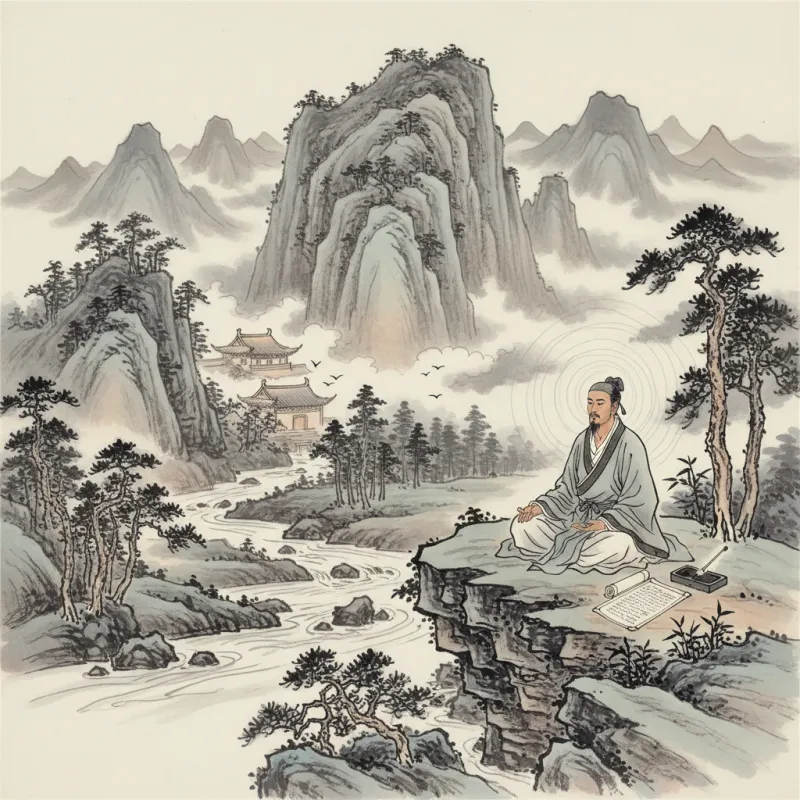
There's a particular kind of silence in Wang Wei's (王维, Wáng Wéi) poetry that doesn't feel peaceful. It feels watchful. You read one of his mountain poems and the quiet presses against you, the way it does when you're alone in a forest and suddenly aware that the forest is not empty—it's full of things that aren't talking.
This is not an accident. Wang Wei was a committed Buddhist practitioner, a follower of the Southern Chan (禅, Chán) school, and he spent the last decades of his life at his Wangchuan estate (辋川别业, Wǎngchuān Biéyè) in the Zhongnan Mountains, writing poems that function less like literature and more like meditation instructions disguised as landscape descriptions.
Western readers often file Wang Wei under "nature poet" and move on. That's like calling Rumi a love poet—technically true, but missing the entire architecture underneath. Wang Wei wasn't describing nature. He was using nature to describe the mechanics of enlightenment, the way a physics teacher uses a falling apple to explain gravity. The landscape is the teaching tool. The silence is the lesson.
The Chan Context: Why Silence Matters
To understand what Wang Wei is doing with silence, you need to understand what Chan Buddhism was doing with language in eighth-century China. The Southern Chan school, particularly under the influence of Huineng (慧能, Huìnéng), the Sixth Patriarch, had developed a profound suspicion of words. Not because words were bad, but because they were too good—too seductive, too capable of creating the illusion that you'd grasped something when all you'd really grasped was a description.
The famous story goes that Huineng, an illiterate woodcutter, achieved enlightenment upon hearing a single line from the Diamond Sutra. He didn't study for years. He didn't memorize texts. He heard one line and the bottom dropped out. This became the template for Southern Chan: sudden enlightenment (顿悟, dùnwù), not gradual cultivation. And if enlightenment is sudden, then all the talking beforehand is just noise.
Wang Wei absorbed this completely. His poems don't explain Buddhism. They enact it. They create the conditions under which the reader might experience what the poem is pointing toward, rather than just understanding it intellectually. This is why his most famous poems feel so empty—they're supposed to. They're clearing space.
The Architecture of Emptiness
Take "Deer Park" (鹿柴, Lù Zhài), probably Wang Wei's most analyzed poem:
空山不见人 (kōng shān bù jiàn rén)
但闻人语响 (dàn wén rén yǔ xiǎng)
返景入深林 (fǎn jǐng rù shēn lín)
复照青苔上 (fù zhào qīng tái shàng)
Empty mountain, no one in sight
Only the sound of someone talking
Reflected light enters the deep forest
And shines again on the green moss
Four lines. Twenty characters in Chinese. And somehow it contains an entire meditation manual.
The first line establishes emptiness—but immediately the second line complicates it. The mountain is empty, but there are voices. So it's not empty? Or it's empty of people but full of sound? Already you're in the paradox that Chan loves: form is emptiness, emptiness is form. The mountain is both empty and not empty, depending on what you're measuring.
Then the light. This is where Wang Wei's training as a painter shows up. The light doesn't just enter the forest—it's reflected light (返景, fǎn jǐng), light that has already bounced off something else. Secondary light. Indirect illumination. And it falls on moss, which grows in shade, which shouldn't be illuminated at all. The poem is describing something that barely exists: a moment of indirect light touching something that lives in darkness, witnessed by no one, in a place that is simultaneously empty and full of human presence.
This is not nature poetry. This is a diagram of consciousness.
Silence as Active Practice
What makes Wang Wei's silence different from, say, the silence in Cold Mountain's hermit poems is that Wang Wei's silence is doing something. Han Shan's silence is the silence of withdrawal, of having left the world behind. Wang Wei's silence is the silence of attention—the silence you create when you stop talking so you can hear what's already there.
Look at "Bamboo Grove House" (竹里馆, Zhú Lǐ Guǎn):
独坐幽篁里 (dú zuò yōu huáng lǐ)
弹琴复长啸 (tán qín fù cháng xiào)
深林人不知 (shēn lín rén bù zhī)
明月来相照 (míng yuè lái xiāng zhào)
Sitting alone in the dark bamboo
Playing the zither and whistling long
In the deep forest no one knows
The bright moon comes to shine on me
The speaker is alone, but he's not silent—he's playing music, he's whistling. But no one knows. The only witness is the moon, which "comes" (来, lái) as if it has agency, as if it chose to be there. The poem creates a space where human activity happens without human witness, where the natural world becomes the audience, where the distinction between observer and observed starts to dissolve.
This is the Chan concept of "no-mind" (无心, wúxīn) in action. The speaker isn't trying to be alone. He's not performing solitude. He's just doing what he's doing, and the moon shows up, and that's the whole event. No interpretation needed. No meaning extracted. Just the thing happening, and the awareness of the thing happening, and no gap between them.
The Wangchuan Estate as Laboratory
After 740, when Wang Wei was in his forties, he essentially retired to his Wangchuan estate and turned it into a laboratory for this kind of poetry. He wrote a series of twenty quatrains describing different locations on the property—"Wangchuan Collection" (辋川集, Wǎngchuān Jí)—and each one is a small experiment in how much you can remove from a poem before it stops being a poem and becomes just... pointing.
"Magnolia Enclosure" (木兰柴, Mùlán Zhài):
秋山敛余照 (qiū shān liǎn yú zhào)
飞鸟逐前侣 (fēi niǎo zhú qián lǚ)
彩翠时分明 (cǎi cuì shí fēn míng)
夕岚无处所 (xī lán wú chù suǒ)
Autumn mountain gathers the last light
Flying birds chase their companions ahead
Colors and greens sometimes distinct
Evening mist has no fixed place
That last line—"evening mist has no fixed place"—is doing so much work. The mist is everywhere and nowhere. It exists but has no location. It's the perfect image for Buddhist emptiness (空, kōng): not the absence of things, but the absence of fixed, independent existence. The mist is real. You can see it. But where is it? What is it? It's already changing by the time you ask.
This is what Wang Wei does over and over: he finds images that embody Buddhist concepts without naming them. The poetry becomes a kind of koan, a puzzle that can't be solved by thinking but might be solved by looking.
The Problem of Translation
Here's the frustrating thing: almost everything I just said is less true in English than it is in Chinese. Classical Chinese poetry works by compression and implication. A single character can carry multiple meanings simultaneously. The grammar is deliberately ambiguous—you often can't tell who's doing what to whom, or even if there's a subject and object at all.
Take that line from "Deer Park" again: 空山不见人 (kōng shān bù jiàn rén). I translated it as "Empty mountain, no one in sight," but it could just as easily be "The empty mountain doesn't see people" or "In the empty mountain, people are not seen" or even "The mountain's emptiness: not seeing people." The Chinese doesn't commit. It holds all these possibilities at once.
This ambiguity is not a bug. It's the entire point. Chan Buddhism is obsessed with the moment before you decide what something means, the moment when it's still just raw experience. Wang Wei's poetry tries to preserve that moment by refusing to resolve into a single interpretation. The poems stay open, the way a meditation session stays open—you're not trying to arrive at a conclusion. You're trying to stay present with what's happening.
English, with its mandatory subjects and objects, its insistence on grammatical clarity, flattens this. We have to choose. We have to say who's doing what. And in choosing, we lose some of the poem's Buddhist function. It becomes a description of an experience rather than an invitation to have the experience.
Why This Matters Now
There's a reason Wang Wei keeps getting translated, keeps getting taught, keeps showing up in anthologies of world poetry. It's not just that the poems are beautiful, though they are. It's that they offer a model for how poetry can do something other than express emotion or tell a story or make an argument. They show poetry as a technology for altering consciousness, for creating a specific kind of attention.
In an era of constant noise, constant commentary, constant interpretation, Wang Wei's silence feels radical. His poems don't explain themselves. They don't tell you what to feel. They just present a moment—light on moss, mist in a valley, birds flying—and trust that the moment is enough. That if you look at it long enough, without trying to extract meaning from it, something might shift.
This is not mysticism. It's not even particularly religious, in the sense of requiring belief in anything supernatural. It's just a different way of using language: not to capture experience, but to point toward it. Not to explain the world, but to help you see it more clearly.
The poems work like those optical illusions where you stare at a dot and suddenly the background image pops into focus. You can't force it. You can't think your way into it. You just have to look, and wait, and let the shift happen on its own.
The Legacy: Poetry as Practice
Wang Wei's influence on later Chinese poetry is enormous, but it's also weirdly invisible. You don't see a lot of poets writing obvious imitations of his style. Instead, you see his approach—this idea that poetry can be a form of spiritual practice, that landscape can be a teaching tool, that silence can be active rather than passive—showing up everywhere, in Song dynasty Chan poetry, in literati painting theory, in the whole tradition of "poetry of the Way" (道诗, dào shī).
The Japanese absorbed it completely. Bashō's haiku are basically Wang Wei's quatrains compressed even further, stripped down to the absolute minimum. That famous frog jumping into the pond? That's Wang Wei's aesthetic: a single moment, precisely observed, with all the interpretation removed. Just the thing happening, and the sound it makes, and the silence after.
Even in contemporary poetry, you can see Wang Wei's ghost. The imagist movement—Pound, H.D., Williams—was trying to do something similar: present the image without the commentary, trust the reader to do the work. "No ideas but in things," Williams said. Wang Wei would have understood that completely. He'd been doing it for twelve hundred years.
The difference is that for Wang Wei, this wasn't an aesthetic choice. It was a spiritual discipline. The poems weren't trying to be beautiful. They were trying to be useful—useful in the specific sense of helping the reader experience what the poem was pointing toward. The beauty was a side effect, the way a well-made tool is beautiful because it does its job perfectly.
That's what makes these poems so strange and so durable. They're not trying to be timeless. They're not trying to be art. They're just trying to show you something: that the world is already complete, already perfect, if you can stop talking long enough to notice. That silence isn't empty. It's full of everything you've been too loud to hear.
Related Reading
- Zen Koans in Poetry Form: When Chinese Verse Became a Riddle
- Buddhist Poetry in Chinese Literature: Enlightenment in Twenty Characters
- Cold Mountain Poems of Hanshan: The Hermit Who Wrote on Rocks
- Buddhist Impermanence in Tang Poetry: Everything You Love Will Disappear
- The Spiritual Depth of Chinese Classical Poetry: Insights from Tang, Song, and Yuan Poets
- Sun Tzu's Art of War: The Complete Guide for Modern Readers
- The Enchantment of Song Dynasty Poets: A Deep Dive into Their Timeless Verses
- War Poetry of the Tang Dynasty: When Soldiers Became Poets
Explore Chinese Culture
- Explore the Tang dynasty's golden age
- Explore Daoist themes in classical poetry
- Explore Chinese literary traditions