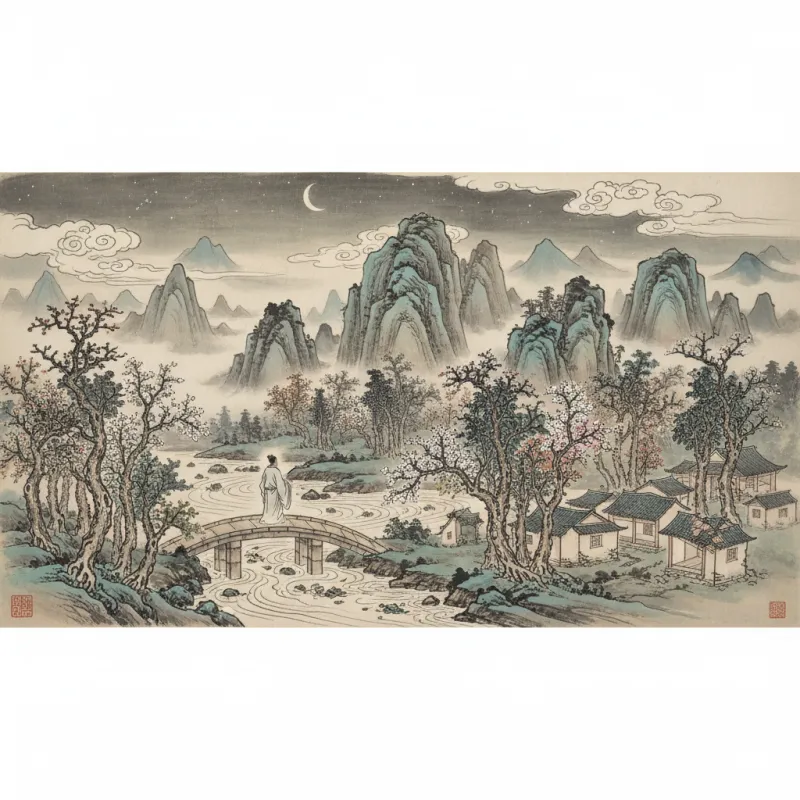
The poet Wang Wei stood in the ruins of a monastery he'd visited as a young man. The halls were empty. The monks were gone. Weeds grew through the courtyard stones. He was 61 years old, and everything he'd loved in his youth had vanished like morning mist. So he wrote a poem about it, because that's what you do when you're a Tang dynasty poet and the universe has just reminded you that nothing—absolutely nothing—stays.
This wasn't abstract philosophy for Wang Wei. The An Lushan Rebellion had torn through China like a wildfire through paper. Cities burned. Millions died. The glittering cosmopolitan empire of his youth became a landscape of ghosts. And Wang Wei, who'd spent decades studying Buddhist texts and meditating in mountain temples, found that all those teachings about impermanence (无常, wúcháng) weren't preparation for loss. They were just accurate descriptions of what loss feels like when it actually happens.
When Philosophy Becomes Experience
Buddhist impermanence isn't a metaphor. It's not poetic language. It's the literal claim that everything you can perceive—your body, your thoughts, your relationships, the dynasty you serve, the mountain you're looking at—is in the process of dissolving. Right now. Always. The technical term is anitya in Sanskrit, 无常 (wúcháng) in Chinese, and it's one of the three marks of existence in Buddhist teaching.
Tang poets knew the theory. They'd read the sutras. They'd memorized the passages. But theory and experience are different animals entirely. Du Fu knew impermanence as an abstract principle when he was young and ambitious, writing poems for the imperial examinations. He knew it as lived reality when he was old and displaced, watching his children die of malnutrition while the empire collapsed around him.
The difference shows up in the poetry. Early Tang poets like Wang Bo wrote about impermanence with the confidence of people who haven't really lost anything yet. Their poems are elegant, controlled, philosophically sophisticated. Late Tang poets like Li Shangyin wrote about it with the exhaustion of people who've watched everything fall apart twice. Their poems are strange, fragmented, haunted by images that don't quite resolve into meaning.
The Rebellion That Made Impermanence Real
The An Lushan Rebellion (安史之乱, Ān Shǐ zhī Luàn) started in 755 CE and lasted eight years. The numbers are almost incomprehensible: roughly 36 million people died, about two-thirds of the empire's registered population. To put that in perspective, it's one of the deadliest conflicts in human history, comparable to World War II in absolute numbers and far worse in percentage terms.
Before the rebellion, Tang China was the richest, most cosmopolitan civilization on earth. Chang'an, the capital, had over a million residents. You could walk through the Western Market and hear Persian, Arabic, Sanskrit, Sogdian, Turkish. The empire stretched from the Korean peninsula to the edges of Persia. The civil service examinations were producing a literate elite who wrote poetry as naturally as they breathed.
After the rebellion, the dynasty limped on for another 150 years, but it was never the same. The central government lost control of the provinces. The economy collapsed. The cosmopolitan culture fragmented. And the poets who lived through it—Du Fu, Wang Wei, Cen Shen—wrote about impermanence with a new kind of urgency.
Du Fu's "Spring View" (春望, Chūn Wàng) was written in 757, while he was trapped in the occupied capital. The opening lines are famous: "The nation is broken; mountains and rivers remain. / Spring comes to the city; grass and trees grow deep." The nation is broken. Mountains and rivers remain. That's impermanence in two lines: human civilizations dissolve, but the landscape endures. Except the landscape doesn't endure either—it just dissolves more slowly.
Wang Wei's Empty Mountains
Wang Wei is the Tang poet most associated with Buddhism, and his poetry is saturated with impermanence. But it's not the dramatic, catastrophic impermanence of Du Fu's war poems. It's quieter. More intimate. More unsettling.
Take "Deer Park" (鹿柴, Lù Zhài): "Empty mountain, no one in sight. / Only the sound of someone's voice. / Returning light enters the deep forest, / Shining again on the green moss." The poem is only 20 characters in Chinese. It describes a moment that lasts maybe ten seconds. And in those ten seconds, everything appears and disappears: the mountain, the voice, the light, the moss. Nothing stays. Nothing was ever really there to begin with.
Wang Wei's mountains are always empty. Not because no one lives there, but because emptiness (空, kōng) is the fundamental nature of things in Buddhist philosophy. Emptiness doesn't mean "nothing exists." It means "nothing exists independently, permanently, or essentially." The mountain exists, but only as a temporary arrangement of causes and conditions. The voice exists, but only as a sound wave that's already dissipating. The light exists, but only as photons bouncing off moss that's already dying.
This is why Wang Wei's poetry feels so strange. He's not describing a world where things disappear. He's describing a world where things were never really there in the first place. Buddhist themes in Tang poetry often explore this tension between appearance and emptiness, but Wang Wei takes it further than almost anyone.
Li Bai's Drunken Impermanence
Li Bai approached impermanence differently. He got drunk and wrote about it.
This sounds flippant, but it's not. Li Bai's drinking poems are some of the most sophisticated meditations on impermanence in the Tang canon. "Waking from Drunkenness on a Spring Day" (春日醉起言志, Chūn Rì Zuì Qǐ Yán Zhì) opens with: "I wake from drunkenness in the spring, / And the sun is already setting." He's lost an entire day. Time has vanished while he was unconscious. And his response isn't grief or panic—it's a kind of amused acceptance.
Li Bai's most famous drinking poem, "Drinking Alone Beneath the Moon" (月下独酌, Yuè Xià Dú Zhuó), takes this further. He's drinking by himself, so he invites the moon and his shadow to join him. Three drinking companions, except two of them aren't real. The moon is a reflection. The shadow is an absence of light. And Li Bai himself is drunk, which means his consciousness is altered, unreliable, not quite "him" in any stable sense.
The poem ends with Li Bai making plans to meet the moon and his shadow again in the Milky Way. It's absurd. It's impossible. And it's a perfect expression of impermanence: if nothing lasts anyway, if everything is already dissolving, then the distinction between real and unreal becomes less important. The moon-companion and the human-companion are equally temporary. They'll both disappear.
Bai Juyi's Bureaucratic Impermanence
Bai Juyi was a government official who wrote poetry about government work, which sounds boring until you realize he's writing about impermanence in the most mundane contexts possible. His poem "The Old Man of Xinfeng with the Broken Arm" (新丰折臂翁, Xīnfēng Zhé Bì Wēng) tells the story of an old man who broke his own arm to avoid military conscription during the An Lushan Rebellion.
The old man is now 88. The rebellion ended decades ago. Everyone who fought in it is dead. The generals, the rebels, the emperor who started the war—all gone. But the old man is still alive, with his broken arm, telling his story to a government official who's writing it down in a poem that will outlast both of them.
That's impermanence in action: the massive historical event dissolves, but the small personal consequence remains. Except it doesn't remain—the old man will die soon, and then only the poem will be left. And eventually the poem will be lost too, or mistranslated, or forgotten. Nothing escapes.
Bai Juyi wrote about this constantly. His poems are full of ruined palaces, abandoned gardens, forgotten officials, lost loves. He was obsessed with the gap between what people think will last and what actually lasts. Spoiler: nothing actually lasts. Tang dynasty poets and Buddhism often grappled with this realization, but Bai Juyi made it his entire career.
The Aesthetics of Disappearance
Tang poets developed a specific aesthetic vocabulary for impermanence. Certain images appear over and over: autumn leaves, setting suns, abandoned palaces, overgrown gardens, distant mountains, fading light. These aren't just pretty pictures. They're technical devices for making impermanence visible.
Autumn leaves are perfect for this. They're beautiful precisely because they're dying. The colors intensify as the chlorophyll breaks down. The leaves become most vivid in the moment before they fall. Tang poets understood this: beauty and impermanence aren't opposites. They're the same thing viewed from different angles.
Setting suns work the same way. The light is most dramatic when it's disappearing. The sky turns colors that don't exist at any other time of day. And then it's gone. Du Mu's "Mooring at Qinhuai" (泊秦淮, Bó Qínhuái) uses this perfectly: "Smoke veils the cold water, moon veils the sand. / At night I moor at Qinhuai, near a tavern. / Singing girls don't know the grief of a lost nation— / Across the river they still sing 'Flowers in the Rear Court.'" The beauty of the scene—smoke, water, moon, sand, singing—is inseparable from the grief of the lost nation. They're both impermanent. They're both already gone.
Why This Still Matters
You might think Buddhist impermanence is depressing. The Tang poets didn't. Or rather, they did, but they also found it liberating.
If nothing lasts, then your failures don't last either. Your embarrassments, your mistakes, your regrets—they're all dissolving right now. The person you were yesterday is already gone. The person you'll be tomorrow doesn't exist yet. You're living in a constant state of disappearance, which means you're also living in a constant state of renewal.
This is why Wang Wei could write such peaceful poems about emptiness. This is why Li Bai could get drunk and laugh at the moon. This is why Du Fu could write about catastrophic loss without descending into complete despair. They understood that impermanence cuts both ways: yes, everything you love will disappear, but everything you fear will disappear too.
The Tang dynasty ended in 907 CE. The poets are dead. The empire is gone. The palaces are ruins. But the poems remain—for now. They're impermanent too, of course. Languages change. Texts get lost. Meanings shift. Eventually, these poems will be as incomprehensible as Sumerian cuneiform.
But right now, in this moment, you can read Wang Wei's empty mountains and Li Bai's drunken moon and Du Fu's broken nation. You can feel what they felt: the strange, vertiginous recognition that nothing stays, nothing was ever really here, and somehow that makes everything more precious, not less.
The monastery Wang Wei visited is gone. The weeds have been cleared away by other weeds. The stones have crumbled into soil. But the poem he wrote about it—"Visiting the Temple of Gathered Fragrance" (过香积寺, Guò Xiāngjī Sì)—still exists. For now. Which is all anything ever does: exist for now, in this moment, before dissolving into the next moment, and the next, and the next, until there are no more moments and no one left to count them.
That's not depressing. That's just accurate. And accuracy, the Tang poets understood, is its own kind of beauty.
Related Reading
- Zen Koans in Poetry Form: When Chinese Verse Became a Riddle
- Wang Wei's Buddhist Nature Poems: Silence as Spiritual Practice
- Buddhist Poetry in Chinese Literature: Enlightenment in Twenty Characters
- Cold Mountain Poems of Hanshan: The Hermit Who Wrote on Rocks
- The Spiritual Depth of Chinese Classical Poetry: Insights from Tang, Song, and Yuan Poets
- Unveiling the Essence of Chinese Classical Poetry: Insights from Tang, Song, and Yuan Poets
- The Enchantment of Song Dynasty Poets: A Deep Dive into Their Timeless Verses
- Love and Longing in Chinese Classical Poetry: Tang, Song, and Yuan Dynasties Explored
Explore Chinese Culture
- Explore the Tang dynasty's golden age
- Explore Daoist themes in classical poetry
- Explore Chinese literary traditions