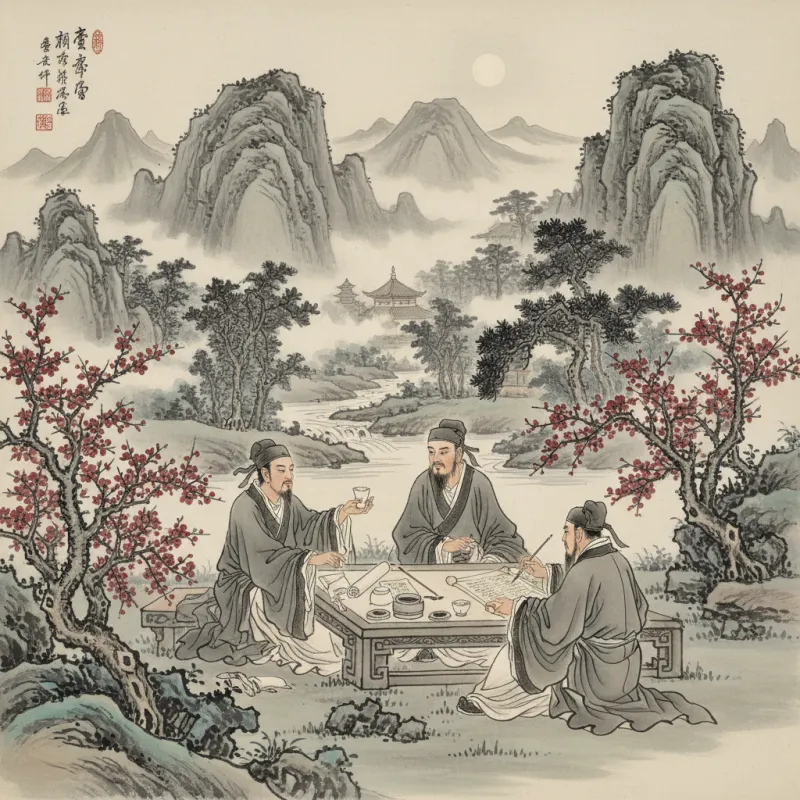
Li Bai drowned in the Yangtze River trying to embrace the moon's reflection while drunk — or so the legend goes. Whether true or not, the story captures something essential about Chinese wine poetry: the willingness to abandon reason, propriety, and even self-preservation in pursuit of transcendent experience. For over two millennia, Chinese poets haven't just written about drinking. They've made intoxication a literary method, a philosophical stance, and a form of spiritual practice.
The Confucian Problem and the Alcoholic Solution
Here's the tension that created wine poetry: Confucian society demanded restraint, hierarchy, and emotional control. But poetry requires honesty, spontaneity, and the courage to say what everyone else is thinking but won't admit. Wine (酒 jiǔ) became the socially acceptable excuse for breaking the rules. A drunk poet could criticize the emperor, confess his failures, or weep over lost friends — and blame it on the alcohol the next morning.
This wasn't mere escapism. The Book of Songs (诗经 Shījīng), compiled around 600 BCE, already contains drinking songs that use wine as a lens for examining mortality, friendship, and the brevity of joy. "Let us drink and be merry," one poem urges, "for who knows what tomorrow brings?" The sentiment sounds hedonistic, but it's actually philosophical: wine makes us confront the impermanence that Confucian ritual tries to obscure.
By the Tang dynasty (618-907 CE), this tension had evolved into a full-blown aesthetic. The court valued decorum; the poets valued truth. Wine became the bridge between these incompatible demands. You could be a loyal official by day and a drunken rebel by night, and both roles were considered authentic expressions of the same person.
Li Bai and the Cult of Intoxication
Li Bai (李白 Lǐ Bái, 701-762 CE) didn't invent wine poetry, but he perfected it to the point where later poets couldn't escape his shadow. He claimed to write his best work while drunk, and his contemporaries believed him. Du Fu (杜甫 Dù Fǔ) wrote that Li Bai could "produce a hundred poems after drinking a gallon of wine," and the imperial court supposedly kept him around specifically to compose verses while intoxicated.
What made Li Bai's drinking poetry revolutionary wasn't the quantity of alcohol — plenty of poets drank heavily. It was his insistence that intoxication revealed truth rather than obscuring it. In "Waking from Drunkenness on a Spring Day" (春日醉起言志 Chūnrì Zuì Qǐ Yán Zhì), he writes: "Life in the world is but a big dream; I will not spoil it by any labor or care." This isn't a drunk person talking nonsense. It's a sober philosophical position that only becomes expressible through the performance of drunkenness.
His most famous drinking poem, "Drinking Alone Under the Moon" (月下独酌 Yuè Xià Dú Zhuó), takes this further. He drinks by himself, invites the moon and his shadow to join him, and creates an imaginary drinking party of three. The poem is playful, melancholic, and slightly unhinged — exactly the emotional complexity that Confucian propriety forbids. Wine doesn't just loosen Li Bai's tongue; it gives him permission to be fully human in a society that demands he be a proper gentleman.
The Eight Immortals of the Wine Cup
Li Bai belonged to a group Du Fu immortalized as the "Eight Immortals of the Wine Cup" (饮中八仙 Yǐn Zhōng Bā Xiān) — eight Tang dynasty poets and officials famous for their drinking. Du Fu's poem about them reads like a celebrity roast: one immortal falls off his horse but keeps drinking from the saddle, another drinks three gallons and then writes manifestos criticizing the emperor, a third passes out in the street and refuses to board the imperial carriage because it would interrupt his nap.
The poem is funny, but it's also making a serious point about the relationship between power and poetry. These men held important government positions, yet their real legacy was what they wrote while drunk. The emperor's carriage — symbol of political authority — matters less than the freedom to pass out in the street. Du Fu is suggesting that wine poetry represents a form of power that outlasts political office: the power to tell the truth and be remembered for it.
This wasn't just Tang dynasty bravado. The Eight Immortals were responding to a genuine crisis in Chinese intellectual life. How do you maintain integrity in a system that rewards conformity? How do you speak truth to power when power controls your career? Wine became the answer: a temporary autonomous zone where normal rules didn't apply. The drinking poem was a space of freedom carved out of an unfree society.
Song Dynasty Refinement and the Ci Tradition
The Song dynasty (960-1279 CE) inherited Tang wine poetry but refined it into something more introspective. The ci (词 cí) form — originally drinking songs performed at banquets — became the vehicle for exploring wine's emotional complexity. Where Li Bai celebrated intoxication, Song poets like Su Shi (苏轼 Sū Shì) and Li Qingzhao (李清照 Lǐ Qīngzhào) examined what happens after the party ends.
Su Shi's "Prelude to Water Melody" (水调歌头 Shuǐ Diào Gē Tóu), written while drunk during the Mid-Autumn Festival, asks: "When will the bright moon appear? Wine cup in hand, I ask the sky." He's drinking alone, missing his brother, contemplating the moon — the same setup as Li Bai's famous poem. But where Li Bai creates imaginary companions, Su Shi accepts solitude as the human condition. The wine doesn't solve his loneliness; it clarifies it.
Li Qingzhao, one of China's greatest poets, used wine imagery to explore grief and memory. After her husband's death, she wrote ci poems where wine becomes a measure of loss: she drinks, but it doesn't bring the oblivion she seeks. "I drink wine at dusk by the eastern fence," she writes, "and a secret fragrance fills my sleeves. Don't say my soul is not consumed — the west wind blows the curtain, and I am thinner than the yellow chrysanthemum." The wine that freed Li Bai traps Li Qingzhao in her sorrow. This is wine poetry's dark side: sometimes intoxication just makes you more aware of what you've lost.
The Philosophy of Drunken Writing
Chinese wine poetry developed its own aesthetic theory, distinct from Western ideas about inspiration and intoxication. The key concept is 酒兴 (jiǔxìng) — literally "wine excitement" or "wine inspiration." It's not about being drunk; it's about the specific mental state where social inhibitions dissolve but artistic control remains intact.
The calligrapher Zhang Xu (张旭 Zhāng Xù) was famous for writing his best work while drunk, but he insisted that drunkenness alone wasn't enough. You needed years of sober practice first, so that when wine removed your conscious control, your trained instincts could take over. This is the opposite of the Western Romantic idea that intoxication reveals raw genius. In the Chinese tradition, wine reveals what you've already cultivated through discipline.
This explains why wine poetry is so technically accomplished. Li Bai's drinking poems follow strict tonal patterns and rhyme schemes even while claiming to be spontaneous drunken outbursts. The performance of intoxication requires sobriety to execute. It's a paradox that Chinese poets embraced rather than resolved: you have to be sober enough to write convincingly about being drunk.
Wine Poetry's Modern Legacy
The tradition didn't end with the classical period. Modern Chinese poets still use wine imagery to explore freedom, authenticity, and resistance to social pressure. But the context has changed. In contemporary China, wine poetry can't play the same role it did in Tang and Song times because the social constraints are different. Confucian propriety has been replaced by other forms of control, and alcohol has lost some of its transgressive power.
Yet the core insight remains relevant: sometimes you need to step outside normal consciousness to see clearly. Whether that step is literal (actual drinking) or metaphorical (the performance of intoxication in poetry), wine poetry reminds us that truth-telling requires courage, and courage sometimes requires an excuse. The Chinese tradition gave poets that excuse for two thousand years, and in doing so, created some of the world's most honest literature about what it means to be human in an inhuman world.
For more on the poets who perfected this tradition, see Li Bai's Moon Poems and Du Fu's Social Commentary. The relationship between wine and artistic creation extends beyond poetry into Chinese Calligraphy and Intoxication.
Related Reading
- Drinking Poetry: Why Chinese Poets Wrote Their Best Work Drunk
- Unraveling the Essence of Drinking Poetry in Tang, Song, and Yuan Eras
- Li Bai's Drinking Poems: Wine, Moon, and Immortality
- Drinking Poetry: Wine, Moonlight, and the Art of Getting Drunk with Purpose
- Poetry Drinking Games: When Literature Met Entertainment
- Unveiling the Essence of Chinese Classical Poetry: Insights from Tang, Song, and Yuan Poets
- The Harmony of Nature in Chinese Classical Poetry: Tang, Song, and Yuan Dynasties
- The Enchantment of Song Dynasty Poets: A Deep Dive into Their Timeless Verses
Explore Chinese Culture
- Explore the Tang dynasty's golden age
- Explore Daoist themes in classical poetry
- Explore Chinese literary traditions