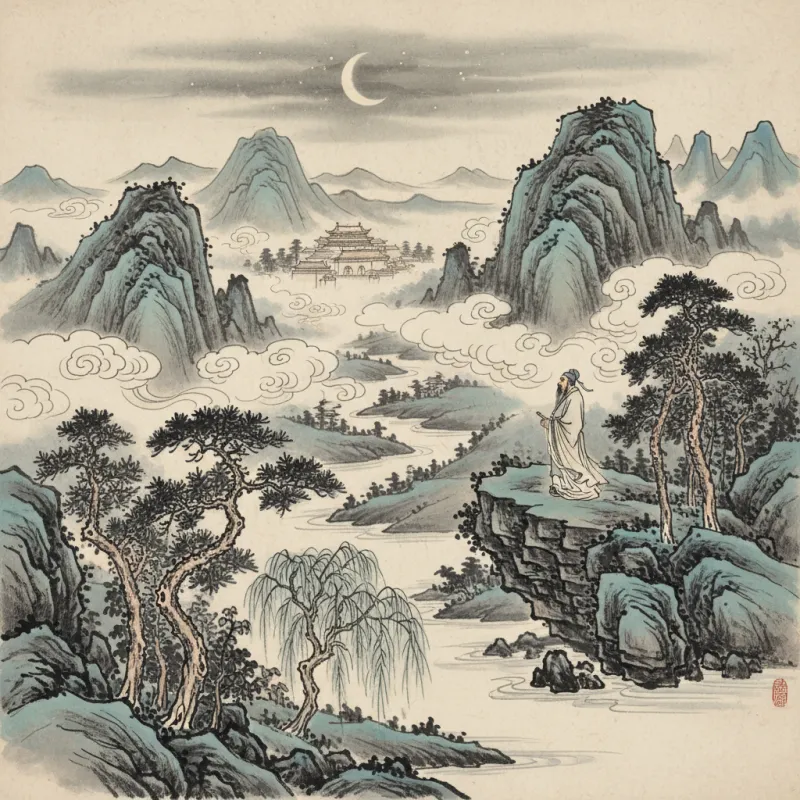
The Emperor Xuanzong of Tang had everything—absolute power, vast territories, the finest wines and silks—yet he threw it all away for a woman who wasn't even supposed to be his. Yang Guifei, his son's former consort, became the obsession that would topple an empire. Bai Juyi's Chang Hen Ge (長恨歌, "The Song of Everlasting Sorrow") immortalizes this scandalous love affair in 840 lines of haunting verse, creating what might be the most influential narrative poem in Chinese literary history.
The Poet Who Wrote for Everyone
Bai Juyi (白居易, Bái Jūyì, 772–846 CE) wasn't your typical Tang Dynasty literati. While contemporaries like Li Bai crafted dazzling, allusive verses that required extensive classical education to decode, Bai Juyi deliberately wrote in accessible language. He famously tested his poems on an elderly illiterate woman, revising any lines she couldn't understand. This populist approach didn't diminish his artistry—it amplified his impact. By the time he penned The Song of Everlasting Sorrow in 806, he'd already established himself as a master of the yuefu (樂府) ballad tradition, a form rooted in folk songs rather than elite literary conventions.
His timing was perfect. The An Lushan Rebellion (755–763), which forms the historical backdrop of the poem, had ended just decades before Bai Juyi's birth. The trauma was still fresh in collective memory—the rebellion had killed an estimated 36 million people, roughly two-thirds of the empire's population. Everyone knew the story of how Emperor Xuanzong's infatuation with Yang Guifei had distracted him from governance, creating the conditions for catastrophe. But Bai Juyi did something remarkable: he transformed a cautionary tale about political negligence into a meditation on the nature of love itself.
The Story Behind the Sorrow
The historical facts are stark. In 745, the 61-year-old Emperor Xuanzong became infatuated with Yang Yuhuan, who was then married to his eighteenth son. He "convinced" her to become a Daoist nun (a convenient loophole), then installed her as his imperial consort. Yang Guifei, as she became known, wasn't just beautiful—she was talented, witty, and politically astute. For over a decade, she held the emperor's complete devotion.
But her family's rise to power bred resentment. Her cousin Yang Guozhong became chancellor and made enemies throughout the court. When General An Lushan launched his rebellion in 755, the emperor fled the capital with Yang Guifei and a small retinue. At Mawei Slope, the imperial guards mutinied. They'd had enough of the Yang family's corruption. The soldiers demanded Yang Guifei's death as the price for continuing to protect the emperor. Xuanzong, the man who'd risked everything for her, acquiesced. She was strangled with a silk cord and buried in a hasty roadside grave. She was 38 years old.
The Poem's Architecture
The Song of Everlasting Sorrow unfolds in three distinct movements, each with its own emotional register. The opening section (roughly the first 200 characters) depicts the emperor's obsession with beauty and his discovery of Yang Guifei. Bai Juyi's descriptions are sensuous without being crude: "Her cloud-like hair, flower-like face, golden hairpins that sway / Behind the hibiscus curtains on spring nights, they play." The qiyan (七言, seven-character) regulated verse creates a hypnotic rhythm that mirrors the emperor's enchantment.
The middle section chronicles the rebellion and Yang Guifei's death with devastating economy. Bai Juyi doesn't dwell on battle scenes or political machinations. Instead, he focuses on intimate details: the emperor unable to look away as she's led to her death, the rain mixing with his tears, the yellow dust of the road. The line "The sovereign could not save her, he could only stare" (君王掩面救不得) captures the absolute powerlessness of absolute power.
The final movement ventures into the supernatural. A Daoist priest travels to the heavens and the underworld searching for Yang Guifei's spirit. He finds her on an immortal island, still beautiful, still longing for the emperor. She sends tokens of their love—a hairpin, a box—and reminds him of a secret vow they'd made under the stars. The poem ends with the title phrase: "In heaven, let us be birds flying wing to wing / On earth, let us be trees with branches intertwining / Heaven and earth may end, but this sorrow is everlasting" (天長地久有時盡, 此恨綿綿無絕期).
Why "Sorrow" Not "Regret"?
The Chinese character hen (恨) in the title is notoriously difficult to translate. It encompasses regret, resentment, sorrow, and unfulfilled longing all at once. Some translators choose "regret," emphasizing the political and moral dimensions—the emperor's failure of duty. Others prefer "sorrow," highlighting the emotional loss. Bai Juyi's genius lies in refusing to separate these meanings. The poem asks: Can we condemn the emperor's negligence while still honoring the authenticity of his grief? Can love be both genuine and destructive?
This ambiguity made the poem controversial from the start. Confucian critics argued that Bai Juyi romanticized a disastrous relationship that had nearly destroyed the dynasty. They had a point—the poem's sympathetic portrayal of Xuanzong and Yang Guifei does soften their culpability. But Bai Juyi wasn't writing propaganda or moral instruction. He was exploring the tragic gap between human desire and human duty, a theme that resonates across cultures and centuries.
The Poem's Afterlife
The Song of Everlasting Sorrow became a cultural phenomenon almost immediately. Within decades, it had inspired paintings, operas, and countless imitations. The Japanese Heian court was obsessed with it—Murasaki Shikibu references the poem multiple times in The Tale of Genji. In China, the story of Xuanzong and Yang Guifei became the archetypal doomed romance, influencing everything from Yuan Dynasty drama to modern film.
The poem's influence on Chinese poetic form was equally profound. Bai Juyi demonstrated that narrative poetry could achieve the emotional intensity of lyric verse while telling a complex story. Later poets like Bai Pu and Yuan Zhen (Bai Juyi's close friend and fellow poet) built on this foundation, expanding the possibilities of the changpian gushi (長篇古詩, long-form ancient-style poetry).
Reading Bai Juyi Today
What makes The Song of Everlasting Sorrow endure isn't its historical subject matter—most Western readers couldn't care less about Tang Dynasty politics. It's Bai Juyi's unflinching examination of how love and power corrupt each other. The emperor's devotion to Yang Guifei is real, but it's also selfish, blinding him to his responsibilities. Yang Guifei's love is genuine, but she also enjoys the luxury and influence her position brings. Neither is simply victim or villain.
The poem's supernatural ending, which might seem like a cop-out, actually deepens this complexity. By reuniting the lovers in the afterlife, Bai Juyi suggests that their love transcends the political disaster it caused. But he doesn't erase that disaster. The "everlasting sorrow" isn't just the emperor's grief—it's the permanent stain of their choices, the lives lost, the trust broken. Heaven and earth may end, but consequences echo forever.
For modern readers approaching Tang poetry, The Song of Everlasting Sorrow offers an accessible entry point precisely because of Bai Juyi's commitment to clarity. You don't need extensive knowledge of classical allusions to feel the poem's emotional force. The images are vivid and immediate: the emperor searching through fallen leaves for Yang Guifei's hairpin, the palace dancers who remind him of her grace, the lonely nights when he counts the stars they once watched together.
The Lesson of Mawei Slope
Bai Juyi never explicitly moralizes, but the poem's structure contains its judgment. The first section shows us the intoxication of love and beauty. The middle section reveals the cost. The final section offers consolation—but it's a consolation that changes nothing in the mortal world. The soldiers still mutinied. Yang Guifei still died. The empire still nearly fell. All the supernatural reunions and eternal vows can't undo what happened at Mawei Slope.
This is why The Song of Everlasting Sorrow remains relevant. We live in an age that celebrates romantic love as the highest good, that tells us to "follow our hearts" regardless of consequences. Bai Juyi understood that love—even genuine, profound love—exists in a world of competing obligations and limited resources. The emperor's tragedy wasn't that he loved Yang Guifei, but that he loved her to the exclusion of everything else. His sorrow is everlasting because it's earned.
Related Reading
- Du Fu: The Conscience of Chinese Poetry
- Women Poets of China: Voices Across Three Millennia
- Wang Wei: The Poet-Painter Who Captured Silence
- Tao Yuanming: The Recluse Who Found Paradise
- The Great Poets of China: Li Bai, Du Fu, and the Rivalry That Never Was
- Classical Chinese Prose: The Essays That Shaped a Civilization
- Unveiling the Rich Tapestry of Chinese Classical Poetry: Insights from Tang, Song, and Yuan Dynasties
- Drinking Poetry: Why Chinese Poets Wrote Their Best Work Drunk
Explore Chinese Culture
- Explore the Tang dynasty's golden age
- Explore Daoist themes in classical poetry
- Explore Chinese literary traditions