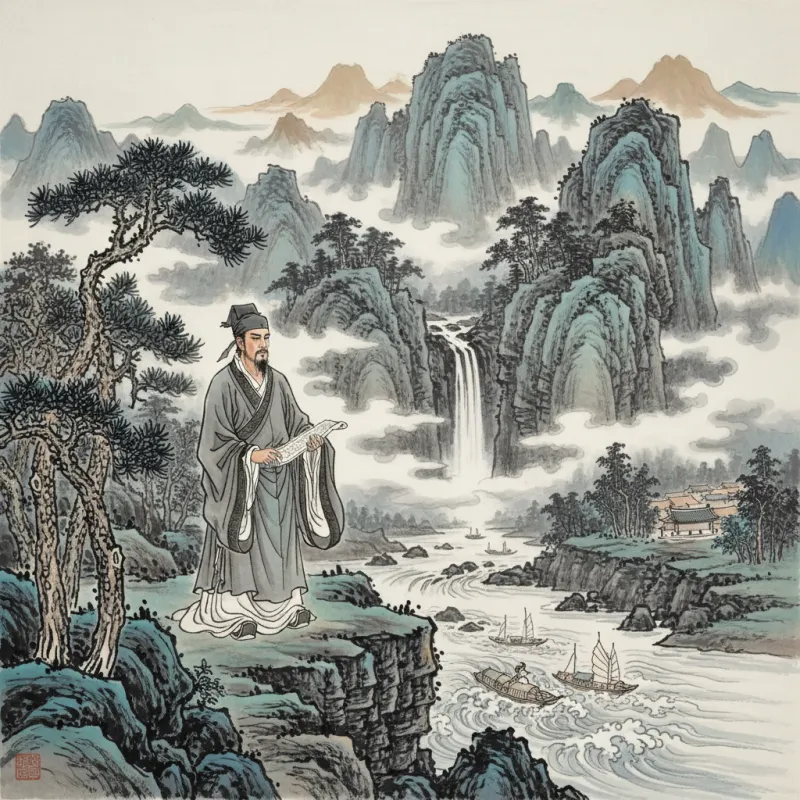
Every June, roughly a billion people eat sticky rice wrapped in bamboo leaves and watch dragon boat races. Most of them know it has something to do with a poet who drowned himself. Fewer know why he did it, or why his death still matters 2,300 years later.
Qu Yuan (屈原 Qū Yuán) wasn't just the first named poet in Chinese history. He invented the idea that a writer could be a moral voice — that poetry wasn't just decoration but a form of conscience. And he paid for that idea with his life.
The Minister from Chu
Qu Yuan was born around 340 BCE into the royal family of the state of Chu (楚国 Chǔguó), one of the major powers during the Warring States period (战国时代 Zhànguó Shídài). He was brilliant, well-educated, and rose quickly to become a senior advisor to King Huai of Chu (楚怀王 Chǔ Huáiwáng). This wasn't ceremonial work. Chu was fighting for survival against six other major states, and Qu Yuan was helping shape foreign policy at the highest level.
His position gave him a front-row seat to one of history's great political dramas: the rise of Qin (秦国 Qínguó), the state that would eventually unify China. Qu Yuan saw it coming. He advocated for an alliance with Qi (齐国 Qíguó) to counter Qin's expansion. It was the right strategy, but it made him enemies at court.
The problem with being right in politics is that someone else is usually profiting from being wrong. Rival ministers, likely bribed by Qin agents, convinced King Huai that Qu Yuan was arrogant and unreliable. In 304 BCE, Qu Yuan was banished from the capital. He would spend the rest of his life in exile, watching from a distance as everything he predicted came true.
Inventing Personal Poetry
Before Qu Yuan, Chinese poetry was mostly anonymous and collective. The Book of Songs (诗经 Shījīng) contains 305 poems, and we don't know who wrote any of them. They're folk songs, court hymns, ritual chants — the voice of a culture, not an individual.
Qu Yuan changed that. In exile, he created a new form called chu ci (楚辞 Chǔcí), literally "Songs of Chu." These weren't anonymous folk songs. They were signed, personal, and intensely emotional. His most famous work, "Encountering Sorrow" (离骚 Lísāo), runs to 373 lines and reads like a fever dream — part political allegory, part spiritual journey, part howl of rage.
The poem opens with Qu Yuan announcing his birth date and lineage, then launches into an extended metaphor where he's a rejected lover and the king is a faithless woman seduced by scheming courtiers. He flies through the heavens on a dragon chariot, meets goddesses, considers leaving the mortal world entirely. It's baroque, hallucinatory, and utterly unlike anything written before in Chinese.
What makes "Encountering Sorrow" revolutionary isn't just its style but its premise: that one person's inner life — their grief, their moral outrage, their sense of betrayal — matters enough to record in detail. Qu Yuan wasn't speaking for his community or performing a ritual function. He was speaking for himself, and he expected people to care.
This is the birth of the Chinese literary tradition as we know it. After Qu Yuan, poets could be individuals with names, personalities, and grievances. The exile poetry that would become central to Chinese literature starts here, with a disgraced minister writing furious verses in the wilderness.
The Shaman Poet
Qu Yuan's poetry is soaked in the religious culture of Chu, which was different from the more rationalist north. Chu was a land of shamans, spirit journeys, and ecstatic ritual. The state's southern location, near modern Hunan and Hubei, gave it a distinct cultural flavor — more mystical, more emotionally expressive, more comfortable with the supernatural.
You can see this in Qu Yuan's work. "The Nine Songs" (九歌 Jiǔgē) are hymns to various deities — the Lord of the Clouds, the River Goddess, the Mountain Spirit. They're sensual, strange, full of longing and divine encounters. One poem describes a shaman preparing to meet a god, adorning herself with orchids and cinnamon, only to be stood up. Another depicts a battle deity riding through the sky, his war drums shaking the heavens.
These aren't the sober, Confucian hymns of the northern states. They're ecstatic, erotic, dangerous. Qu Yuan brought this shamanic energy into Chinese poetry and it never entirely left. You can trace a line from his spirit journeys to Li Bai's (李白 Lǐ Bái) drunken flights through the cosmos eight centuries later.
The Loyal Minister's Dilemma
The core of Qu Yuan's tragedy is a question that would haunt Chinese intellectuals for millennia: what do you do when the ruler you serve is making catastrophic mistakes?
Confucian doctrine said a minister should remonstrate with the ruler, but ultimately obey. Daoist philosophy suggested withdrawing from politics entirely. Qu Yuan chose a third path: he stayed loyal to the state of Chu while condemning its leadership. He refused to serve a corrupt court, but he also refused to abandon his homeland.
This position is almost impossible to maintain. In "Encountering Sorrow," Qu Yuan considers leaving Chu entirely, even contemplates suicide, but keeps circling back to his sense of duty. He's trapped between his conscience and his loyalty, and the tension is unbearable.
In 278 BCE, Qin armies finally conquered Chu's capital, Ying (郢 Yǐng). Everything Qu Yuan had warned about for decades had come to pass. According to legend, he walked to the Miluo River (汨罗江 Mìluó Jiāng), wrote one final poem called "Embracing Sand" (怀沙 Huáishā), and drowned himself.
The story goes that local people raced out in boats to save him, beating drums to scare away fish and throwing rice dumplings into the water to keep fish from eating his body. This is supposedly the origin of dragon boat races and zongzi (粽子 zòngzi), the sticky rice dumplings eaten during the Dragon Boat Festival (端午节 Duānwǔjié).
Why Qu Yuan Still Matters
Qu Yuan's suicide made him immortal in a way his poetry alone might not have. He became the prototype of the loyal minister destroyed by a corrupt system — a figure that would appear again and again in Chinese history and literature.
Every time a scholar-official was exiled for speaking truth to power, Qu Yuan's ghost was there. When Su Shi (苏轼 Sū Shì) was banished to Hainan Island, when Han Yu (韩愈 Hán Yù) was sent to the malarial south, when countless others found themselves writing poetry in exile, they were walking in Qu Yuan's footsteps.
But Qu Yuan's legacy goes deeper than just being a symbol of political martyrdom. He established the idea that literature could be a form of moral witness. Before Qu Yuan, poetry was functional — it celebrated harvests, praised rulers, accompanied rituals. After Qu Yuan, poetry could be an act of conscience, a way of saying "this is wrong" when no one else would.
This is why Chinese intellectuals kept returning to him. He proved that a writer could matter, that words could be worth dying for. It's a dangerous idea, and it's gotten a lot of people killed over the centuries. But it's also the foundation of Chinese literary culture.
The First Modern Poet
There's something almost modern about Qu Yuan's sensibility. His poetry is personal, psychological, full of doubt and contradiction. He doesn't have answers. He's not dispensing wisdom or performing a social function. He's working through his own confusion and pain in real time.
"Encountering Sorrow" reads like a modernist poem in some ways — fragmented, surreal, more interested in emotional truth than logical coherence. Qu Yuan doesn't resolve his dilemma. He just keeps circling it, trying different metaphors, different mythological frameworks, never quite finding peace.
This is why his work still feels alive 2,300 years later. He's not a distant historical figure dispensing ancient wisdom. He's a person in crisis, trying to figure out how to live with integrity in a corrupt world. That question hasn't gotten any easier.
The Dragon Boat Festival is officially about commemorating Qu Yuan's death, but what we're really commemorating is the choice he represents: the decision to care about something more than survival, to insist that some things matter even when the world says they don't. Every year, a billion people eat rice dumplings and watch dragon boats race, and most of them don't think about the exiled poet who started it all. But he's there in the background, still asking his impossible question: what do you do when loyalty and conscience point in different directions?
Qu Yuan never answered that question. He just showed us what it costs to ask it seriously.
Related Reading
- The Melancholy of Exile: A Journey Through Tang, Song, and Yuan Poetry
- Su Shi in Exile: How Banishment Produced China's Greatest Prose
- Su Shi in Exile: Making the Best of Banishment
- Political Poetry: When Poets Challenged Emperors
- Exile Poetry: When Banishment Produced China's Greatest Literature
- Unraveling Themes in Chinese Classical Poetry: Insights from Tang, Song, and Yuan Dynasties
- Li Bai: The Life of China's Most Legendary Poet
- The Enchantment of Song Dynasty Poets: A Deep Dive into Their Timeless Verses
Explore Chinese Culture
- Explore the Tang dynasty's golden age
- Explore Daoist themes in classical poetry
- Explore Chinese literary traditions