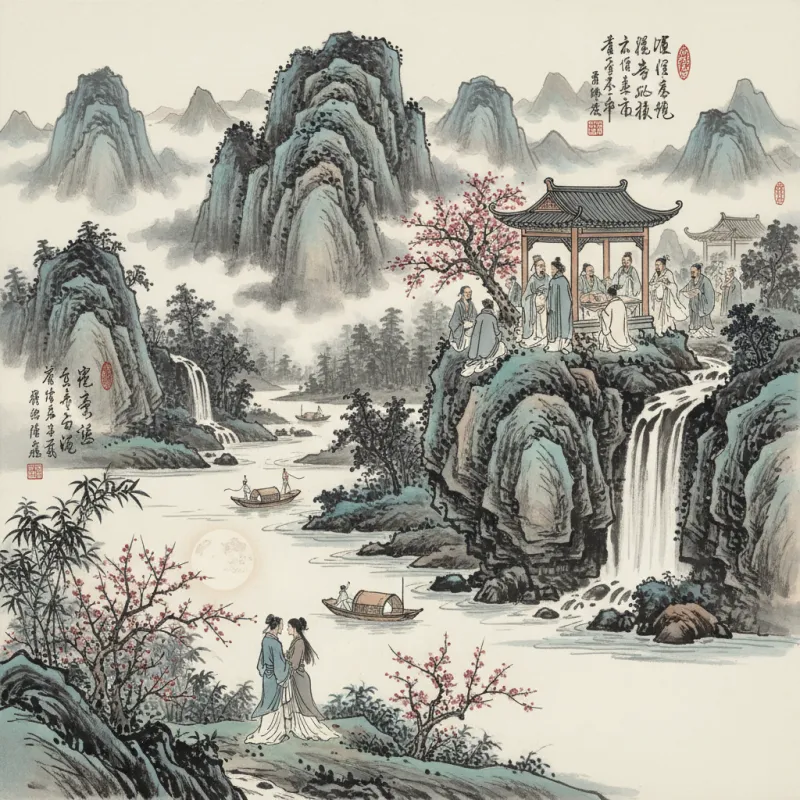
When Li Bai stood drunk beneath the moon, composing verses to a courtesan he'd never touch, he wasn't just writing love poetry—he was perfecting an art form that would define Chinese romantic expression for a millennium. The love poems of the Tang, Song, and Yuan dynasties weren't mere declarations of affection; they were intricate dances between desire and restraint, public propriety and private longing, where a single plum blossom could carry more erotic weight than a thousand direct confessions.
The Tang Revolution: When Love Poetry Became High Art
The Tang dynasty (618-907 CE) transformed love poetry from folk sentiment into sophisticated literature. Before Tang poets picked up their brushes, romantic verse existed primarily in the Shijing (诗经, Book of Songs) tradition—direct, sometimes crude, often anonymous. Then came the Tang literati, who discovered that the most powerful way to express desire was through indirection.
Li Bai (李白, 701-762) exemplified this approach in his qing (情) poems, where romantic longing merged with wine, moonlight, and philosophical wandering. His famous "Changgan xing" (长干行, Song of Changgan) tells of a merchant's wife waiting for her husband's return, but the genius lies in what's unsaid—the physical yearning compressed into images of moss growing too thick to sweep away, of autumn butterflies dying in pairs. The eroticism emerges from absence, not presence.
Du Fu (杜甫, 712-770), often considered more serious-minded than Li Bai, wrote some of the period's most poignant marital poetry. His verses to his wife during their wartime separation reveal that Tang love poetry wasn't always about courtesans and fantasy—sometimes it documented real marriages, real separations, real grief. When he writes of his wife's hair turning white while he's away at war, the intimacy cuts deeper than any elaborate metaphor.
But the Tang's true innovation in love poetry came through the ci (词) form's early development and the yuefu (乐府) tradition's refinement. Poets learned to embed romantic content within musical structures, creating verses meant to be sung by courtesans in wine houses—a meta-textual layer where the poem's speaker, the poet, and the performer created a triangle of desire that readers could enter from any angle.
Song Dynasty Subtlety: The Art of Saying Everything While Saying Nothing
The Song dynasty (960-1279) took Tang directness and made it whisper. If Tang poets painted love in bold strokes, Song poets worked in ink wash—suggestion, atmosphere, the space between words. This shift reflected Song culture's increasing refinement and the growing influence of Neo-Confucian thought, which viewed overt emotional display as vulgar.
Li Qingzhao (李清照, 1084-1155) stands as the period's greatest love poet, and possibly the finest female voice in Chinese literary history. Her early ci poems to her husband Zhao Mingcheng capture marital intimacy with unprecedented psychological depth. In "Ru meng ling" (如梦令, Like a Dream), she describes getting drunk on wine and losing her way home in lotus flowers—a scene of innocent pleasure that carries undertones of erotic disorientation. After Zhao's death, her later poems transform into something darker: desire without object, memory without comfort.
The male Song poets developed what scholars call wan yue (婉约, "graceful and restrained") style in love poetry. Yan Jidao (晏几道, 1038-1110) perfected the art of writing about courtesans without ever being crude. His poems describe singing girls, drinking parties, and romantic encounters, but always through veils of melancholy and temporal distance—"that year," "that night," "that person." The effect is haunting: love becomes inseparable from loss, even in the moment of possession.
Liu Yong (柳永, 987-1053) broke from this restraint, writing explicitly for and about courtesans in language they actually used. The literary establishment despised him for it—the emperor allegedly said Liu should stick to writing lyrics for singing girls rather than pursuing an official career. But Liu's poems, with their colloquial directness and genuine sympathy for women in the entertainment quarters, revealed dimensions of love that refined ci poetry often missed: economic transaction, professional performance, and the strange authenticity that can emerge within commercial intimacy.
Yuan Drama: Love Gets a Voice and a Body
The Yuan dynasty (1271-1368) brought Mongol rule and, paradoxically, an explosion of Chinese literary creativity in the zaju (杂剧) dramatic form. For the first time, love poetry wasn't just written—it was embodied, performed, shouted from stages. The romantic verse embedded in Yuan drama gave love a physicality that classical poetry had always sublimated.
Guan Hanqing's (关汉卿, c. 1220-1300) zaju plays feature courtesans as protagonists with agency, desire, and voices. In "Rescuing a Prostitute" (Jiufeng chen, 救风尘), the courtesan Zhao Pan'er manipulates, schemes, and ultimately controls her romantic destiny—a far cry from the passive beauties of earlier poetry. The love poetry within these plays is direct, sometimes bawdy, always human. When characters sing their qu (曲, dramatic songs), they express desire in language that would scandalize Song dynasty poets.
Wang Shifu's (王实甫, 1260-1336) "Romance of the Western Chamber" (Xixiang ji, 西厢记) contains some of Chinese literature's most famous love poetry, embedded in dramatic scenes of forbidden romance. The scholar Zhang and the maiden Cui Yingying conduct their courtship through poetry, but unlike classical exchanges, these verses lead to physical consummation—scandalous for its time. The play's poetry moves from refined classical allusion to raw desire, tracking the relationship's progression from literary flirtation to sexual fulfillment.
The Yuan poets also developed sanqu (散曲, "free songs")—qu poetry written for reading rather than performance. Ma Zhiyuan (马致远, 1250-1321) and others used this form to write love poetry that combined classical refinement with dramatic immediacy. The result was a hybrid: poems that read like internal monologues from plays that were never written, giving voice to romantic psychology in unprecedented ways.
Techniques of Indirection: How Chinese Poets Encoded Desire
Chinese classical love poetry operates through a sophisticated system of symbolic substitution. Understanding these codes transforms seemingly innocent nature poetry into erotic verse. The plum blossom (mei, 梅) represents feminine beauty and resilience—but also sexual ripeness and the brief window of opportunity. When a Tang poet writes about plum blossoms falling, he's often writing about lost virginity or fading youth.
The moon serves as witness, confidant, and symbol of separation. Lovers separated by distance can at least share the same moon—a trope so common it became cliché, yet poets continued finding new angles. Li Bai's "Drinking Alone Beneath the Moon" uses lunar imagery to explore solitary desire, making the moon itself into a kind of lover, present but untouchable.
Willow trees (liu, 柳) carry multiple meanings: parting (the word sounds like "to stay," liu, 留), feminine grace, and sexual availability. The "willow waist" describes a woman's slender figure, but "breaking willow branches" was a parting gesture between lovers—the physical act encoding both tenderness and violence. Song dynasty poets exploited these layered meanings, writing poems where every natural image carries erotic subtext.
The technique of bi xing (比兴, comparison and evocation) allowed poets to write about love while ostensibly describing nature, politics, or philosophy. A poem about a neglected garden might actually lament a abandoned wife. Verses about migratory birds could encode messages about separation and reunion. This indirection wasn't just aesthetic choice—it was social necessity in a culture that valued restraint and feared the chaos of uncontrolled passion.
Gender and Power: Who Gets to Speak of Love?
The gender dynamics of Chinese classical love poetry reveal complex power structures. Male poets dominated the tradition, yet they frequently adopted female voices—a practice called gui yuan (闺怨, "boudoir lament"). These poems, supposedly expressing women's longing for absent husbands or lovers, were actually male fantasies about being desired. The woman's voice becomes a vehicle for male poets to explore their own anxieties about loyalty, aging, and abandonment.
Yet real women poets existed and wrote with different perspectives. Li Qingzhao's love poetry to her husband contains details male poets rarely included: the physical comfort of shared sleep, the intellectual pleasure of examining antiques together, the specific texture of marital intimacy. Her poems don't idealize or fantasize—they remember and mourn actual experience.
Courtesan poets like Xue Tao (薛涛, 768-831) and Yu Xuanji (鱼玄机, 844-868) wrote from positions of sexual experience that respectable women couldn't acknowledge. Their poems often subvert conventional romantic tropes, revealing the commercial and performative aspects of desire that male poets preferred to ignore. Yu Xuanji's bitter verses about being abandoned by her lover carry an edge of anger that "proper" poetry rarely expressed.
The power dynamics extended beyond gender to class. Scholars writing about courtesans occupied positions of economic and social superiority, yet their poems often portrayed themselves as emotionally subordinate—enslaved by beauty, helpless before desire. This reversal allowed elite men to explore vulnerability while maintaining actual power, a dynamic that Tang Dynasty courtesans and their cultural influence examines in greater depth.
The Philosophy of Longing: Buddhist and Daoist Influences
Chinese love poetry absorbed Buddhist and Daoist philosophical concepts, transforming romantic longing into spiritual metaphor—and vice versa. The Buddhist concept of yuan (缘, karmic connection) explained why certain people felt inexplicably drawn together: they were working out destinies from previous lives. This belief gave romantic love cosmic significance while simultaneously diminishing it—if love was predetermined karma, individual choice mattered less.
Daoist ideas about wu wei (无为, non-action) and natural spontaneity influenced how poets portrayed ideal love. The best relationships, like water flowing downhill, should be effortless. Forced passion, like forced anything in Daoist thought, violated natural order. This philosophy produced poems celebrating spontaneous encounters and condemning possessive attachment—though poets often ignored their own advice, writing obsessively about lost loves.
The Buddhist teaching that all attachment causes suffering (dukkha) created productive tension in love poetry. Poets knew they shouldn't cling to romantic desire, yet they couldn't help themselves. This conflict generated some of the tradition's most psychologically complex work, as poets simultaneously indulged and critiqued their own longing. The monk-poet Hanshan (寒山, Cold Mountain) wrote verses that blur the line between spiritual and romantic yearning, making enlightenment sound like erotic union and vice versa.
Legacy and Transformation: How Classical Love Poetry Shaped Modern Chinese Romance
The techniques and tropes of Tang, Song, and Yuan love poetry didn't disappear—they evolved into modern Chinese romantic expression. Contemporary Chinese pop songs still use plum blossoms and willow trees as romantic symbols. The indirection that classical poets perfected remains culturally valued; direct declarations of love can seem crude or foreign, influenced by Western media.
The classical tradition also established templates for romantic narrative that persist today. The scholar-beauty romance (caizi jiaren, 才子佳人) plot—talented young man meets beautiful woman, obstacles intervene, love eventually triumphs—originated in Yuan drama and still dominates Chinese romantic fiction and film. The idea that true love requires literary compatibility, that lovers should exchange poems, remains culturally powerful even in the age of text messages.
Yet something was lost in modernity. Classical love poetry's sophisticated symbolic system required extensive literary education to fully appreciate. As classical Chinese education declined in the 20th century, these poems became increasingly opaque to ordinary readers. What once was subtle became merely obscure. Modern translations and adaptations often make explicit what was deliberately implicit, changing the poetry's fundamental nature.
The question remains whether contemporary Chinese culture can develop new forms of romantic expression with the depth and sophistication of classical poetry, or whether the evolution of romantic themes in Chinese literature represents an irreplaceable loss. Perhaps the answer lies not in recovery but in transformation—finding new ways to encode desire, new symbols for longing, new forms that speak to contemporary experience while honoring the tradition's essential insight: that love's power often lies in what remains unspoken.
Related Reading
- Poems of Separation: The Chinese Art of Saying Goodbye
- Love Poetry in Chinese Literature: The Art of Saying Everything by Saying Nothing
- The 10 Greatest Chinese Love Poems of All Time
- Love and Longing in Chinese Classical Poetry: Tang, Song, and Yuan Dynasties Explored
- Li Qingzhao: China's Greatest Female Poet
- How to Read Chinese Poetry: A Guide for English Speakers
- Ci Poetry: When Poems Were Songs
- Delving into the Techniques of Chinese Classical Poetry: Insights from Tang, Song, and Yuan Poets
Explore Chinese Culture
- Explore the Tang dynasty's golden age
- Explore Daoist themes in classical poetry
- Explore Chinese literary traditions