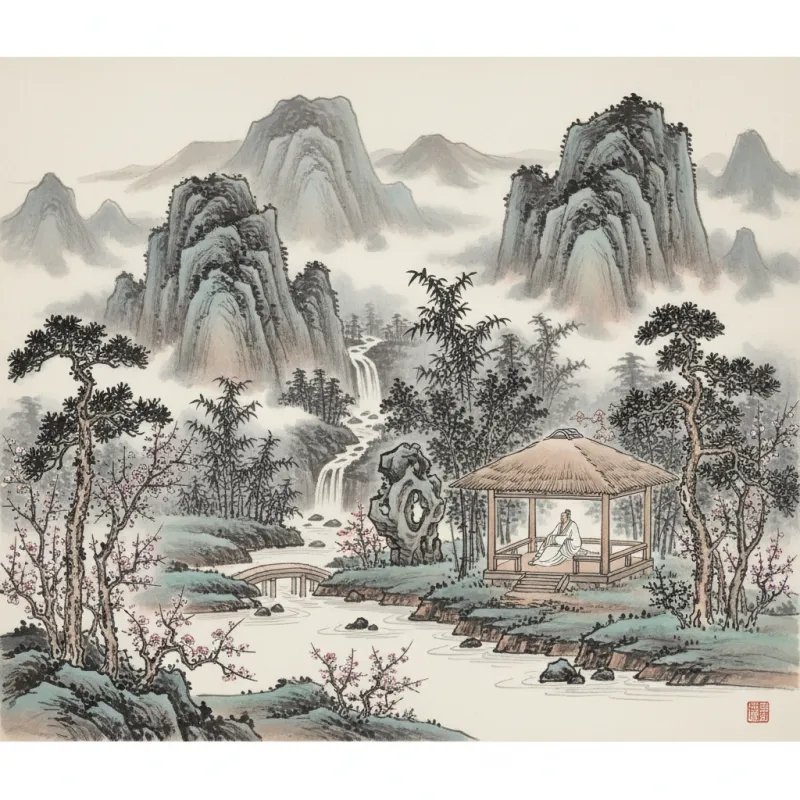
You're reading a Tang dynasty poem in English, and it's beautiful. The imagery flows, the emotions resonate, you feel something profound. Then someone who reads Chinese tells you: "That's not what it says." Not exactly. Not really. Not in the way that matters most. Welcome to the paradox every translator of Chinese poetry faces — the more faithful you are to the meaning, the further you drift from the experience.
What Makes Chinese Poetry Different
Chinese poetry doesn't just use a different language. It uses a different operating system for meaning itself. Where English builds sentences with grammar — subjects, verbs, objects marching in order — classical Chinese poetry strips away almost everything except the essential images. A line might be just four characters: "moon," "fall," "crow," "cry." No verb tense. No articles. No indication of who's doing what to whom. The reader assembles the scene from pure elements, like watching a film editor's raw footage before the cuts are made.
This compression creates what linguists call "semantic density" — more meaning packed into fewer syllables than almost any other poetic tradition. A single character can carry multiple layers: its literal meaning, its sound, its visual composition, and centuries of literary associations. The character 秋 (qiū, "autumn") doesn't just mean the season. It carries the weight of every poem ever written about autumn — melancholy, harvest, decline, the approach of winter, the scholar's loneliness. When Du Fu (杜甫 Dù Fǔ) writes 秋, he's not just setting a scene. He's activating an entire emotional frequency that Chinese readers recognize instantly.
English can't do this. Our words are too specific, too locked into grammatical roles. We have to choose: Do we translate 秋 as "autumn," "fall," "the autumn season," "in autumn"? Each choice narrows the meaning, forces a decision the original never made.
The Music You Can't Hear
Tang dynasty poetry was written to be heard, not just read. The tonal patterns of Mandarin — four distinct pitches that change a word's meaning — create a musical structure that's built into the language itself. Regulated verse (律詩 lǜshī) follows strict tonal patterns: level tones alternating with deflected tones in prescribed sequences, creating a rhythm as formal as a sonnet's meter but operating on pitch rather than stress.
When Li Bai writes "床前明月光" (chuáng qián míng yuè guāng), the tones rise and fall in a specific pattern: level-level-level-deflected-level. It's music before you even consider the meaning. English translations give you "Before my bed, the bright moonlight" — the sense is there, but the song is gone. We can approximate meter and rhyme, but we can't recreate the tonal melody because English doesn't use pitch to distinguish words. It's like trying to play a piano piece on a drum kit. You can keep the rhythm, but you've lost half the instrument.
Some translators try to compensate by creating elaborate rhyme schemes or metrical patterns in English. Arthur Waley avoided rhyme entirely, arguing that forced rhymes in English create a singsong effect that Chinese poetry never has. Ezra Pound went the opposite direction, creating dense, imagistic English that captures the compression if not the music. Both approaches work. Both fail. The original does something neither can reproduce.
Visual Poetry: Reading With Your Eyes
Chinese characters aren't just phonetic symbols. They're pictures, compressed and stylized, but pictures nonetheless. The character 林 (lín, "forest") is literally two trees 木木 standing together. When you see 森 (sēn, "dense forest"), you're looking at three trees. The meaning is visual before it's linguistic. Poets exploit this constantly, choosing characters not just for sound and sense but for how they look on the page.
Wang Wei (王維 Wáng Wéi), the great Tang dynasty poet-painter, composed poems that work as visual art. His famous line "明月松間照" (míng yuè sōng jiān zhào) — usually translated as "The bright moon shines between the pines" — contains the character 松, which shows a tree (木) that's "public" or "open" (公), suggesting the pine's distinctive spreading branches. The character itself looks like what it describes. This visual dimension disappears completely in alphabetic translation. We can describe what the characters look like, but we can't make English words embody their meanings the way Chinese characters do.
This matters more than you might think. Classical Chinese readers didn't just read poetry — they practiced calligraphy, copying poems in their own hand, feeling the brush strokes that create each character. The physical act of writing was part of experiencing the poem. Translation can't touch this dimension at all. It's like describing a sculpture to someone over the phone.
The Allusion Problem
Chinese poetry is built on a foundation of shared cultural knowledge so deep and specific that it functions as a second language. When a Tang poet mentions "Peach Blossom Spring" (桃花源 táo huā yuán), educated readers immediately think of Tao Yuanming's (陶淵明 Táo Yuānmíng) fourth-century story about a hidden utopia — and everything that story implies about escaping political corruption, the impossibility of return, and the gap between ideal and reality. The poet doesn't need to explain. The two words carry the entire story and its centuries of interpretation.
English poetry has allusions too, but nothing like this density. Chinese poets can reference historical events, philosophical concepts, earlier poems, legendary figures, and geographical locations — all in a single line — and expect readers to catch every reference. Du Fu's poetry is so allusion-dense that traditional Chinese editions include more commentary than original text, explaining references that even educated Chinese readers might miss.
Translators face an impossible choice: explain the allusions (breaking the poem's flow with footnotes longer than the poem itself) or leave them unexplained (rendering the poem incomprehensible). Some translators try to find English equivalents — replacing Chinese historical figures with Greek ones, for instance — but this creates a different poem, one that gestures toward Western culture rather than Chinese. The original's cultural specificity is precisely what makes it untranslatable. As explored in The Role of Historical Context in Understanding Tang Poetry, you can't separate the poems from the world that created them.
Grammar's Absence, Ambiguity's Presence
Classical Chinese poetry often omits subjects, objects, and verbs, leaving the reader to infer who's doing what. This isn't vagueness — it's deliberate ambiguity that allows multiple readings to coexist. Li Shangyin's (李商隱 Lǐ Shāngyǐn) poetry is famously "obscure" (朦朧 ménglóng), but the obscurity is the point. His poems shimmer with possible meanings, none definitively correct, all simultaneously valid.
English demands clarity. We need subjects and verbs. We have to choose whether a line describes the poet's action or observation, whether it's past or present, whether it's literal or metaphorical. The original doesn't choose. It holds all possibilities in suspension. Translation collapses this quantum state into a single classical outcome.
Consider the famous opening of Li Bai's "Quiet Night Thought": "床前明月光,疑是地上霜" (chuáng qián míng yuè guāng, yí shì dì shàng shuāng). Word by word: "bed-before-bright-moon-light, suspect-is-ground-on-frost." Is the moonlight before the bed or is the poet before the bed looking at moonlight? Is he currently suspecting or did he suspect? Is this a statement or a question? The Chinese doesn't say. English must decide. Every translation makes choices the original refuses to make.
What Survives Translation
Here's the surprising part: despite everything that's lost, something essential does survive. The core images, the emotional trajectory, the philosophical insight — these can cross languages. When Arthur Waley translates Wang Wei's "Deer Park" as "Empty hills, no man in sight / But voices, human voices, echoing," you're not getting the tonal music or the visual characters or the full weight of allusion. But you are getting the essential experience: solitude, the surprise of distant human presence, the interplay of emptiness and sound.
The best translations don't try to recreate what's impossible. They create equivalent experiences in English — poems that work as English poems while remaining faithful to the spirit of the original. This requires translators who are poets themselves, who understand that translation is recreation, not transcription. As discussed in Modern Approaches to Translating Classical Chinese Poetry, contemporary translators increasingly embrace this creative freedom.
Reading Translation as Its Own Art Form
Once you understand what's untranslatable, you can read translations differently — not as failed originals but as successful interpretations. Compare multiple translations of the same poem and you'll see different translators making different choices, each revealing something the others miss. Burton Watson's translations emphasize clarity and directness. David Hinton's versions are more imagistic and compressed. Red Pine includes extensive historical and Buddhist context. Each approach illuminates different facets of the original.
The untranslatability of Chinese poetry isn't a problem to solve. It's a condition to accept and work within. Every translation is a compromise, but compromise isn't failure — it's the only way to build bridges between languages that operate on fundamentally different principles. The beauty that gets lost in translation is real. But so is the beauty that survives, transformed but recognizable, like moonlight reflected in water. Not the moon itself, but still luminous. Still worth looking at. Still capable of moving you, even if you can't read a single character of Chinese.
Related Reading
- Translating Chinese Poetry: Why Every Translation Is Wrong (And Why That Is Fine)
- Best English Translations of Tang Poetry: A Comparative Guide
- AI vs. Human Translation of Chinese Poetry: A 2024 Comparison
- Ezra Pound and Chinese Poetry: Beautiful Mistakes
- Exploring the Depths of Chinese War Poetry from Tang to Yuan Dynasties
- Exploring Chinese Classical Poetry: Tang, Song, and Yuan Poets’ Literary Legacy
- Buddhist Poetry in Chinese Literature: Enlightenment in Twenty Characters
Explore Chinese Culture
- Explore the Tang dynasty's golden age
- Explore Daoist themes in classical poetry
- Explore Chinese literary traditions