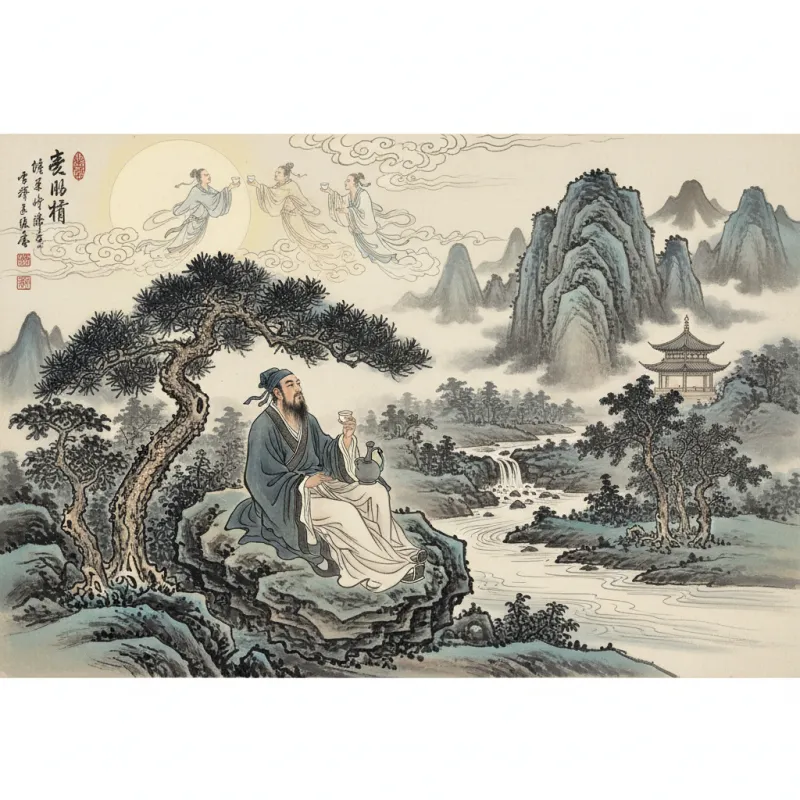
Picture this: It's 742 CE, and the most celebrated poet in the Tang Empire is face-down drunk in the imperial garden, having just insulted the most powerful eunuch in China. The emperor's favorite concubine is laughing. The court officials are scandalized. And Li Bai? He's composing verses that will outlive the dynasty itself. This wasn't rock-star behavior — this was a deliberate philosophical stance, a rejection of Confucian sobriety in favor of something wilder, more Daoist, more true.
Wine as Gateway to the Authentic Self
Li Bai didn't drink to escape reality. He drank to access it. In Tang Dynasty China, where every gesture was choreographed by ritual and every word weighed for political implication, wine offered a socially acceptable excuse to speak truth. The concept of jiujie (酒解 jiǔjiě) — "wine explanation" — meant that anything said while drunk could be forgiven, creating a narrow window of authentic expression in an otherwise suffocating court culture.
His most famous drinking poem, "Drinking Alone Beneath the Moon" (月下独酌 Yuè Xià Dú Zhuó), opens with a scene of radical solitude: "Among the flowers, a jug of wine / I pour alone, no friend in sight." But then he invites the moon and his shadow to join him, creating a party of three from nothing. This isn't loneliness — it's self-sufficiency elevated to cosmic proportions. The moon becomes his drinking companion, his shadow his dance partner. He's not drowning sorrows; he's manufacturing joy from moonlight and imagination.
The poem's genius lies in its refusal of self-pity. Where a lesser poet might wallow in isolation, Li Bai transforms it into a celebration. By the end, he's making plans to meet the moon again in the Milky Way — treating the cosmos itself as his local tavern. This is drinking as creative act, as world-building, as a way of populating emptiness with meaning.
The Hundred Poems, Hundred Cups Philosophy
The Tang Dynasty drinking culture had a specific term for Li Bai's approach: dou jiu shi bai pian (斗酒诗百篇 dǒu jiǔ shī bǎi piān) — "a dou of wine, a hundred poems." A dou was roughly ten liters. The math here is important: Li Bai's contemporaries believed his creative output was directly proportional to his alcohol intake. His friend Du Fu immortalized this in "Eight Immortals of the Wine Cup," writing that Li Bai could produce a hundred poems after a single dou of wine, and that he'd sleep in a wine shop in the capital, refusing even the emperor's summons.
This wasn't hyperbole for entertainment. It was a documented creative method. Li Bai genuinely believed that wine dissolved the barriers between the mundane and the transcendent. In Daoist terms, it helped achieve wuwei (无为 wúwéi) — effortless action, the state where the self gets out of the way and lets the Dao flow through. His poems written while drunk have a spontaneity, a lack of artifice, that his sober contemporaries couldn't match even with careful revision.
Compare this to the Confucian ideal of moderation in all things. The Analects explicitly warn against excessive drinking. But Li Bai was fundamentally a Daoist poet operating in a Confucian world, and his drinking was part of that rebellion. When he writes "I wake, we make love together / Drunk, each goes his own way," he's not just describing a drinking session with the moon — he's articulating a philosophy of non-attachment that would make any Buddhist monk nod in recognition.
Immortality Through Intoxication
The connection between wine and immortality runs deep in Chinese mythology. The Eight Immortals themselves were famous drinkers, and the peaches of immortality were said to be fermented into celestial wine. Li Bai tapped into this tradition deliberately, positioning himself not as a mortal poet but as a potential immortal who'd simply chosen to spend his time on earth drinking.
In "Waking from Drunkenness on a Spring Day," he writes: "Heaven and earth — the inn of all things / Time itself — the traveler of a hundred generations." This is drinking as existential philosophy. If we're all just temporary guests at the universe's tavern, why not enjoy the wine? The poem continues: "And this floating life is like a dream / How much joy can we get?" It's a question that doesn't expect an answer because Li Bai is already demonstrating the answer: this much joy, right here, in this cup, under this moon.
The immortality theme reaches its peak in poems where Li Bai explicitly identifies with the wine immortals. He's not aspiring to join them someday — he's claiming membership now. When he writes "I was originally a person from the wine stars," he's not being metaphorical. In his cosmology, he literally descended from the celestial realm of drinking immortals, and wine is how he maintains contact with his true home.
This connects to the broader Tang Dynasty fascination with Daoist immortality practices, where alcohol was sometimes used in alchemical preparations meant to extend life. Li Bai wasn't interested in the literal alchemy, but he understood the symbolic power: wine as a substance that transforms the ordinary into the extraordinary, the mortal into the immortal, the mundane moment into eternal poetry.
The Moon as Drinking Companion
Li Bai mentions the moon in roughly a quarter of his poems, and in his drinking poems, it's almost always present. This isn't decorative imagery. The moon represents everything wine helps him access: beauty, distance, reflection, transformation, the eternal cycle of waxing and waning that mirrors the cycle of sobriety and intoxication.
In "Asking the Moon with a Wine Cup," he writes: "When did the moon first appear in the sky? / I stop drinking now to ask." The poem is structured as a conversation with the moon about time, mortality, and the nature of beauty. But notice: he stops drinking to ask the question. The implication is that drinking is what prompted the question in the first place. Wine opens the door to cosmic inquiry; sobriety is what allows him to articulate it.
The moon also serves as a mirror for his own solitude. Unlike the sun, which illuminates everything equally, the moon is selective, intimate, personal. When Li Bai drinks with the moon, he's drinking with an aspect of himself — the part that's distant, cool, reflective, untouchable by the chaos of court politics and human disappointment. The moon never judges, never disappoints, never dies. It's the perfect drinking companion for a poet who found most humans inadequate company.
This lunar obsession distinguishes Li Bai from other Tang Dynasty drinking poets. While Wang Wei's wine poems focus on landscape and Buddhist detachment, Li Bai's are cosmic and Daoist, always reaching upward toward the moon, the stars, the realm of immortals. His drinking doesn't ground him in earthly reality — it launches him into the heavens.
Friendship, Farewell, and the Floating Cup
Not all of Li Bai's drinking was solitary. His poems about drinking with friends reveal another dimension: wine as the medium of connection, the substance that makes genuine friendship possible in a world of political alliances and strategic relationships. When he writes about drinking with fellow poets like Du Fu or Meng Haoran, the wine creates a temporary utopia where status doesn't matter and truth can be spoken.
The floating cup (流觞 liúshāng) tradition — where wine cups were floated down a stream and whoever the cup stopped in front of had to drink and compose a poem — appears in several of Li Bai's works. This wasn't just a drinking game; it was a way of surrendering control, letting chance and nature determine the evening's course. Very Daoist. Very Li Bai.
His farewell poems often feature wine as both comfort and catalyst for honest emotion. "Seeing Meng Haoran Off to Guangling from Yellow Crane Tower" includes the famous image of his friend's boat disappearing into the distance while Li Bai presumably stands on the shore with a wine cup, watching until there's nothing left but the Yangtze River flowing east. The wine doesn't numb the sadness of parting — it intensifies it, makes it beautiful, transforms it into art.
These drinking-with-friends poems reveal that Li Bai's philosophy wasn't about isolation but about authentic connection. Wine didn't separate him from others; it separated him from the false self that court life demanded. With the right companions and enough wine, he could be who he actually was: brilliant, irreverent, generous, melancholy, wild.
The Dark Side Nobody Talks About
Here's what the traditional scholarship glosses over: Li Bai's drinking probably killed him. The most credible accounts of his death involve him drunkenly trying to embrace the moon's reflection in the Yangtze River and drowning. Even if that's apocryphal (and it probably is), the fact that it's the most famous version of his death tells you something about how his contemporaries saw him.
His career was destroyed by drinking. That incident in the imperial garden? It got him permanently expelled from court. His most powerful patron, the Daoist princess Yuzhen, eventually gave up on him because he was too unreliable. He spent the last decades of his life wandering from patron to patron, increasingly broke, increasingly drunk, increasingly brilliant but also increasingly unemployable.
The poems don't show this decline. They maintain their joy, their cosmic perspective, their refusal of self-pity right up to the end. But read between the lines and you can see it: the increasing frequency of poems about being misunderstood, about the world not recognizing true talent, about preferring wine to human company. These aren't just philosophical positions — they're rationalizations of a life that didn't work out the way it should have.
Does this undermine the beauty of the poems? Not at all. If anything, it makes them more remarkable. Li Bai maintained his vision of wine as transcendence even as it was destroying him. He never broke character, never admitted that maybe the Confucians had a point about moderation. He died as he lived: drunk, reaching for the moon, absolutely convinced that this was the right way to be human.
Why Li Bai's Drinking Poems Still Matter
We live in an age of wellness culture, of mindful drinking, of apps that track your alcohol intake and congratulate you for sober days. Li Bai would have hated all of it. His drinking poems are a corrective to our contemporary obsession with optimization and self-improvement. They insist that some experiences are worth the cost, that transcendence sometimes requires excess, that the moon is more important than your liver function.
But they're not an endorsement of alcoholism. They're an endorsement of intensity, of refusing to live a diminished life, of choosing beauty and truth over safety and longevity. The wine is just the method. The real subject is how to be fully alive in a world that constantly demands you be less than you are.
Modern readers often approach classical Chinese drinking poetry as quaint historical artifact, but Li Bai's poems resist that domestication. They're still dangerous, still excessive, still insisting that the proper response to existence is not careful management but wild celebration. Pour a cup, look at the moon, write a poem, make a fool of yourself, die young, leave a beautiful corpse of verses that will outlive empires.
That's not advice. That's not a lifestyle recommendation. But it's a reminder that there are other ways to be human than the ones our culture currently endorses. Li Bai drank like he meant it, lived like he meant it, wrote like he meant it. Fifteen hundred years later, we're still reading his poems, still moved by his moon, still wondering if maybe he was right about everything.
Related Reading
- Drinking Poetry: Why Chinese Poets Wrote Their Best Work Drunk
- Wine Poetry: The Chinese Tradition of Drinking and Writing
- Unraveling the Essence of Drinking Poetry in Tang, Song, and Yuan Eras
- Drinking Poetry: Wine, Moonlight, and the Art of Getting Drunk with Purpose
- Poetry Drinking Games: When Literature Met Entertainment
- How to Read Chinese Poetry: A Guide for English Speakers
- The Resonance of War in Chinese Classical Poetry: Analyzing Tang, Song, and Yuan Poets
- The Art of Nature in Tang, Song, and Yuan Dynasty Poetry: A Literary Exploration
Explore Chinese Culture
- Explore the Tang dynasty's golden age
- Explore Daoist themes in classical poetry
- Explore Chinese literary traditions