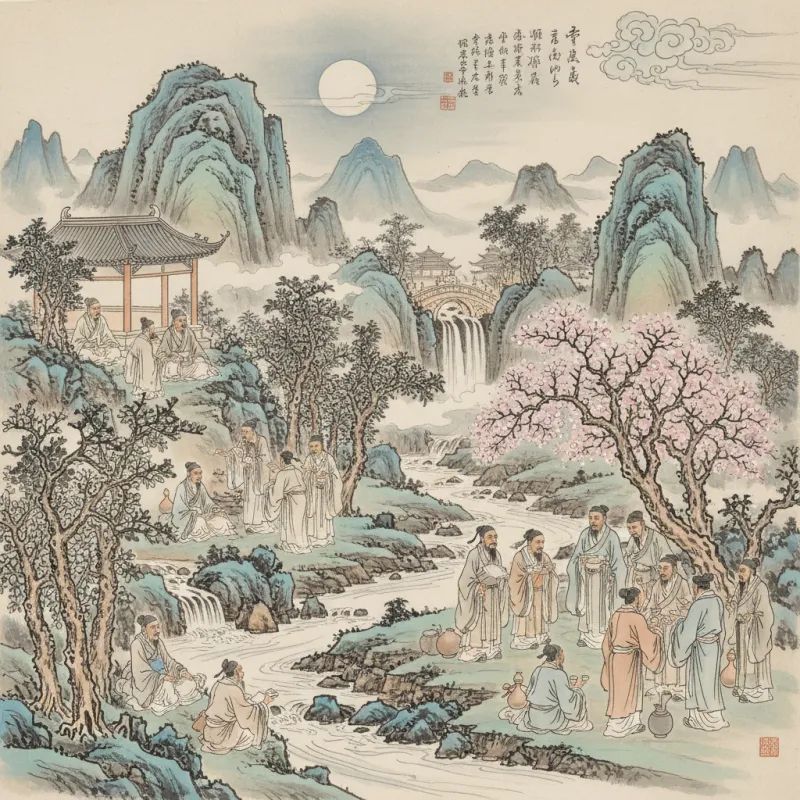
Picture this: Li Bai, already three cups deep into Shaoxing wine, stands on a moonlit riverbank and declares he sees three moons—one in the sky, one in the water, and one in his cup. Rather than stumbling home in disgrace, he pens "Drinking Alone Under the Moon" (月下獨酌, yuè xià dú zhuó), a poem that would echo through thirteen centuries. This wasn't drunken rambling. This was jiǔ shī (酒詩)—drinking poetry—where wine became the catalyst for China's most profound literary revelations.
When Wine Met Words: The Tang Dynasty Revolution
The Tang dynasty (618-907 CE) didn't invent drinking poetry, but it perfected it into an art form that subsequent dynasties could only imitate. What made Tang drinking poetry revolutionary wasn't just the quantity—though Li Bai alone left us over 170 wine-soaked verses—but the philosophical depth these poets achieved while allegedly intoxicated.
The jiǔ lìng (酒令) or drinking games of Tang banquets created a unique literary pressure cooker. Imagine: you're at a gathering in Chang'an, the wine is flowing, and suddenly you must compose a poem on the spot or drink a penalty cup. This wasn't casual entertainment. These gatherings included the empire's brightest minds—officials, scholars, monks—all competing to craft the most memorable verse. Du Fu's "Eight Immortals of the Wine Cup" (飲中八仙歌, yǐn zhōng bā xiān gē) immortalized these legendary drinkers, describing how Zhang Xu would create his wildest calligraphy only after getting thoroughly drunk.
But here's what separates Tang drinking poetry from mere party tricks: these poets used intoxication as a lens for examining zìrán (自然)—the natural way of things. When Li Bai wrote "Life in the World is but a Big Dream; I will not spoil it by any labor or care," he wasn't advocating alcoholism. He was articulating a Daoist philosophy where wine dissolved the artificial barriers between self and cosmos. The drink wasn't the point; the liberation was.
The Song Dynasty's Sober Second Thought
By the Song dynasty (960-1279 CE), drinking poetry had evolved from Tang exuberance into something more introspective, almost melancholic. If Tang poets drank to celebrate life's abundance, Song poets drank to cope with its disappointments.
Su Shi (蘇軾), perhaps the Song's greatest poet, exemplifies this shift. His "Prelude to Water Melody" (水調歌頭, shuǐ diào gē tóu) written during the Mid-Autumn Festival while drunk and missing his brother, asks: "When will the moon be clear and bright? / With a cup of wine in my hand, I ask the blue sky." The wine here isn't a gateway to transcendence—it's a companion to loneliness. Su Shi had been exiled, politically sidelined, separated from family. His drinking poetry reflects the Song literati's frequent frustrations with court politics and the precariousness of official life.
The Song also saw the rise of cí (詞) poetry, a more musical and flexible form than the rigid shī (詩) of the Tang. Drinking songs in cí form, like those by Liu Yong (柳永), were performed in wine houses and entertainment quarters, bringing drinking poetry from elite banquets to urban taverns. This democratization changed the genre's character—less philosophical grandeur, more immediate emotional honesty about heartbreak, poverty, and the consolations of a good drink.
What's fascinating is how Song poets like Ouyang Xiu (歐陽修) began writing meta-poetry about drinking poetry itself. His "The Old Drunkard's Pavilion" (醉翁亭記, zuì wēng tíng jì) famously declares "The old drunkard's intention lies not in the wine, but in the mountains and rivers." This self-awareness—this acknowledgment that drinking poetry was really about everything except drinking—marked a sophisticated evolution in the genre.
Yuan Drama: When Drinking Poetry Left the Page
The Mongol-ruled Yuan dynasty (1271-1368 CE) disrupted everything about Chinese literary culture, including drinking poetry. With the traditional examination system suspended and Chinese scholars largely excluded from government, many literati turned to zájù (雜劇)—variety plays—as their creative outlet. Drinking poetry migrated from the written page to the theatrical stage.
Guan Hanqing's (關漢卿) plays frequently featured drinking scenes where characters revealed their true feelings through wine-loosened tongues. In "The Injustice to Dou E" (竇娥冤, Dòu É yuān), drinking scenes provide moments of dark comedy amid tragedy. The Yuan approach was earthier, more colloquial than Song refinement or Tang elegance. These weren't scholar-officials composing at moonlit banquets; these were displaced intellectuals writing for urban audiences who wanted entertainment with their philosophy.
The sànqǔ (散曲) form—a freer, more vernacular style of cí—became the vehicle for Yuan drinking poetry. Ma Zhiyuan's (馬致遠) "Autumn Thoughts" (天淨沙·秋思, tiān jìng shā·qiū sī) captures the era's melancholy: withered vines, old trees, crows at dusk, and a lonely traveler far from home. While not explicitly about drinking, it embodies the emotional landscape that drove Yuan literati to their cups—displacement, nostalgia, and the loss of the world they once knew.
The Philosophy in the Flask: What They Were Really Drinking To
Here's what modern readers often miss: Chinese drinking poetry was never really about alcohol. It was about jiè jiǔ jiāo chóu (借酒澆愁)—using wine to drown sorrows—but also jiè jiǔ xìng shī (借酒興詩)—using wine to inspire poetry. The drink was a tool, a social lubricant, a ritual object that marked the boundary between ordinary consciousness and poetic insight.
The recurring motifs tell the story. The moon appears constantly in drinking poetry—Li Bai's moon, Su Shi's moon, countless moons reflected in countless wine cups. Why? Because the moon represents what's simultaneously present and unreachable, beautiful and cold, constant yet ever-changing. It's the perfect metaphor for the human condition these poets were exploring. Understanding the symbolism of the moon in Tang poetry reveals layers of meaning modern readers might otherwise miss.
Similarly, the chrysanthemum flower (júhuā, 菊花) appears repeatedly in drinking poetry, especially around the Double Ninth Festival (重陽節, chóngyáng jié) when tradition called for drinking chrysanthemum wine. Tao Yuanming's (陶淵明) famous line "Picking chrysanthemums under the eastern fence, I gaze leisurely at the southern mountains" established the flower as a symbol of reclusive contentment—the life of someone who'd rejected official ambition for rural simplicity and good wine.
The Social Architecture of Drinking Verse
What's often overlooked is how drinking poetry functioned as social technology. These weren't solitary compositions—even Li Bai's "Drinking Alone" poems were paradoxically social, addressing the moon and his shadow as companions. The jiǔ huì (酒會) or drinking gathering was where relationships were forged, political alliances tested, and social hierarchies both reinforced and temporarily suspended.
The hé shī (和詩) tradition—writing poems in response to others' poems—turned drinking gatherings into collaborative literary events. One poet would compose a verse, and others would respond using the same rhyme scheme or thematic elements. This created chains of poems, conversations in verse that could span years and hundreds of miles. The art of poetic response in Song dynasty gatherings shows how these exchanges built literary communities.
The drinking game poems (jiǔ lìng shī, 酒令詩) had specific rules: compose within a time limit, incorporate specific words or themes, match particular rhyme schemes. These constraints, far from limiting creativity, often sparked it. The pressure of performance, the loosening effect of wine, the competitive atmosphere—all combined to produce some of Chinese literature's most memorable verses.
Why Drinking Poetry Still Matters
In our age of craft cocktails and wine influencers, Tang-Song-Yuan drinking poetry might seem quaint, a relic of pre-modern excess. But these poems address something timeless: how do we find meaning in transient pleasures? How do we connect with others across the gulf of individual consciousness? How do we face mortality, disappointment, and exile—whether literal or metaphorical?
The genius of Chinese drinking poetry lies in its refusal to moralize. These poets didn't condemn drinking or celebrate it uncritically. They used it as a lens for examining what it means to be human—social yet lonely, rational yet emotional, mortal yet yearning for transcendence. When Li Bai wrote "Since Heaven made my talent, let it be employed!" before calling for more wine, he wasn't being irresponsible. He was asserting that joy and creativity were legitimate responses to existence, even—especially—in a world that often seemed determined to crush both.
The progression from Tang exuberance through Song introspection to Yuan earthiness mirrors any thoughtful person's relationship with pleasure over a lifetime. First, the intoxication of discovery. Then, the complicated awareness of costs and consequences. Finally, a hard-won appreciation for simple joys amid difficult circumstances. The evolution of wine imagery across Chinese dynasties traces this emotional and philosophical journey.
Reading Drinking Poetry Today
Modern readers approaching these poems need to understand the cultural context. When a Tang poet writes about "three cups," he's not describing light drinking—Chinese wine cups were substantial, and the wine, while lower in alcohol than modern spirits, was consumed in quantity. The "drunkenness" described was real, not metaphorical.
Yet the poems themselves transcend their occasions. You don't need to be drunk—or even drink—to appreciate Su Shi's longing for his brother, Li Bai's cosmic loneliness, or Guan Hanqing's bitter humor. These poets used drinking as their subject, but their real topic was always the human heart in all its contradictions: seeking connection yet cherishing solitude, embracing joy while acknowledging sorrow, celebrating the moment while mourning its passage.
The best drinking poetry achieves what the best wine does: it transforms ordinary experience into something memorable, connects us to others across time and space, and reminds us that life's pleasures, however fleeting, are worth savoring. That's a tradition worth raising a cup to—whether it's filled with wine, tea, or just moonlight.
Related Reading
- Li Bai's Drinking Poems: Wine, Moon, and Immortality
- Poetry Drinking Games: When Literature Met Entertainment
- Drinking Poetry: Why Chinese Poets Wrote Their Best Work Drunk
- Wine Poetry: The Chinese Tradition of Drinking and Writing
- Drinking Poetry: Wine, Moonlight, and the Art of Getting Drunk with Purpose
- Delving into the Techniques of Chinese Classical Poetry: Insights from Tang, Song, and Yuan Poets
- Song Ci: The Lyrics That Broke Poetry's Rules
- The 10 Greatest Chinese Love Poems of All Time
Explore Chinese Culture
- Explore the Tang dynasty's golden age
- Explore Daoist themes in classical poetry
- Explore Chinese literary traditions