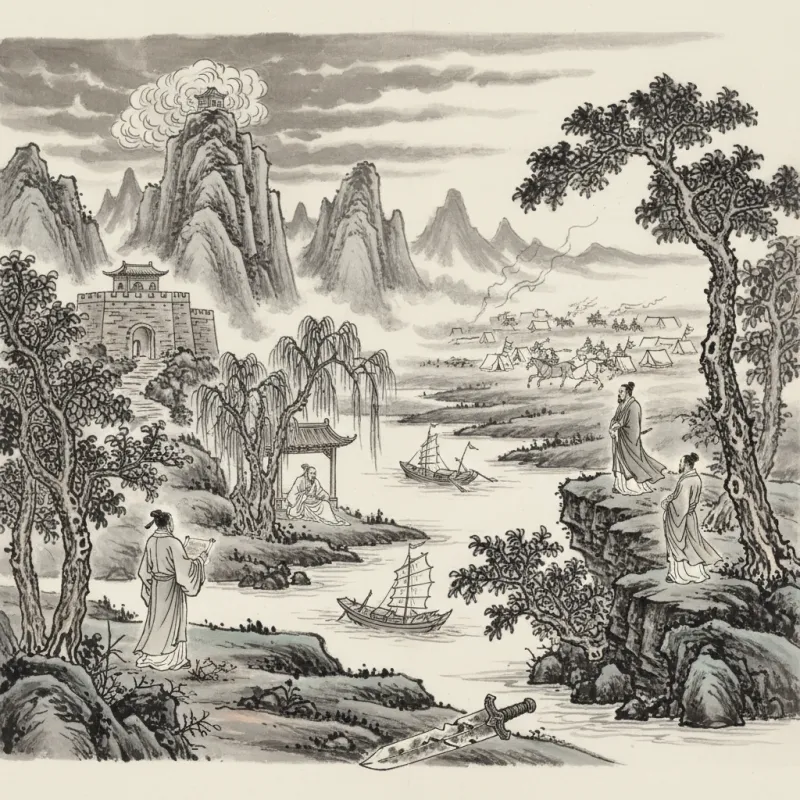
The battlefield stretches silent under moonlight, but in the poet's study, war thunders through every brushstroke. When Du Fu (杜甫, Dù Fǔ) wrote "A nation shattered, mountains and rivers remain" during the An Lushan Rebellion, he wasn't just documenting history—he was transforming catastrophe into art that would echo for over a millennium. Chinese classical poetry doesn't merely describe war; it dissects its psychological toll, questions its necessity, and preserves the voices of those crushed beneath its wheels.
The Tang Dynasty: When War Poetry Reached Its Apex
The Tang dynasty (618-907 CE) produced what many scholars consider the golden age of Chinese war poetry, and for good reason. This wasn't poetry written from comfortable distance—Tang poets like Cen Can (岑参, Cén Shēn) and Wang Changling (王昌龄, Wáng Chānglíng) actually served on the frontier, breathing the dust of military camps and witnessing combat firsthand. Their verses carry the weight of lived experience.
Cen Can's frontier poems (边塞诗, biānsài shī) stand out for their visceral imagery. In "Song of White Snow in Farewell to Field-Clerk Wu Going Home," he describes snow so thick it bends the bows of soldiers, creating an atmosphere where nature itself becomes an adversary as formidable as any human enemy. This wasn't romanticization—it was reportage elevated to art.
But the true genius of Tang war poetry lies in its emotional range. Wang Changling's "Out of the Frontier" captures the bitter irony of endless campaigns: "The bright moon of Qin, the passes of Han / Ten thousand li of征人 (zhēngrén, soldiers on campaign) have not yet returned." The poem's power comes from its restraint—no graphic violence, just the quiet devastation of absence stretching across generations. The same moon that shone on ancient dynasties now illuminates a present where young men still die far from home, and nothing has changed.
Du Fu: The Conscience of War Poetry
If Tang poetry represents war's golden age, Du Fu represents its conscience. Unlike poets who glorified military valor or focused on strategic victories, Du Fu turned his lens toward war's collateral damage—the common people ground up by forces beyond their control. His poem "Spring View" (春望, Chūn Wàng), written during the An Lushan Rebellion (755-763 CE), contains one of Chinese literature's most devastating couplets: "The nation broken, mountains and rivers remain / Spring in the city, grass and trees grow deep."
What makes Du Fu revolutionary isn't just his sympathy for the suffering masses—it's his refusal to separate personal grief from political catastrophe. In "Ballad of the Army Carts" (兵车行, Bīngchē Xíng), he records the wails of conscripts being dragged from their families, their parents clinging to them as they're marched away. This isn't abstract commentary; it's documentary poetry that names the human cost of imperial ambition. Du Fu understood something that many war poets miss: the real tragedy isn't the battle itself but the thousands of small destructions that ripple outward from it.
His influence on later poets cannot be overstated. When we examine the evolution of frontier poetry, Du Fu's humanitarian approach becomes the ethical standard against which all subsequent war poetry is measured.
Song Dynasty: War Poetry in an Age of Anxiety
The Song dynasty (960-1279 CE) inherited Tang's poetic traditions but faced a fundamentally different military reality. Constantly threatened by northern powers—first the Liao, then the Jin, and finally the Mongols—Song China lived under perpetual existential threat. This anxiety permeates Song war poetry, giving it a darker, more introspective quality than its Tang predecessor.
Lu You (陆游, Lù Yóu) embodies this shift. A fervent patriot who spent his life advocating for military campaigns to recover lost northern territories, Lu You wrote over 9,000 poems, many obsessed with China's military humiliation. His famous deathbed poem "Showing My Sons" pleads: "When the royal armies reconquer the Central Plains / Don't forget to tell your father at the family sacrifice." The pathos here is crushing—a man dying without seeing his nation restored, begging his children to remember him when victory finally comes. Spoiler: it never did during Song times.
What distinguishes Song war poetry is its self-awareness about poetry's limitations. Xin Qiji (辛弃疾, Xīn Qìjí), another patriotic poet-warrior, wrote ci (词, cí) poems—lyric verses set to music—that overflow with martial imagery and frustrated ambition. His "Broken Array" describes dreaming of military glory, only to wake up in his study, powerless and aging. Song poets understood that writing about war and actually fighting it were two very different things, and this tension between literary aspiration and political impotence gives their work a melancholic edge.
The Feminine Perspective: Li Qingzhao's War Witness
No discussion of Song war poetry is complete without Li Qingzhao (李清照, Lǐ Qīngzhào), whose work demonstrates that war's impact extends far beyond the battlefield. When the Jin dynasty invaded and forced the Song court to flee south in 1127, Li Qingzhao lost her home, her extensive library, and eventually her husband. Her later poems document war from a civilian woman's perspective—a viewpoint almost entirely absent from Tang poetry.
Her ci poem "Slow Slow Song" (声声慢, Shēngshēng Màn) doesn't mention war explicitly, but its atmosphere of desolation and irretrievable loss captures war's psychological aftermath better than any battle description could. The famous opening line—"Seeking, seeking, cold, cold, clear, clear, sad, sad, grieving, grieving"—uses repetition to create a sense of endless, circular suffering. This is what war looks like after the armies have moved on: empty rooms, scattered memories, and a life that can never be reassembled.
Yuan Dynasty: Conquest from the Other Side
The Yuan dynasty (1271-1368 CE) presents a fascinating inversion: for the first time, China was ruled by foreign conquerors—the Mongols. Yuan poetry about war often carries a strange duality, written by Chinese literati serving a Mongol court, describing campaigns that expanded an empire they both belonged to and felt alienated from.
Ma Zhiyuan (马致远, Mǎ Zhìyuǎn) and other Yuan poets developed the sanqu (散曲, sǎnqǔ) form—freer, more colloquial verses that could express ambivalence impossible in more formal genres. Their war poetry tends toward the philosophical, questioning the very meaning of conquest and empire. When your own nation has been conquered, celebrating military victory becomes complicated.
The Yuan period also saw increased interest in historical war narratives, particularly the Three Kingdoms period. This wasn't escapism—it was a way of processing contemporary powerlessness by examining past conflicts where Chinese heroes still won. The relationship between historical war narratives and poetry became increasingly complex during this era.
The Enduring Questions: What War Poetry Reveals
Across these three dynasties, certain questions recur with haunting consistency: Is military glory worth its human cost? Can poetry change political reality, or does it merely document suffering? What obligations do the powerful owe to those they send to die?
Tang poets often answered with stoic acceptance—war was terrible but necessary, and honor could be found in service. Song poets grew more skeptical, questioning whether their sacrifices achieved anything. Yuan poets, writing under foreign rule, sometimes wondered if Chinese military tradition had failed entirely.
But the most powerful war poems transcend their immediate historical context. When Du Fu writes about refugees fleeing conflict, he could be describing any war in any century. When Li Qingzhao captures the disorientation of losing everything familiar, she speaks to every displaced person throughout history. This universality explains why these poems, written centuries ago in a language most modern readers can't access without translation, still resonate today.
The Legacy: War Poetry's Modern Relevance
Chinese classical war poetry established templates that persist in modern Chinese literature and beyond. The tension between patriotic duty and humanitarian concern, the focus on war's impact on ordinary people, the skepticism about official narratives—these approaches feel remarkably contemporary.
What makes this body of work particularly valuable today is its refusal of simple narratives. These poets didn't write propaganda (though some tried). They wrote about confusion, moral ambiguity, and the gap between how war is supposed to work and how it actually unfolds. They understood that the soldier and the civilian, the victor and the defeated, all pay prices that victory parades never acknowledge.
Reading Tang, Song, and Yuan war poetry now, in our own age of ongoing conflicts, we find not answers but better questions. How do we honor sacrifice without glorifying violence? How do we remember wars without sanitizing their brutality? How do we write about suffering without exploiting it? Chinese classical poets grappled with these questions a millennium ago, and their struggles—preserved in verses that still cut deep—remind us that some human dilemmas never truly resolve. They just echo forward, waiting for each generation to wrestle with them anew.
Related Reading
- Du Fu's War Poems: Poetry as Witness to Catastrophe
- Patriotic Poetry in Chinese History: From Qu Yuan to Modern Times
- Frontier Poetry (边塞诗): War and Glory at the Empire's Edge
- War Poetry of the Tang Dynasty: Beauty in the Midst of Slaughter
- War Poetry of the Tang Dynasty: When Soldiers Became Poets
- The Timeless Elegance of Chinese Classical Poetry: Tang, Song, and Yuan Eras
- Unraveling the Essence of Drinking Poetry in Tang, Song, and Yuan Eras
- Ban Zhao: Scholar, Historian, Poet — The Woman Who Finished China's Greatest History
Explore Chinese Culture
- Explore the Tang dynasty's golden age
- Explore Daoist themes in classical poetry
- Explore Chinese literary traditions