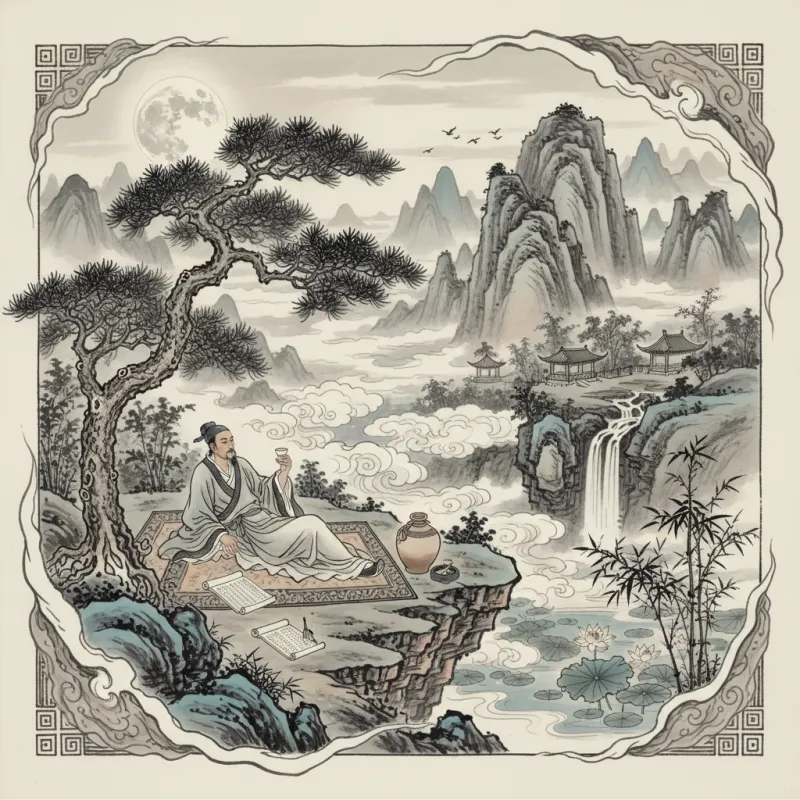
Picture this: It's 742 CE, and China's greatest poet is so drunk he can barely stand. Li Bai staggers toward the palace lake, reaches out to embrace the moon's reflection in the water, and—according to legend—drowns trying to hold it. Whether this story is true doesn't matter. What matters is that generations of Chinese readers found it perfectly plausible that their most celebrated poet would die drunk, chasing moonlight across water, mistaking beauty for something he could grasp.
This is drinking poetry (饮酒诗, yǐnjiǔ shī), and it's not about alcoholism. It's about a deliberate artistic practice where wine becomes the bridge between the mundane world and transcendent experience.
The Metaphysics of Getting Drunk
Chinese poets didn't drink to forget—they drank to remember what sober life made them forget. Wine dissolved the barriers between self and nature, between the poet and the cosmic patterns (道, dào) that governed everything. This wasn't recreational drinking. It was a technology for altered consciousness.
The Daoist philosopher Zhuangzi had already established the framework centuries before the Tang Dynasty. He wrote about "free and easy wandering" (逍遥游, xiāoyáoyóu), a state where the self dissolves into the natural flow of things. Wine was the shortcut. Three cups, and suddenly you weren't a frustrated bureaucrat stuck in a provincial posting—you were part of the wind, the moon, the eternal patterns of change.
Li Bai understood this better than anyone. In "Drinking Alone Beneath the Moon" (月下独酌, yuè xià dú zhuó), he doesn't just drink—he creates a cosmic drinking party. The moon becomes his companion, his shadow becomes his friend, and suddenly solitude transforms into a gathering that spans heaven and earth. "举杯邀明月,对影成三人" — "I raise my cup to invite the bright moon; facing my shadow makes us three." This is drinking as cosmology.
Wine as Social Rebellion
But there's a sharper edge to drinking poetry. In a Confucian society obsessed with hierarchy, ritual, and proper behavior, getting drunk was a form of resistance. The "Seven Sages of the Bamboo Grove" (竹林七贤, zhúlín qīxián) in the 3rd century made this explicit. They gathered in a bamboo forest, drank heavily, and openly mocked the political establishment. Ruan Ji (阮籍) would drink for days to avoid having to speak to officials he despised.
This tradition of drinking as refusal continued through the Tang Dynasty. When poets wrote about wine, they were often writing about freedom from social obligation. Tao Yuanming (陶渊明), who quit his government post to become a farmer and full-time drinker, wrote: "I built my hut in a zone of human habitation, yet near me there sounds no noise of horse or coach." Wine created a psychological space where the demands of career and status couldn't reach.
The connection between drinking and Poetry Drinking Games: When Literature Met Entertainment shows how this rebellious spirit became institutionalized into social practice. Even the games themselves were a way of using alcohol to temporarily suspend normal hierarchies.
The Technical Craft of Drunk Writing
Here's what's remarkable: these poets weren't just drinking and scribbling whatever came to mind. They were producing technically sophisticated verse while intoxicated. Li Bai's poems maintain perfect tonal patterns, complex allusions, and intricate parallelism—all while he was allegedly "drunk as mud" (醉如泥, zuì rú ní).
This suggests that the drunkenness was often performative or strategic. Du Fu's famous line "李白斗酒诗百篇" (Lǐ Bái dǒu jiǔ shī bǎi piān)—"Li Bai drinks a gallon and writes a hundred poems"—is clearly hyperbole. But it points to something real: the belief that wine could unlock a particular kind of creative fluency.
The poet Ouyang Xiu (欧阳修) from the Song Dynasty was more honest about the process. He described himself as the "Old Drunkard" (醉翁, zuì wēng) but admitted that his real pleasure wasn't the wine itself—it was the state of mind wine enabled. "醉翁之意不在酒,在乎山水之间也" — "The old drunkard's intention is not the wine, but the mountains and waters." Wine was the method, not the goal.
Moon, Wine, and Loneliness: The Holy Trinity
If you read enough Tang poetry, you'll notice the same three elements appearing together constantly: moon (月, yuè), wine (酒, jiǔ), and solitude (独, dú). This isn't coincidence—it's a deliberate aesthetic constellation.
The moon represents the unreachable, the beautiful, the eternal. Wine represents the temporary dissolution of boundaries. Solitude represents the authentic self, freed from social performance. Put them together, and you get the core experience of drinking poetry: a lone figure, cup in hand, gazing at the moon, experiencing a moment of connection with something vast and indifferent and beautiful.
Li Bai's "Drinking Alone Beneath the Moon" is the definitive example, but the pattern appears everywhere. Wang Wei (王维) writes: "独坐幽篁里,弹琴复长啸" — "Sitting alone in the dark bamboo, I play my zither and whistle long." Add wine to this scene, and you have the complete picture.
This aesthetic influenced The Hermit Poets: Drinking Alone in the Mountains, where solitary drinking became not just a poetic theme but a lifestyle choice.
The Dark Side: When Wine Stops Working
Not all drinking poetry is celebratory. Some of the most powerful poems in this tradition are about the failure of wine to deliver what it promises.
Bai Juyi (白居易) wrote extensively about drinking, but often with a note of desperation. In his later years, he describes drinking to numb physical pain and emotional disappointment. "把酒问月" becomes less about cosmic connection and more about trying to forget that you're old, sick, and far from home.
Li Shangyin (李商隐), the master of melancholy, wrote: "相见时难别亦难,东风无力百花残" — "Meeting is hard, parting is hard too; the east wind is powerless, a hundred flowers wither." He drinks, but the wine doesn't help. The beauty is still dying. The separation still hurts.
This is the other side of drinking poetry: the recognition that wine is a temporary solution to permanent problems. The moon is still unreachable. The exile is still an exile. The dead friend is still dead. Wine creates a moment of transcendence, but then morning comes.
The Legacy: Why This Still Matters
The drinking poetry tradition didn't end with the Tang Dynasty. It became a template for how Chinese intellectuals thought about the relationship between art, consciousness, and escape. Every subsequent dynasty produced its own drinking poets, each one aware they were participating in a tradition that stretched back centuries.
But the tradition also became a trap. By the Ming and Qing dynasties, drinking poetry had become so conventionalized that it sometimes felt like poets were just going through the motions—drinking because that's what poets did, writing about wine because that's what poetry required.
The real power of drinking poetry isn't in the alcohol. It's in the permission it gave poets to step outside normal consciousness and report back on what they found there. Li Bai didn't need wine to be a great poet—but wine gave him permission to write about embracing the moon, about becoming one with the mountains, about the cosmic loneliness of being human.
When he writes "天生我材必有用,千金散尽还复来" — "Heaven gave me talent, it must have use; a thousand gold pieces scattered will come back again"—he's drunk, yes. But he's also articulating a philosophy of radical self-trust that transcends the drinking. The wine is just the vehicle.
That's the real art of getting drunk with purpose: using altered consciousness not as an escape from meaning, but as a path toward it. Even if that path leads you, like Li Bai, to reach for the moon's reflection and find only water closing over your head.
Related Reading
- Li Bai's Drinking Poems: Wine, Moon, and Immortality
- Unraveling the Essence of Drinking Poetry in Tang, Song, and Yuan Eras
- Drinking Poetry: Why Chinese Poets Wrote Their Best Work Drunk
- Wine Poetry: The Chinese Tradition of Drinking and Writing
- Nature Poetry in the Tang Dynasty: Mountains, Rivers, and the Art of Seeing
- Poetic Forms: The Rules That Made Chinese Poetry Great
- Ezra Pound and Chinese Poetry: Beautiful Mistakes
Explore Chinese Culture
- Explore the Tang dynasty's golden age
- Explore Daoist themes in classical poetry
- Explore Chinese literary traditions