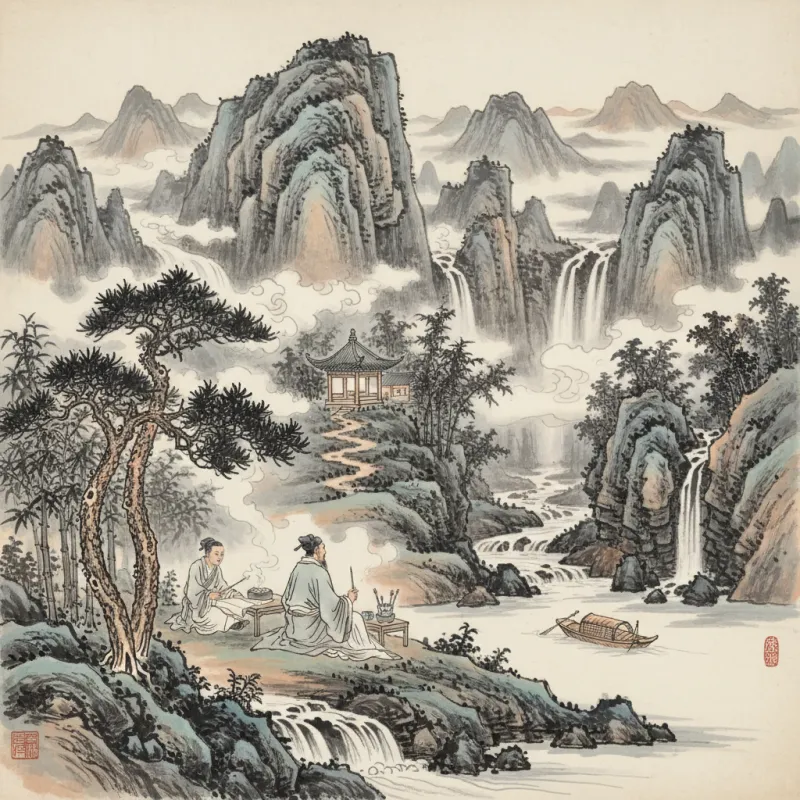
A single breath. Four lines. Twenty-eight characters. That's all a Tang Dynasty poet needed to capture moonlight on water, the ache of separation, or the weight of an empire's decline. While Western sonnets labored through fourteen lines and European haiku would later compress to three, Chinese poets of the 7th century had already perfected something in between—the jueju (絕句, juéjù), literally "cut-off lines," a form so sharp it could slice through pretension and land straight in the heart.
The Deceptive Simplicity of Four Lines
Don't let the brevity fool you. A jueju operates like a perfectly balanced equation where every character carries exponential weight. The standard form comes in two varieties: wujue (五絕, wǔjué) with five characters per line, and qijue (七絕, qījué) with seven. Do the math—that's either 20 or 28 characters total to convey what lesser poets might fumble through in paragraphs.
The structure follows strict tonal patterns inherited from regulated verse, with specific characters required to fall on level (ping, 平) or oblique (ze, 仄) tones. The second and fourth lines must rhyme, typically using level tones, while the first line may or may not participate in the rhyme scheme. This isn't arbitrary musicality—it's architectural. The tonal patterns create a rising and falling rhythm that mirrors natural speech while elevating it to something memorable, something that sticks in the mind like a melody you can't shake.
Two Couplets, One Vision
Think of a jueju as a diptych painting hinged in the middle. The first couplet (lines 1-2) typically establishes scene or situation—the "what" and "where." The second couplet (lines 3-4) delivers the emotional payload, the insight, the turn that makes the poem worth remembering. This pivot between couplets, called the "turn" (zhuan, 轉), is where competent poets become masters.
Take Wang Zhihuan's (王之渙) "Climbing Stork Tower" (登鸛雀樓), written around 700 CE. The first couplet describes the sun sinking into mountains and the Yellow River flowing to the sea—pure observation. Then the turn: "If you want to see a thousand miles further, climb one more story." Suddenly we're not talking about geography anymore. We're talking about ambition, perspective, the human drive to transcend limitations. Four lines, and you've got a philosophy of life.
The Tang Dynasty Laboratory
The jueju didn't spring fully formed from the void. Early examples appear in the Southern Dynasties (420-589 CE), but the form crystallized during the Tang Dynasty when poetry became the empire's obsession. Civil service examinations required poetic composition. Scholars traded verses like currency. Poetry wasn't a hobby—it was how educated people communicated, competed, and made sense of their world.
Li Bai (李白, 701-762) and Du Fu (杜甫, 712-770), the twin giants of Tang poetry, both excelled at jueju, though their approaches differed dramatically. Li Bai's jueju feel spontaneous, wine-soaked, touched by moonlight and madness. His "Quiet Night Thought" (靜夜思) remains the most memorized poem in Chinese—four lines about homesickness that every schoolchild knows. Du Fu's jueju carry more weight, more historical consciousness, the gravity of a man who lived through the An Lushan Rebellion and watched the empire crack.
What Gets Left Out Matters Most
Western readers often struggle with jueju because they're trained to expect explicit connections, clear transitions, spelled-out emotions. Chinese poetry works differently. The art lies in what's implied, the space between images where meaning crystallizes. This aesthetic principle, called "leaving blank" (liubai, 留白), borrowed from ink painting, trusts the reader to complete the circuit.
Wang Wei (王維, 699-759), the poet-painter, mastered this technique. His jueju read like minimalist landscapes—a few brushstrokes suggesting mountains, water, solitude. In "Deer Park" (鹿柴), he writes of empty mountains, no one in sight, yet returning voices echo. Then: sunlight enters the forest and shines on green moss. That's it. No explanation of what it means, no emotional signposting. Just images that somehow convey profound stillness, the presence of absence, the way light and sound can make emptiness feel full.
The Parallel Couplet Technique
Many jueju employ parallelism (duizhang, 對仗) between the two middle lines, creating a balanced structure that feels both natural and artfully constructed. The parallel lines mirror each other grammatically and semantically—noun matches noun, verb matches verb, image reflects image. This isn't mere decoration; it's a way of thinking, of seeing relationships between things.
Du Mu (杜牧, 803-852), a Late Tang master, used parallelism to devastating effect. His jueju about historical sites often juxtapose past glory with present decay, the parallel structure itself embodying the comparison. In poems about the fallen Tang capital, he'll place images of former splendor in one line and current desolation in the next, the grammatical symmetry highlighting the historical asymmetry.
Beyond the Tang: Evolution and Influence
The jueju didn't die with the Tang Dynasty. Song Dynasty (960-1279) poets continued the tradition, though they often favored the longer lyric meters that allowed more elaborate development. Yet even Song masters like Su Shi (蘇軾) returned to jueju when they wanted directness, immediacy, the punch of concentrated expression.
The form influenced Japanese poetry profoundly. While haiku gets more international attention, the jueju's impact on Japanese verse forms was substantial. The compressed imagery, the seasonal references, the trust in implication—these aesthetic principles migrated across the sea and took root in different soil.
Writing Your Own: The Impossible Made Possible
Can non-native speakers write authentic jueju? The tonal requirements alone present formidable obstacles—Mandarin has four tones, Cantonese has nine, and Classical Chinese pronunciation differs from both. Add the requirement for classical grammar, literary allusions, and cultural resonance, and you're looking at a form that takes decades to master in its original language.
Yet the principles translate. Try this: Write four lines. Make them imagistic rather than abstract. Create a turn between the second and third lines. Let the final line resonate rather than explain. Use concrete details that suggest larger meanings. Trust your reader. That's the spirit of jueju, even if the letter remains elusive.
The form endures because it matches something in human cognition—our ability to grasp complex ideas through juxtaposed images, to feel depth in brevity, to find the universal in the specific. Four lines. One breath. Everything that matters.
Related Reading
- Poetic Forms: The Rules That Made Chinese Poetry Great
- Modern Chinese Poetry: From Classical Forms to Free Verse
- Ci (词): The Song Lyrics That Became High Art
- Ci Poetry: When Poems Were Songs
- Poetic Forms in Chinese Literature: The Rules That Set Poetry Free
- Xin Qiji: The Warrior Poet Who Never Got His War
- The Timeless Art of Song Poets: A Deep Dive into Classical Chinese Poetry
- Poetry Drinking Games: When Literature Met Entertainment
Explore Chinese Culture
- Explore the Tang dynasty's golden age
- Explore Daoist themes in classical poetry
- Explore Chinese literary traditions