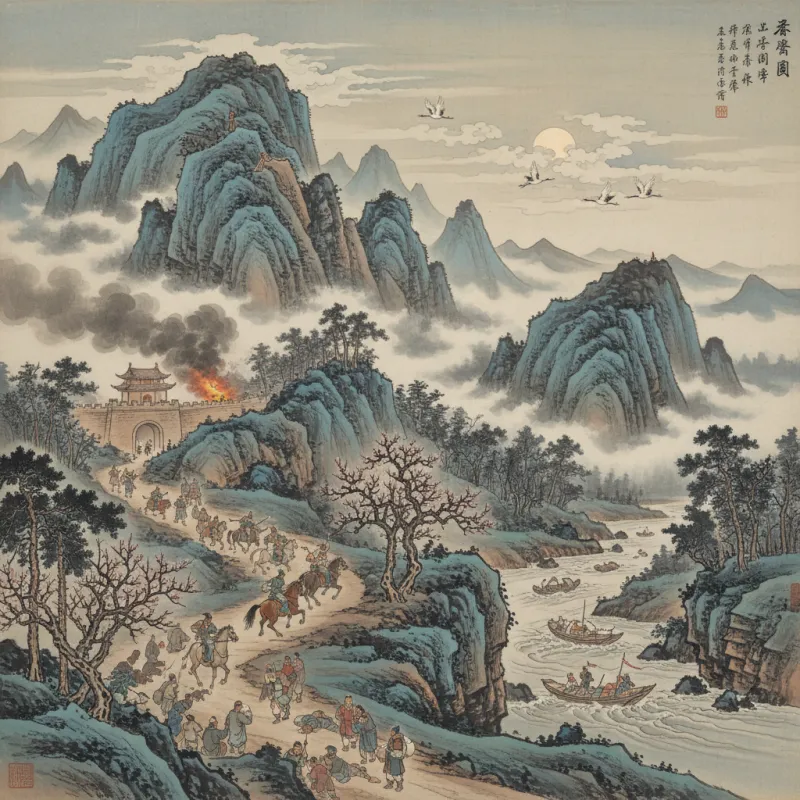
The year is 756. Chang'an, the glittering capital of the Tang Dynasty—home to a million souls, the largest city on earth—lies in ruins. Palace halls that once echoed with music now stand silent, their lacquered pillars blackened by fire. An elderly poet, forty-four years old and already feeling ancient, picks his way through the rubble. His name is Du Fu (杜甫, Dù Fǔ), and what he sees will transform Chinese poetry forever. The An Lushan Rebellion has shattered not just an empire, but the very notion that poetry should concern itself primarily with beauty, wine, and the moon.
When the World Collapsed: Understanding the An Lushan Rebellion
The An Lushan Rebellion (安史之乱, Ān Shǐ zhī Luàn, 755-763 CE) wasn't just another dynastic squabble—it was an apocalypse. General An Lushan, a corpulent frontier commander who had charmed his way into the imperial court's favor, launched his revolt in December 755 with an army of 200,000 battle-hardened troops. Within weeks, he had captured Luoyang. By June 756, Chang'an itself fell, and Emperor Xuanzong fled westward in disgrace, his beloved consort Yang Guifei strangled by his own guards along the way.
The numbers tell a grim story: China's population plummeted from approximately 53 million to 17 million during the rebellion years. Whether through direct violence, famine, disease, or displacement, the Tang Dynasty lost two-thirds of its registered population. Entire provinces were depopulated. The sophisticated tax system collapsed. The cosmopolitan confidence that had defined the High Tang era—when Li Bai's romantic poetry celebrated wine and wandering—evaporated like morning dew.
Du Fu experienced this catastrophe firsthand. Separated from his family, he was captured by rebel forces and held in occupied Chang'an for months. When he finally escaped to join the loyalist court in 757, he found his wife and children starving in a village north of the capital. His youngest son had died of hunger. This wasn't abstract suffering—it was personal, immediate, and it demanded a new kind of poetry.
Breaking with Tradition: Du Fu's Revolutionary Approach
Before Du Fu, Chinese war poetry followed predictable patterns. Poets wrote about frontier campaigns from a comfortable distance, romanticizing military glory or expressing genteel melancholy about separation. Even the yuefu (乐府, yuèfǔ) folk ballads that touched on soldiers' hardships maintained a certain aesthetic distance. Du Fu demolished these conventions.
His poem "Spring View" (春望, Chūn Wàng), written while imprisoned in Chang'an in 757, opens with a line that still stops readers cold: "The nation is broken; mountains and rivers remain" (国破山河在, guó pò shān hé zài). Notice what he does here—the natural world endures while human civilization crumbles. This inversion of the typical Chinese poetic hierarchy, which usually celebrated the permanence of culture, was radical. He continues: "The city turns to spring; grass and trees grow deep" (城春草木深, chéng chūn cǎo mù shēn). Spring, traditionally a season of renewal and joy in Chinese poetry, becomes sinister. The overgrown vegetation signals abandonment, not vitality.
The poem's emotional climax comes in its final couplet: "White hairs, scratched, grow even thinner; / Soon they'll no longer hold a hatpin" (白头搔更短, 浑欲不胜簪, bái tóu sāo gèng duǎn, hún yù bù shèng zān). Du Fu isn't just describing his aging—he's showing us a man literally falling apart from grief and anxiety. The hatpin detail is brilliant: in Tang China, a man's ability to properly pin his official cap was a marker of dignity and social standing. Du Fu can't even maintain this basic gesture of civilization.
The Common People's Poet: Witnessing Ordinary Suffering
What truly distinguishes Du Fu's war poetry is his relentless focus on common people. While other poets might mention peasant suffering in passing, Du Fu makes it his central subject. His "Three Officials" (三吏, Sān Lì) and "Three Partings" (三别, Sān Bié) series, written in 759 as he traveled through war-torn regions, reads like documentary reportage.
In "The Ballad of the Army Carts" (兵车行, Bīng Chē Xíng), he describes conscription with devastating specificity: "Carts rattle and squeak, / Horses snort and neigh, / Conscripts march, each with bow and arrows at his waist. / Fathers, mothers, wives, and children run to see them off; / Dust clouds are so thick they obscure the Xianyang Bridge." The poem then shifts to direct speech—a conscript's voice explaining how men are taken from age fifteen to forty, how fields lie fallow, how eastern provinces are reduced to thorns and brambles.
This technique—letting ordinary people speak in their own voices—was unprecedented in elite poetry. Du Fu wasn't summarizing their plight; he was channeling it. In "Recruiting Officer at Shihao Village" (石壕吏, Shí Háo Lì), he narrates a night when he witnessed officials dragging an old woman from her home to fill conscription quotas. Her sons are dead, her husband too old, her daughter-in-law recently widowed. She volunteers herself to cook for the army—anything to protect her remaining family. Du Fu doesn't editorialize. He simply reports what he saw, and the horror speaks for itself.
Technical Mastery in Service of Truth
Du Fu's war poems aren't just emotionally powerful—they're technically brilliant. He worked primarily in lüshi (律诗, lǜshī), the regulated verse form that demanded strict tonal patterns, parallelism, and rhyme schemes. Lesser poets might have found these constraints limiting when dealing with raw subject matter. Du Fu made them sing.
Consider "Moonlit Night" (月夜, Yuè Yè), written while separated from his family in 756. The poem imagines his wife in Fuzhou, looking at the same moon he sees from captivity in Chang'an. The middle couplets employ perfect parallelism: "Fragrant mist, cloud-like hair dampened; / Clear radiance, jade-like arms chilled" (香雾云鬟湿, 清辉玉臂寒, xiāng wù yún huán shī, qīng huī yù bì hán). The sensory details—dampness, coldness, the physical discomfort of standing outside too long—ground the cosmic image of the shared moon in bodily reality.
This is Du Fu's genius: he never sacrifices formal excellence for emotional authenticity, nor does he let technical virtuosity become mere display. Every formal choice serves the poem's truth. His use of caesura, his strategic placement of function words, his modulation between different registers of diction—all of it works to create poetry that feels simultaneously artful and urgent.
The Long Shadow: Du Fu's Influence on War Poetry
Du Fu's approach to war poetry created a template that Chinese poets would follow for the next millennium. When Song Dynasty poets confronted their own military crises, they looked to Du Fu's example. His insistence that poetry must engage with social reality, that technical mastery should serve moral witness, became foundational to the Confucian literary tradition.
But his influence extends beyond China. When modern readers encounter Du Fu's war poems in translation, they often compare him to Wilfred Owen or Siegfried Sassoon—World War I poets who similarly rejected romantic notions of military glory. The comparison is apt, though Du Fu preceded them by more than a thousand years. His "Ballad of the Firewood Carriers" (负薪行, Fù Xīn Xíng), which describes refugees reduced to gathering firewood in winter, could sit alongside Owen's "Dulce et Decorum Est" in its unflinching portrayal of war's human cost.
The Chinese critic and poet Huang Tingjian (黄庭坚, Huáng Tíngjian, 1045-1105) wrote that Du Fu "used poetry as history" (以诗为史, yǐ shī wéi shǐ). This phrase captures something essential: Du Fu's war poems aren't just artistic responses to historical events—they are themselves historical documents, preserving experiences that official chronicles often ignored or sanitized.
Reading Du Fu Today: Why These Poems Still Matter
In our own age of displacement and conflict, Du Fu's war poems feel uncomfortably contemporary. His description of refugees, his attention to how war destroys families and communities, his documentation of how ordinary people bear the costs of elite political failures—these themes haven't aged at all.
What makes Du Fu's poetry endure isn't just its historical importance or technical excellence. It's his fundamental humanity, his refusal to look away from suffering, and his insistence that poetry must bear witness to reality. When he writes in "Lament by the Riverside" (哀江头, Āi Jiāng Tóu) about the abandoned palace grounds where Emperor Xuanzong once strolled with Yang Guifei, he's not just mourning a dynasty's fall—he's mourning all the ways that human folly and ambition create suffering.
The An Lushan Rebellion eventually ended. The Tang Dynasty limped on for another century and a half. But China never fully recovered its pre-rebellion glory, and Du Fu never recovered his faith that the world was fundamentally ordered and just. His war poems are the record of that disillusionment, written with such skill and compassion that they transcend their historical moment to speak to anyone who has witnessed the gap between how the world should be and how it actually is.
Reading Du Fu's war poems today, we encounter a voice that refuses easy consolations, that won't prettify horror, but that also never quite surrenders to despair. In poem after poem, he documents catastrophe while simultaneously asserting, through the very act of writing, that human experience matters enough to be recorded, remembered, and mourned. That's not a small thing. In fact, it might be everything.
Related Reading
- The Complete Guide to Chinese Classical Poetry: From Tang Poems to Song Ci
- Bai Juyi: The People's Poet
- Li Bai's Drinking Poems: Wine, Moon, and the Soul of Chinese Poetry
- 10 Greatest Tang Poems Every Reader Should Know
- What Is Tang Poetry? A Complete Introduction for English Readers
- Exile Poetry: When Banishment Produced China's Greatest Literature
- Li Shangyin: Master of Romantic Ambiguity
- Regulated Verse (律诗): The Strictest Form in World Poetry
Explore Chinese Culture
- Explore the Tang dynasty's golden age
- Explore Daoist themes in classical poetry
- Explore Chinese literary traditions