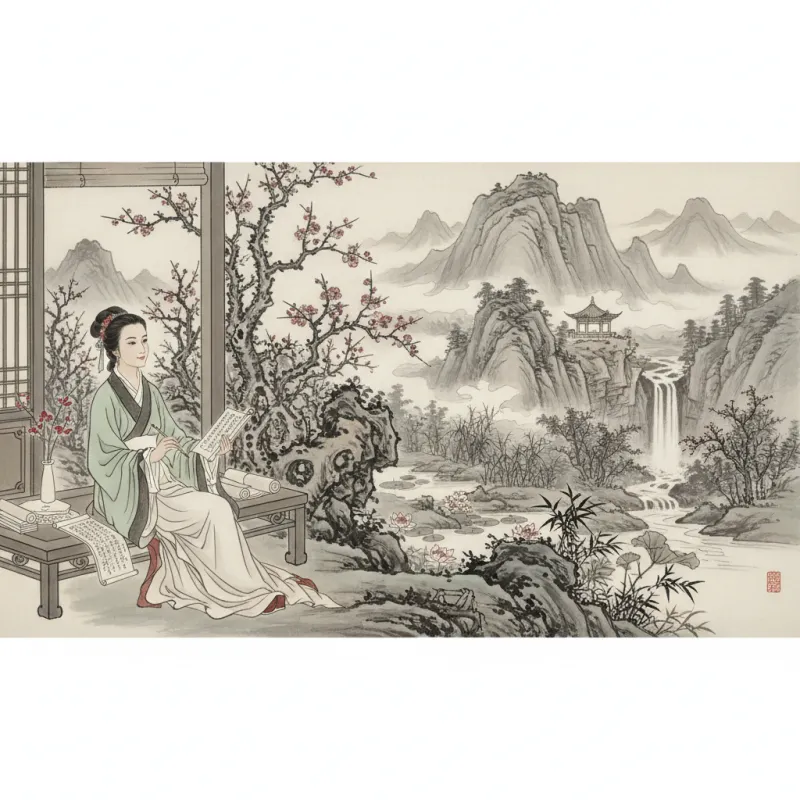
She won so much money gambling that her husband worried about her reputation. Li Qingzhao (李清照 Lǐ Qīngzhào, 1084-1155) didn't just write poetry — she wrote a technical manual on gambling strategy, drank wine in an era when respectable women weren't supposed to touch alcohol, and publicly eviscerated the most celebrated male poets of the Song Dynasty for their incompetence with ci (词 cí) lyric poetry. When her second marriage turned abusive, she divorced him, knowing full well that a woman initiating divorce in 12th-century China meant automatic imprisonment. She served the time. She considered it worth it.
This is China's greatest female poet: brilliant, competitive, uncompromising, and utterly unwilling to perform the demure femininity that later centuries tried to project onto her.
A Scholar's Daughter in the Golden Age
Li Qingzhao was born around 1084 in Jinan (济南 Jǐnán), Shandong province, into exactly the kind of family that produced intellectuals: her father Li Gefei (李格非 Lǐ Géfēi) was a prominent scholar connected to Su Shi's (苏轼 Sū Shì) literary circle, and her mother was the granddaughter of a prime minister. This wasn't just privilege — it was access to the books, the conversations, and the literary training that most women never received.
The Northern Song Dynasty (960-1127) was experiencing a cultural renaissance. The capital Kaifeng (开封 Kāifēng) was the largest city in the world, with over a million residents. Printing technology had made books more accessible. The civil service examination system meant that literary skill could translate into political power. And the ci form — originally entertainment songs from wine houses — was being elevated into serious poetry by masters like Su Shi and Zhou Bangyan (周邦彦 Zhōu Bāngyàn).
Li Qingzhao absorbed all of it. By her late teens, she was already known in literary circles for her poetry. When she married Zhao Mingcheng (赵明诚 Zhào Míngchéng) at eighteen, she married someone who shared her obsessions: he was an epigrapher and antiquarian, and together they would spend the next decades collecting ancient texts, bronze vessels, and stone inscriptions.
The Gambling Treatise Nobody Talks About
Here's what gets left out of the romantic narratives about Li Qingzhao: she was a serious gambler who wrote a technical treatise called "A Discourse on Shuanglu" (打马图经 Dǎmǎ Tújīng) about board game strategy. Shuanglu was a complex dice-and-board game, and Li Qingzhao didn't just play it — she analyzed it, systematized it, and wrote about it with the same intellectual rigor she brought to poetry.
She describes in her own writing how she and Zhao Mingcheng would gamble over their collection of books and antiquities. They'd compete to see who could remember the exact location of a passage in their library — which volume, which page, which line. The winner got to drink tea first. She usually won.
This matters because it reveals something essential about Li Qingzhao's character: she was competitive, analytical, and uninterested in pretending to be less intelligent than she was. The gambling treatise is lost now, but its existence tells us that she claimed authority in a male-dominated intellectual space without apology.
The Poetry of Happiness
Li Qingzhao's early poetry is full of wine, flowers, and unguarded joy. In one famous ci to the tune "Like a Dream" (如梦令 Rú Mèng Lìng), she writes about getting so drunk on a summer evening that she rows her boat into a lotus pond and startles the waterbirds into flight. There's no moralizing, no apology for the drinking, just the pure sensory pleasure of the moment.
Another poem describes her husband leaving for a trip. She writes about putting on makeup and asking him to send her a letter, then adds a line that's become famous: "I'm afraid the little boat at Twin Creek / Cannot carry so much sorrow" (只恐双溪舴艋舟,载不动许多愁 zhǐ kǒng shuāngxī zéměng zhōu, zài bù dòng xǔduō chóu). The image is hyperbolic, almost playful — her sorrow is so heavy it would sink a boat. This is love poetry that's emotionally direct without being sentimental.
What makes these early poems remarkable is their confidence. Li Qingzhao writes about her own experiences — her desires, her boredom, her hangovers — as worthy subjects for serious poetry. She uses the ci form, which was still considered somewhat lowbrow compared to classical shi (诗 shī) poetry, and she uses it better than almost anyone else.
The Catastrophe: The Fall of Kaifeng
In 1127, everything collapsed. The Jurchen Jin Dynasty invaded from the north, conquered Kaifeng, and captured the emperor. The Song court fled south, establishing a new capital in Hangzhou (杭州 Hángzhōu). This event — the Jingkang Incident (靖康之变 Jìngkāng Zhī Biàn) — split Chinese history into the Northern and Southern Song dynasties.
For Li Qingzhao and Zhao Mingcheng, it meant losing almost everything. They had spent decades building one of the finest private collections of antiquities in China. As they fled south, they had to abandon most of it. What they managed to transport was later lost to fire, theft, and the chaos of war. Zhao Mingcheng died in 1129, possibly of illness, possibly of shame after failing to defend a city under his administration.
Li Qingzhao was forty-five years old, widowed, and living as a refugee in a country that no longer existed in the form she'd known.
The Late Poetry: Sorrow Without Sentimentality
The poetry Li Qingzhao wrote after 1127 is different. The playfulness is gone, replaced by a grief that's almost unbearable in its clarity. In "Slow Slow Song" (声声慢 Shēng Shēng Màn), she writes:
"Searching, searching, seeking, seeking / Cold, cold, clear, clear / Sad, sad, sorrowful, sorrowful" (寻寻觅觅,冷冷清清,凄凄惨惨戚戚 xún xún mì mì, lěng lěng qīng qīng, qī qī cǎn cǎn qī qī).
The repetition creates a rhythm of obsessive searching that finds nothing. She's looking for something — her husband, her old life, her lost collection — but there's only emptiness. The poem ends with her unable to sleep, watching the rain and waiting for dawn.
What's remarkable is that Li Qingzhao never becomes maudlin. Her grief is specific: she misses the weight of a particular bronze vessel, the smell of a particular wine, the sound of her husband's voice discussing a particular inscription. This isn't abstract sorrow — it's the acute pain of losing irreplaceable things.
The Second Marriage Disaster
Around 1132, Li Qingzhao remarried. Her new husband, Zhang Ruzhou (张汝舟 Zhāng Rǔzhōu), was a minor official who apparently married her to get access to what remained of her collection. When she discovered he'd lied about his credentials and was abusive, she divorced him.
This required extraordinary courage. Song Dynasty law stated that a woman who accused her husband of a crime — even if the accusation was true — would be imprisoned for two years. A woman who initiated divorce faced automatic imprisonment. Li Qingzhao knew this and proceeded anyway. She gathered evidence of Zhang Ruzhou's fraud, presented it to the authorities, and got the marriage annulled.
She served nine days in prison before influential friends secured her release. She never remarried.
The Critical Writings: Taking Down the Masters
Li Qingzhao didn't just write poetry — she wrote literary criticism that's still studied today. Her "Afterword to Records on Metal and Stone" (金石录后序 Jīnshí Lù Hòuxù) is a memoir of her life with Zhao Mingcheng and their collection. But her most controversial work was her essay on ci poetry, where she systematically criticized the most famous poets of her era.
She argued that Su Shi, for all his genius, didn't really understand the musical requirements of ci. She said that even the great Zhou Bangyan sometimes got the tones wrong. She claimed that most male poets treated ci as a lesser form and didn't give it the technical attention it deserved.
This was audacious. Su Shi was the most revered literary figure of the age. For a woman — even one as accomplished as Li Qingzhao — to publicly criticize him was almost unthinkable. But she was right. Her understanding of ci prosody was more sophisticated than most of her male contemporaries, and she knew it.
The Legacy: Misremembering Li Qingzhao
Later centuries tried to domesticate Li Qingzhao. They emphasized her grief and her loyalty to her first husband. They downplayed the gambling, the drinking, the divorce, and the critical writings. They turned her into a symbol of feminine suffering — the tragic widow writing sad poems.
This is a profound misreading. Li Qingzhao's poetry is powerful not because she suffered, but because she refused to perform the kind of suffering that would make her acceptable. She wrote about her own experiences with an honesty that was almost confrontational. She claimed authority in spaces where women weren't supposed to have authority. She lived according to her own standards, even when it meant imprisonment.
Her ci poetry influenced every generation that followed. The Qing Dynasty poet Nalan Xingde (纳兰性德 Nàlán Xìngdé) studied her work obsessively. Modern scholars recognize her as one of the supreme masters of the ci form, male or female. Her technical innovations — particularly her use of colloquial language and her manipulation of tonal patterns — expanded what the form could do.
Why Li Qingzhao Still Matters
Reading Li Qingzhao today, what strikes you is how modern she feels. Not because she was ahead of her time — that's condescending — but because she wrote about human experiences that don't change: desire, loss, boredom, joy, the specific pain of losing irreplaceable things.
She also matters because she refused the bargain that patriarchal societies offer talented women: be exceptional, but not threatening. Be accomplished, but know your place. Li Qingzhao was threatening. She was better than most male poets at ci and she said so. She divorced an abusive husband when divorce was almost impossible. She drank, gambled, and wrote about both without shame.
The poetry survives because it's technically brilliant and emotionally devastating. But Li Qingzhao herself survives as a model of what it means to be uncompromising: to value your own intelligence, to refuse to make yourself smaller, to serve the jail time if that's what it costs to live according to your own standards.
She considered it worth it. Eight hundred years later, so do we.
Related Reading
- The 10 Greatest Chinese Love Poems of All Time
- Poems of Separation: The Chinese Art of Saying Goodbye
- Exploring Love in Chinese Classical Poetry: Tang, Song, and Yuan Poets’ Romantic Artistry
- Love Poetry in Classical Chinese: The Art of Saying Everything by Saying Almost Nothing
- Love Poetry in Chinese Literature: The Art of Saying Everything by Saying Nothing
- Du Fu's War Poems: Witnessing the An Lushan Rebellion
- Zen Koans in Poetry Form: When Chinese Verse Became a Riddle
- How to Read Chinese Poetry: A Guide for English Speakers
Explore Chinese Culture
- Explore the Tang dynasty's golden age
- Explore Daoist themes in classical poetry
- Explore Chinese literary traditions