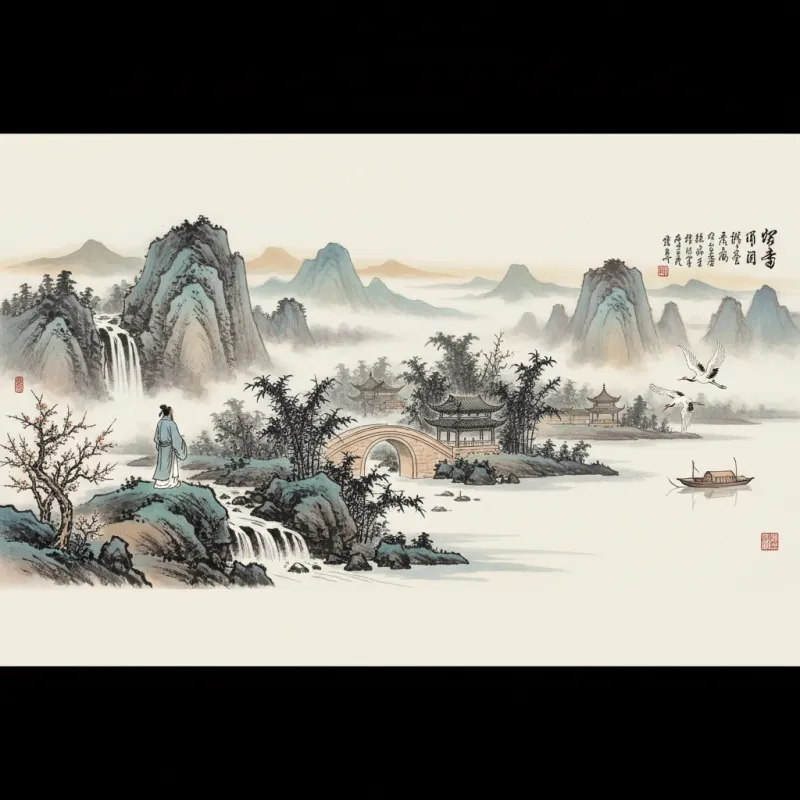
When Li Shangyin wrote "春蚕到死丝方尽" (chūn cán dào sǐ sī fāng jìn) — "The spring silkworm spins silk until death" — he wasn't being morbid. He was being erotic. The line appears in one of Chinese literature's most famous love poems, and it says nothing about love directly. Instead, it gives you a silkworm, the act of spinning, and the moment of death. The rest happens in your mind, where the best love poetry always lives.
The Radical Restraint of Chinese Love Poetry
Western love poetry tends toward declaration. "I love you" appears in countless variations across languages and centuries. Chinese love poetry does something stranger and more powerful: it removes the lover entirely, or nearly so, and replaces direct emotion with objects that carry emotional weight.
This isn't evasion. It's precision. When Du Fu (杜甫, 712-770) writes about his wife, he doesn't describe her beauty or profess his devotion. He shows her standing at the window, worrying about his safety during war. The emotion emerges from the image, not from the statement. The reader completes the circuit.
The technique has roots in the Shijing (诗经, Book of Songs), China's oldest poetry collection, compiled around 600 BCE. These folk songs established a vocabulary of natural imagery — willows for parting, lotus flowers for purity, mandarin ducks for marital fidelity — that would persist for three thousand years. But they also established something more fundamental: the principle that poetry works through suggestion rather than assertion.
Li Shangyin and the Art of Deliberate Obscurity
Li Shangyin (李商隐, 813-858) took indirection to its logical extreme. His love poems are so allusive, so layered with symbolism, that scholars still argue about their basic meaning. Take his most famous poem, "无题" (wú tí, "Untitled"):
相见时难别亦难
东风无力百花残
"Meeting is difficult, parting is difficult too / The east wind is powerless, a hundred flowers wither."
Is this about a forbidden love affair? A lost political opportunity? Both? Neither? Li Shangyin refuses to tell you. The poem continues with the silkworm line, then moves to candles burning down, then to a woman's reflection in her morning mirror, then to a mountain pass where immortals might dwell. Each image suggests longing, loss, devotion, separation — but the poem never confirms what kind of relationship it describes or whether the lovers ever meet again.
This ambiguity isn't a flaw. It's the point. By refusing to specify, Li Shangyin makes the poem applicable to any experience of longing. The reader brings their own losses, their own impossible loves, and finds them reflected in the poem's deliberately vague surface. As explored in The 10 Greatest Chinese Love Poems of All Time, this technique of meaningful ambiguity became a hallmark of the tradition.
The Vocabulary of Absence
Chinese love poetry developed a sophisticated system of coded imagery. These weren't arbitrary symbols — they emerged from shared cultural knowledge and literary tradition. A poet could invoke an entire emotional landscape with a single image.
The willow tree (柳, liǔ) appears constantly in parting poems because its name sounds like "to stay" (留, liú). Breaking a willow branch became a ritual gesture of farewell. When a Tang dynasty poet mentions willows, the reader immediately understands: someone is leaving, and someone else wants them to stay.
Mandarin ducks (鸳鸯, yuān yāng) always swim in pairs, so they represent marital devotion and fidelity. A poem showing separated mandarin ducks doesn't need to explain that it's about a broken marriage — the image does the work.
The empty bed, the cold pillow, the unshared blanket — these domestic objects appear repeatedly in poems about separation. They're more effective than any direct statement of loneliness because they're concrete. You can picture them. You can feel the cold.
What Gets Lost in Translation
The indirection of Chinese love poetry creates enormous translation problems. When you render "春蚕到死丝方尽" as "The spring silkworm spins silk until death," you lose the pun: 丝 (sī, silk) sounds identical to 思 (sī, longing/thought). The line simultaneously describes a silkworm's life cycle and declares that the speaker's longing will continue until death. English can't do both at once.
Similarly, the famous line "衣带渐宽终不悔" (yī dài jiàn kuān zhōng bù huǐ) — "My belt grows looser, yet I feel no regret" — loses its impact in translation. In Chinese, the loosening belt immediately suggests weight loss from lovesickness, a conventional sign of romantic suffering. The English reader might just think the speaker needs a new belt.
These aren't just linguistic quirks. They're fundamental to how the poetry works. Chinese love poetry relies on a shared cultural vocabulary that allows poets to say everything while saying nothing directly. Translation necessarily makes the implicit explicit, which changes the emotional effect.
The Modern Inheritance
Contemporary Chinese poets still work within this tradition of indirection, though they've adapted it to modern contexts. Gu Cheng (顾城, 1956-1993) wrote: "黑夜给了我黑色的眼睛 / 我却用它寻找光明" (hēi yè gěi le wǒ hēi sè de yǎn jīng / wǒ què yòng tā xún zhǎo guāng míng) — "The dark night gave me dark eyes / Yet I use them to seek light." It's not explicitly a love poem, but it uses the same technique: an image that carries emotional weight without direct statement.
The tradition also influenced modern Chinese fiction. Eileen Chang's (张爱玲) love stories rarely feature declarations of love. Instead, characters reveal their feelings through gestures, silences, and the objects they notice. Her famous line "于千万人之中遇见你所要遇见的人" (yú qiān wàn rén zhī zhōng yù jiàn nǐ suǒ yào yù jiàn de rén) — "Among thousands of people, you meet the one you're meant to meet" — describes love without using the word.
Why Indirection Works
Direct statement of emotion can feel reductive. When you say "I love you," you've named the feeling, but you haven't conveyed its texture, its specific quality, what makes this love different from any other. Chinese love poetry understood that emotion is better shown than told.
The willow branch, the mandarin duck, the silkworm spinning silk — these images don't just represent feelings. They embody them. They give the reader something concrete to hold onto, something that exists in the physical world. The emotion emerges from the interaction between image and reader, which makes it feel discovered rather than imposed.
This technique also creates emotional distance that paradoxically increases intimacy. By not stating feelings directly, the poet invites the reader to complete the emotional circuit. You have to work to understand what's being said, and that work makes the emotion yours. You're not just receiving someone else's feelings — you're generating them yourself through the act of reading.
The Unspoken as Technique
The greatest achievement of Chinese love poetry isn't what it says — it's what it doesn't say. The gaps, the silences, the refusal to explain. Li Shangyin's "Untitled" poems remain powerful precisely because they're unclear. They preserve the mystery that direct statement would destroy.
This connects to broader principles in Chinese aesthetics. In painting, empty space is as important as brushstrokes. In poetry, what's left unsaid is as important as what's written. The technique appears across forms, as discussed in Understanding Classical Chinese Poetry Forms.
When Li Shangyin writes about silkworms and candles, he's not avoiding the subject of love — he's approaching it from an angle that allows him to say more than direct statement ever could. The indirection isn't a limitation. It's the entire point. It's how you say everything by saying nothing at all.
Related Reading
- The 10 Greatest Chinese Love Poems of All Time
- Li Qingzhao: China's Greatest Female Poet
- Love and Longing in Chinese Classical Poetry: Tang, Song, and Yuan Dynasties Explored
- Exploring Love in Chinese Classical Poetry: Tang, Song, and Yuan Poets’ Romantic Artistry
- Poems of Separation: The Chinese Art of Saying Goodbye
- Du Fu's War Poems: Poetry as Witness to Catastrophe
- Unraveling Themes in Chinese Classical Poetry: Insights from Tang, Song, and Yuan Dynasties
- Women Poets of China: The Voices That History Almost Silenced
Explore Chinese Culture
- Explore the Tang dynasty's golden age
- Explore Daoist themes in classical poetry
- Explore Chinese literary traditions