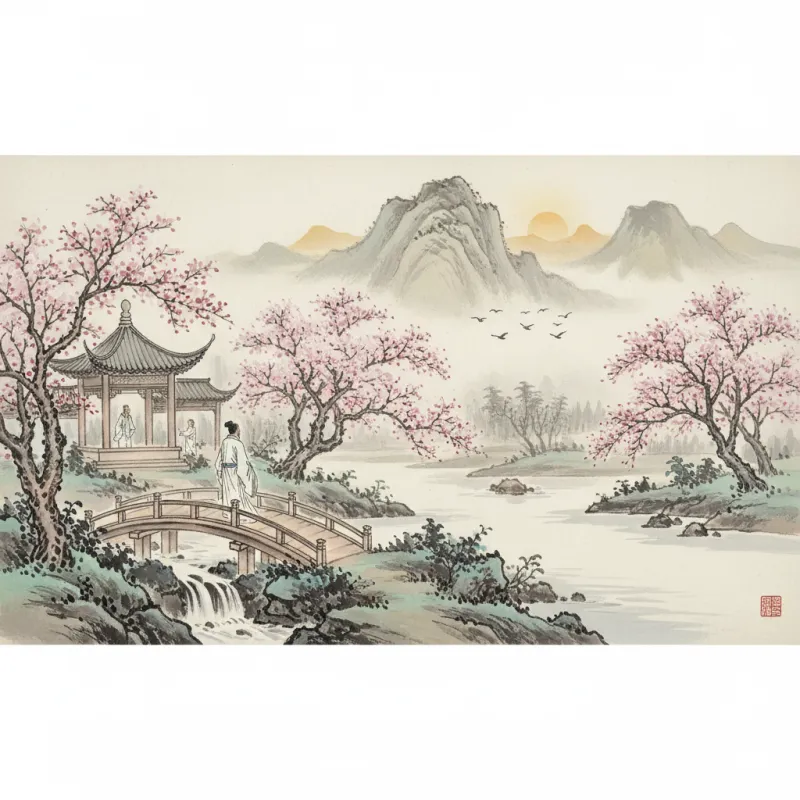
The Weaving Maid sits at her loom in heaven, separated from her lover by the entire Milky Way. They can see each other — the stars are right there — but they can't touch. Once a year, on the seventh day of the seventh month, magpies form a bridge across the sky so they can meet for a single night. Then back to the loom. Back to the separation. This is how Chinese poets talked about love: through cosmic distance, through waiting, through the unbearable fact of being able to see what you cannot have.
Chinese love poetry doesn't announce itself. There are no grand declarations, no "I love you" carved into tree bark. Instead, there's a woman embroidering alone at night. A man watching geese fly south. Two people drinking wine and not saying what they mean. The emotion lives in what's not said, in the image that stands in for everything. These ten poems have lasted a thousand years or more because they understood something fundamental: the most intense feelings are the ones we can barely speak.
The Cowherd and Weaving Maid — Anonymous (Han Dynasty)
迢迢牵牛星,皎皎河汉女。
纤纤擢素手,札札弄机杼。
终日不成章,泣涕零如雨。
河汉清且浅,相去复几许?
盈盈一水间,脉脉不得语。
Far, far away, the Cowherd Star. Bright, bright, the Weaving Maid across the river of heaven.
Tiáotiáo Qiānniú Xīng, jiǎojiǎo Héhàn Nǚ.
This poem comes from the "Nineteen Old Poems" (古诗十九首 Gǔshī Shíjiǔ Shǒu), written around 200 CE during the Han Dynasty. Nobody knows who wrote them. They were probably folk songs first, passed around and polished until they became literature.
The Cowherd and Weaving Maid story is one of China's oldest love myths, and this poem captures it perfectly. She weaves all day but can't finish a single piece of cloth because she's crying too hard. The river between them is shallow and clear — you can see across it — but they still can't speak. That last image is devastating: yíngyíng yī shuǐ jiān, màimài bù dé yǔ (盈盈一水间,脉脉不得语) — "full of longing across a single stream of water, gazing at each other but unable to speak." The physical distance is nothing. The separation is everything.
"Thinking of Someone" — Li Bai (李白)
美人卷珠帘,深坐颦蛾眉。
但见泪痕湿,不知心恨谁。
The beautiful one rolls up the pearl curtain, sits deep inside, frowning.
Měirén juǎn zhū lián, shēn zuò pín éméi.
Li Bai (701-762 CE) wrote this during the Tang Dynasty, and it's only four lines long. A woman sits alone, crying. We don't know who she's waiting for. We don't know if he's coming back. We don't even know who she's angry at — the last line says "but we don't know who her heart resents." Maybe it's the person who left. Maybe it's herself for caring. Maybe it's the whole situation.
This is typical Li Bai efficiency. He gives you one image — a woman behind a curtain — and lets you fill in the entire story. The poem works because everyone has been that person, sitting alone, crying about something they can't quite name. For more on Li Bai's approach to emotion in poetry, see Li Bai's Most Famous Poems.
"The Peacock Flies Southeast" — Anonymous (汉乐府)
This isn't a short lyric poem — it's a 350-line narrative from the Han Dynasty, the longest surviving poem from that period. It tells the story of Liu Lanzhi (刘兰芝) and Jiao Zhongqing (焦仲卿), a married couple torn apart by his mother's disapproval.
孔雀东南飞,五里一徘徊。
Kǒngquè dōngnán fēi, wǔ lǐ yī páihuái.
The peacock flies southeast, every five li it hesitates and turns back.
The opening line became proverbial. The peacock keeps looking back, can't commit to leaving — just like the couple who can't quite let go of each other even as they're being forced apart. Jiao Zhongqing's mother insists he divorce Liu Lanzhi. He does, reluctantly. Liu Lanzhi is forced to remarry. On her wedding day, Jiao Zhongqing drowns himself. When Liu Lanzhi hears, she hangs herself.
It's a brutal story, and the poem doesn't soften it. What makes it a love poem is the way it shows two people who would rather die than live without each other, but who also can't defy the social structures crushing them. The tragedy isn't that they die — it's that they have to choose between love and filial duty, and there's no good answer.
"The Song of Everlasting Sorrow" — Bai Juyi (白居易)
在天愿作比翼鸟,在地愿为连理枝。
天长地久有时尽,此恨绵绵无绝期。
In heaven, we wish to be birds flying wing to wing. On earth, we wish to be trees with branches intertwined.
Zài tiān yuàn zuò bǐyì niǎo, zài dì yuàn wéi liánlǐ zhī.
Bai Juyi (772-846 CE) wrote this 840-line epic about Emperor Xuanzong (唐玄宗) and his beloved concubine Yang Guifei (杨贵妃). It's one of the most famous poems in Chinese literature, and these final lines are what everyone remembers.
The emperor loved Yang Guifei so much he neglected his duties. A rebellion broke out. His own soldiers forced him to have her executed to restore order. After she died, he was inconsolable. He sent Daoist priests to search for her soul in the afterlife. They found her in a paradise realm, still wearing the hairpin he'd given her, still waiting.
The poem is about obsessive love — the kind that destroys kingdoms. But it's also about grief that outlasts everything. "Heaven and earth may last forever, but even they will end someday. This sorrow goes on and on, with no end in sight." That's the final couplet, and it's one of the most quoted lines in Chinese poetry. For more on Tang Dynasty love stories, see Tang Dynasty Romance Poetry.
"To One Unnamed" — Li Shangyin (李商隐)
相见时难别亦难,东风无力百花残。
春蚕到死丝方尽,蜡炬成灰泪始干。
Meeting is hard, parting is hard too. The east wind is weak, a hundred flowers wither.
Xiāngjiàn shí nán bié yì nán, dōngfēng wúlì bǎi huā cán.
Li Shangyin (813-858 CE) wrote some of the most cryptic, allusive love poetry in Chinese literature. Many of his poems are titled "To One Unnamed" (无题 Wútí) because he couldn't — or wouldn't — say who they were about. This one is famous for the second couplet: "The spring silkworm spins silk until it dies. The candle's tears don't dry until it burns to ash."
The Chinese word for silk thread (丝 sī) sounds like the word for longing (思 sī). So the silkworm spinning until death is also someone thinking about their lover until they die. The candle crying wax tears until it's nothing but ash — that's grief that consumes you completely. Li Shangyin's poems are full of these double meanings, images that work on multiple levels at once.
"The Phoenix Hairpin" — Lu You (陆游)
红酥手,黄縢酒,满城春色宫墙柳。
东风恶,欢情薄,一怀愁绪,几年离索。
错!错!错!
Red soft hands, yellow-sealed wine, the whole city full of spring, willows by the palace wall.
Hóng sū shǒu, huáng téng jiǔ, mǎn chéng chūn sè gōng qiáng liǔ.
Lu You (1125-1210 CE) wrote this during the Song Dynasty about his first wife, Tang Wan (唐婉). His mother forced them to divorce. Years later, they ran into each other at a garden. Tang Wan was remarried. She sent him wine. He wrote this poem on the garden wall.
The poem remembers her hands, the wine they used to drink, the spring day when everything was still possible. Then it turns: "The east wind is cruel, our joy was shallow, a heart full of sorrow, years of separation." And then, three times: Cuò! Cuò! Cuò! (错!错!错!) — "Wrong! Wrong! Wrong!"
What's wrong? The divorce? The remarriage? The fact that they ever met again? Lu You doesn't say. He just repeats the word like someone who can't stop thinking about a mistake they can't undo. Tang Wan later wrote a response poem on the same wall, equally heartbroken. She died not long after. Lu You lived to be 85 and never stopped writing about her.
"Butterflies Lingering Over Flowers" — Liu Yong (柳永)
衣带渐宽终不悔,为伊消得人憔悴。
My belt grows looser, I don't regret it. For her, I'm willing to waste away.
Yīdài jiàn kuān zhōng bù huǐ, wèi yī xiāo dé rén qiáocuì.
Liu Yong (987-1053 CE) wrote ci (词) poetry — song lyrics meant to be performed to music. This couplet became one of the most famous expressions of romantic devotion in Chinese literature. The speaker is literally wasting away from longing — his clothes don't fit anymore because he's stopped eating, stopped sleeping, stopped caring about anything except the person he can't have.
And he doesn't regret it. That's the key line. Zhōng bù huǐ (终不悔) — "in the end, no regret." Most love poetry is about suffering. This poem says the suffering is worth it. The pain is the point. If you're not willing to waste away for someone, it's not really love.
"The Immortal at the River" — Su Shi (苏轼)
十年生死两茫茫,不思量,自难忘。
千里孤坟,无处话凄凉。
Ten years, life and death, two vast separations. Even without thinking of you, I can't forget.
Shí nián shēng sǐ liǎng mángmáng, bù sīliàng, zì nánwàng.
Su Shi (1037-1101 CE) wrote this in 1075, ten years after his wife Wang Fu (王弗) died. She was sixteen when they married, twenty-seven when she died. He was devastated. A decade later, he dreamed about her and woke up and wrote this poem.
"Even without thinking of you, I can't forget." That line captures something true about grief — it's not that you're constantly thinking about the person. It's that they're woven into everything, so even when you're not actively remembering, they're still there. Her grave is a thousand li away. He can't visit. He can't tell her how desolate he feels. The separation is absolute.
The poem ends with him waking up from the dream: 相顾无言,惟有泪千行 (xiāng gù wú yán, wéi yǒu lèi qiān háng) — "We looked at each other without speaking, only a thousand lines of tears." Even in the dream, they can't talk. They can only cry. For more on Su Shi's poetry, see Su Shi's Greatest Works.
"The Hairpin Phoenix" — Tang Wan (唐婉)
世情薄,人情恶,雨送黄昏花易落。
晓风干,泪痕残,欲笺心事,独语斜阑。
难!难!难!
The world is cold, people are cruel, rain at dusk makes flowers fall easily.
Shìqíng báo, rénqíng è, yǔ sòng huánghūn huā yì luò.
This is Tang Wan's response to Lu You's "Phoenix Hairpin" poem. She wrote it on the same garden wall after reading his. Where his poem said "Wrong! Wrong! Wrong!", hers says "Difficult! Difficult! Difficult!" (Nán! Nán! Nán! 难!难!难!)
What's difficult? Everything. Living without him. Living with someone else. Pretending to be fine. The world is cold, people are cruel, flowers fall in the rain. She wants to write down what she's feeling, but she's alone, talking to a railing. The poem is full of images of things falling apart — flowers dropping, tears drying, dawn wind blowing cold.
Tang Wan died young, possibly from the grief of seeing Lu You again and realizing what they'd lost. Her poem survived because Lu You preserved it, copied it, wrote about it for the rest of his long life. It's one of the saddest documents in Chinese literature — a woman writing on a wall to a man she can't have, knowing he'll read it, knowing it won't change anything.
"Thinking of You" — Yuan Zhen (元稹)
曾经沧海难为水,除却巫山不是云。
取次花丛懒回顾,半缘修道半缘君。
Once you've seen the ocean, other water seems insignificant. Except for the clouds of Mount Wu, other clouds aren't clouds.
Céngjīng cānghǎi nán wéi shuǐ, chúquè Wūshān bù shì yún.
Yuan Zhen (779-831 CE) wrote this after his wife Wei Cong (韦丛) died. The first couplet became one of the most quoted lines in Chinese poetry. Once you've experienced the real thing — the ocean, the clouds of Mount Wu, true love — everything else is a pale imitation.
The second couplet is equally devastating: "I pass by flowers and don't bother to look back. Half because I'm cultivating the Way, half because of you." He's not interested in other women. Partly because he's trying to be a good Buddhist and transcend desire. But mostly because no one compares to his dead wife.
This is what Chinese love poetry does best — it takes a huge emotion and compresses it into an image so precise you can't argue with it. The ocean. The clouds. The flowers you don't turn around to see. These poems don't explain love. They show you what it looks like from the inside, when you're the one living it, when words fail and all you have left are images of distance and separation and things that used to be whole.
Related Reading
- Li Qingzhao: China's Greatest Female Poet
- Love Poetry in Classical Chinese: The Art of Saying Everything by Saying Almost Nothing
- Poems of Separation: The Chinese Art of Saying Goodbye
- Exploring Love in Chinese Classical Poetry: Tang, Song, and Yuan Poets’ Romantic Artistry
- Love and Longing in Chinese Classical Poetry: Tang, Song, and Yuan Dynasties Explored
- Wine Poetry: The Chinese Tradition of Drinking and Writing
- Li Qingzhao: China's Greatest Female Poet
- Zhuangzi's Butterfly Dream: The Most Famous Thought Experiment in Chinese Philosophy
Explore Chinese Culture
- Explore the Tang dynasty's golden age
- Explore Daoist themes in classical poetry
- Explore Chinese literary traditions