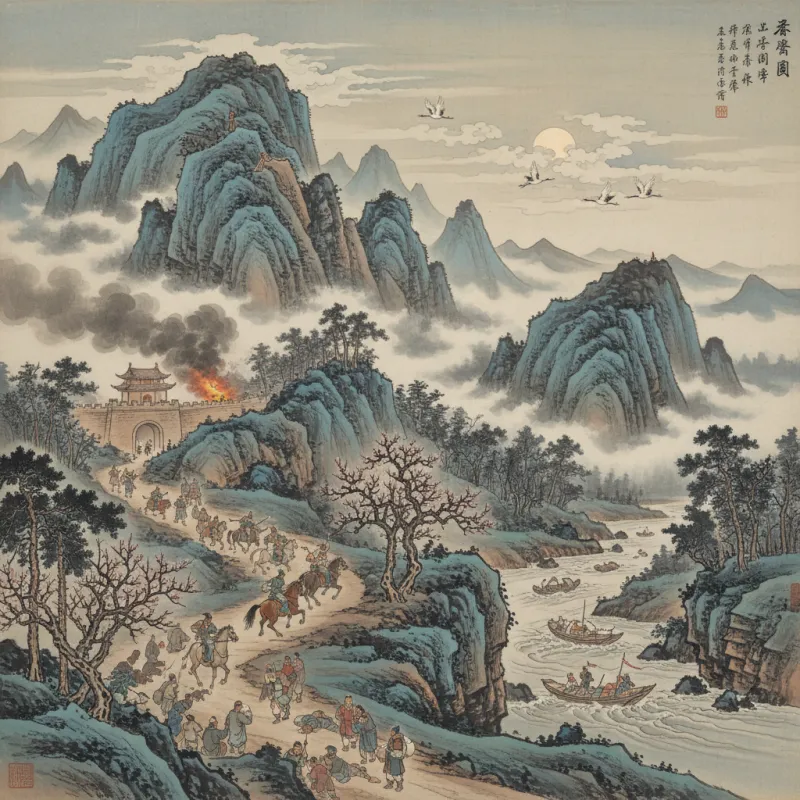
You're standing in the ruins of Chang'an in 756 CE. The capital of the Tang dynasty—the most sophisticated city on earth—is burning. Bodies line the streets. The imperial palace gardens where poets once gathered to compose verses about moonlight and plum blossoms are now mass graves. And somewhere in this nightmare, a 44-year-old failed civil servant named Du Fu (杜甫 Dù Fǔ, 712-770 CE) is taking notes.
Not the kind of notes you'd expect from a classical Chinese poet. Du Fu wasn't writing about the sublime beauty of destruction or finding metaphysical meaning in suffering. He was recording names, ages, details. The old man with the limp being dragged off to fight. The exact number of sons a widow had lost. The specific tax collectors still demanding grain from families who'd already given everything. His war poems read less like literature and more like testimony—the kind of evidence you'd present at a war crimes tribunal, if such things had existed in 8th-century China.
When the Golden Age Shattered
The An Lushan Rebellion (安史之乱 Ān Shǐ zhī Luàn, 755-763 CE) wasn't just another dynastic conflict. It was an apocalypse that killed an estimated 36 million people—roughly one-sixth of the world's population at the time. The rebellion transformed the Tang dynasty from a cosmopolitan empire at its cultural zenith into a fractured state that would never fully recover. For Du Fu, it was personal. He was separated from his family, imprisoned briefly by the rebels, forced to flee through war zones, and reduced to near-starvation.
Most poets of his era responded to crisis by retreating into nature poetry or Buddhist detachment. Du Fu did the opposite. He walked toward the suffering and wrote it down with documentary precision. His poem "Spring View" (春望 Chūn Wàng) opens with one of the most devastating lines in Chinese literature: "The nation is broken; mountains and rivers remain" (国破山河在 guó pò shān hé zài). The natural world endures. Human civilization doesn't. That's not philosophy—it's reportage.
The Conscription Poems: Bureaucracy as Violence
Du Fu's "Three Officials" (三吏 Sān Lì) and "Three Partings" (三别 Sān Bié) series are masterpieces of what we might now call embedded journalism. In "The Ballad of the Army Carts" (兵车行 Bīng Chē Xíng), he records an actual conversation with conscripts being marched to the frontier. They tell him they're being sent to die in wars that started before they were born and will continue after they're dead. The poem doesn't editorialize. It just lets them talk.
"The Old Man of Shihao" (石壕吏 Shíháo Lì) is even more brutal. Du Fu witnesses tax collectors arriving at night to conscript men from a family that's already lost three sons to the war. An elderly woman offers herself instead, volunteering to cook for the army garrison because there are no men left to take. The poem ends with Du Fu leaving at dawn and seeing only the old man, weeping alone. His wife is gone. The bureaucratic machinery of war has consumed her.
This isn't the war poetry of glory and sacrifice you find in earlier Chinese literature. Du Fu's poems expose how war functions as a system—how it grinds up ordinary people to sustain itself, how it turns survival into a form of collaboration, how it makes monsters out of clerks just doing their jobs. The real enemy in these poems isn't the rebels. It's the administrative apparatus that treats human beings as renewable resources.
The Domestic Catastrophe
While poets like Li Bai (李白 Lǐ Bái) wrote about war from a romantic distance, Du Fu wrote about what it did to families. "Moonlit Night" (月夜 Yuè Yè), composed while he was separated from his wife and children, imagines his family looking at the same moon and worrying about him. But the poem's genius is in its specificity—he pictures his young children, too small to understand why their father is gone, and his wife's hair growing white with worry. It's not sentimental. It's precise.
"Lament by the Riverside" (哀江头 Āi Jiāng Tóu) describes the aftermath of the imperial family's flight from Chang'an. Du Fu focuses on the abandoned palace ladies—women who were once symbols of imperial power, now refugees. He notes their makeup running, their silk robes torn, their desperate attempts to maintain dignity while begging for food. The poem understands that war's violence isn't just physical. It's the destruction of the social order that gave people's lives meaning.
This attention to domestic detail connects Du Fu's war poetry to the broader tradition of Tang dynasty social commentary, but with an intimacy that earlier poets avoided. He's not writing about "the people" as an abstraction. He's writing about specific people whose names he knew, whose stories he heard firsthand.
The Poetics of Witness
What makes Du Fu's war poetry revolutionary isn't just its subject matter—it's his formal innovation. He took the regulated verse (律诗 lǜshī) form, designed for elegant parallelism and refined sentiment, and weaponized it. The strict tonal patterns and balanced couplets of regulated verse create an almost unbearable tension when applied to descriptions of violence and suffering. It's like watching someone describe an atrocity in perfect iambic pentameter. The form's beauty makes the content more horrifying, not less.
Consider "Autumn Meditation" (秋兴八首 Qiū Xìng Bā Shǒu), written years after the rebellion. The poems use all the conventional imagery of autumn—falling leaves, migrating geese, cold wind—but every natural image becomes a reminder of displacement and loss. The geese flying south are refugees. The falling leaves are soldiers who'll never return home. Du Fu transforms the entire vocabulary of classical Chinese poetry into a language for describing trauma.
This technique influenced centuries of later poets, from the Song dynasty's patriotic war poetry to modern Chinese writers grappling with the Cultural Revolution. Du Fu proved that you could write about historical catastrophe without abandoning literary craft—that precision and beauty could serve witness rather than escape.
The Unbearable Specificity
What's most striking about Du Fu's war poems is their refusal of consolation. He doesn't offer Buddhist detachment, Daoist acceptance, or Confucian moral lessons. He just describes what he saw. In "Ballad of the Firewood Carriers" (负薪行 Fù Xīn Xíng), he watches old women gathering firewood in the ruins of Chang'an, their backs bent, their hands bleeding. The poem doesn't explain why this matters or what it means. It just insists that you look.
This is what separates Du Fu from other war poets of his era. He understood that the point of witness isn't interpretation—it's preservation. His poems function as evidence that these things happened, that these people existed, that their suffering was real. When he writes "I record these events for future generations" (为后世记 wèi hòushì jì), he's not being grandiose. He's stating his job description.
The Chinese critical tradition calls Du Fu the "Poet-Historian" (诗史 shīshǐ), and it's the perfect title. His poems are historical documents that happen to be written in verse. They're more reliable than official histories because they record what official histories ignore—the texture of ordinary life during catastrophe, the small betrayals and unexpected kindnesses, the way people's faces looked when they talked about their dead children.
The Cost of Looking
Du Fu paid for his witness. His health never recovered from the years of displacement and poverty. He died at 58, probably from malnutrition-related illness, still writing poems about the war's aftermath. His last poems describe a China that's technically at peace but fundamentally broken—a society where the old social contracts have dissolved, where violence has become normalized, where everyone is just trying to survive.
But here's what's remarkable: Du Fu never stopped believing that poetry mattered. Even as he was starving, even as he watched the world he knew disintegrate, he kept writing. Not because he thought poetry could stop wars or change policy. Because he believed that someone needed to remember. That the old man conscripted at Shihao, the widow in "The Ballad of the Army Carts," the abandoned palace ladies—they deserved to be remembered as individuals, not statistics.
Why Du Fu Still Matters
We live in an age of constant catastrophe—wars, pandemics, climate disasters—and we're drowning in information about them. What we lack is witness. The kind of attention Du Fu paid to suffering, the refusal to look away or abstract or find meaning too quickly. His war poems teach us that witness is a discipline. It requires you to get close enough to see details, to learn names, to record the specific rather than the general.
Modern war poetry often struggles with the question of whether beauty aestheticizes violence—whether making art from suffering is a form of exploitation. Du Fu's answer is instructive. His poems are beautiful, but their beauty doesn't comfort or transcend. It sharpens the horror. The formal perfection of his verse makes the content more unbearable, not less. Beauty, in Du Fu's hands, is a tool for making people pay attention.
That's his legacy. Not the idea that poetry can stop wars, but that it can preserve the human cost of war with a precision that other forms of documentation can't match. When you read "The Old Man of Shihao," you don't just learn that the An Lushan Rebellion killed millions. You meet one old man, weeping at dawn, and you understand what one of those millions means. That's what poetry can do that statistics can't. That's why Du Fu matters.
Related Reading
- Patriotic Poetry in Chinese History: From Qu Yuan to Modern Times
- Exploring the Depths of Chinese War Poetry from Tang to Yuan Dynasties
- War Poetry of the Tang Dynasty: Beauty in the Midst of Slaughter
- The Resonance of War in Chinese Classical Poetry: Analyzing Tang, Song, and Yuan Poets
- Frontier Poetry (边塞诗): War and Glory at the Empire's Edge
- Su Shi in Exile: How Banishment Produced China's Greatest Prose
- Li Qingzhao: The Greatest Female Poet in Chinese History
- Jueju: The Art of the Four-Line Poem
Explore Chinese Culture
- Explore the Tang dynasty's golden age
- Explore Daoist themes in classical poetry
- Explore Chinese literary traditions