When Du Fu stood among the ruins of Chang'an in 756 CE, watching spring grass reclaim the imperial capital, he wrote one of Chinese poetry's most devastating lines: "The nation broken, mountains and rivers remain; spring in the city, grass and trees grow deep" (国破山河在,城春草木深). Here was nature's terrible indifference—spring arriving on schedule while an empire collapsed. This tension between nature's cycles and human chaos defines the genius of Chinese seasonal poetry, where plum blossoms and autumn moons carry the weight of exile, loss, and fleeting joy.
The Seasonal Framework of Chinese Poetics
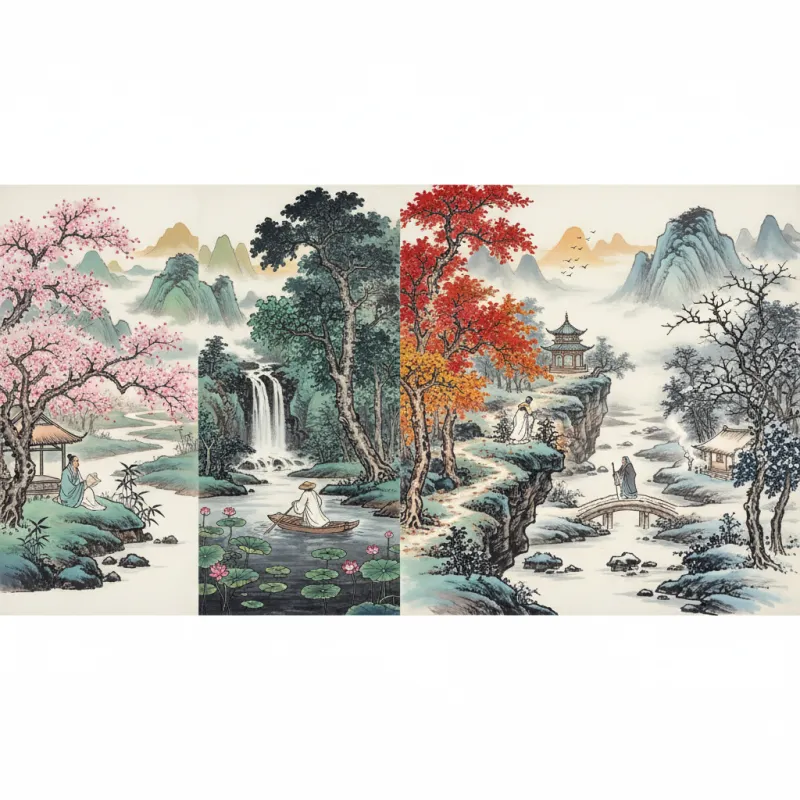
Chinese poets didn't just observe seasons—they inherited a sophisticated vocabulary of seasonal imagery refined over millennia. By the Tang dynasty (618-907 CE), certain associations had crystallized into poetic shorthand. Spring meant willow catkins and parting sorrow (柳絮, liǔxù). Autumn demanded wild geese flying south and frontier loneliness. Winter brought plum blossoms defying snow, symbols of resilience. These weren't clichés but a shared language, allowing poets to evoke complex emotions through precise natural details.
The Book of Songs (诗经, Shījīng), compiled around 600 BCE, established this pattern early. Its agricultural communities marked time through natural phenomena—ice melting, orioles singing, crickets chirping. When later poets like Wang Wei wrote "In the mountains, osmanthus flowers fall; the night is still, spring mountain empty" (人闲桂花落,夜静春山空), they were working within a tradition that saw seasonal change as inseparable from human feeling.
Spring: Departure and Renewal
Spring in Chinese poetry carries a peculiar melancholy. Yes, it brings renewal—peach blossoms, warming rivers, returning swallows—but it's also the season of parting. Government officials received new postings in spring. Travelers resumed journeys after winter. The same willows that symbolized spring's vitality also meant farewell, since friends would break off willow branches (折柳, zhéliǔ) as parting gifts, a pun on "stay" (留, liú).
Li Bai captured this duality perfectly: "A pot of wine among flowers, drinking alone without companion. I raise my cup to invite the bright moon; with my shadow we become three" (花间一壶酒,独酌无相亲。举杯邀明月,对影成三人). Written in spring, the poem's blooming flowers emphasize his isolation rather than joy. The season's beauty becomes almost accusatory—nature thrives while the poet drinks alone.
Wang Wei took a different approach, finding in spring's ephemeral beauty a Buddhist acceptance of impermanence. His famous "Bird-Cry Brook" (鸟鸣涧) presents spring so still that falling osmanthus petals become events: "People idle, osmanthus flowers fall; night quiet, spring mountain empty." The season here isn't about renewal but about presence, attention, the moment before change.
Summer: Abundance and Languor
Summer receives less attention in classical Chinese poetry than other seasons, perhaps because its heat and abundance lack the poignant transitions that poets craved. When summer does appear, it's often as a backdrop for leisure or a contrast to inner turmoil. Yang Wanli (1127-1206), a Song dynasty poet, specialized in summer scenes with almost impressionistic detail: lotus leaves spreading across ponds, dragonflies perching on buds, children chasing butterflies.
The summer poems that endure tend to focus on specific moments—afternoon thunderstorms, cicadas droning in heat, the first lotus blooming. Du Fu's "A Guest Arrives" (客至) uses summer's lushness to emphasize his poverty: "My thatched cottage lies south of the river, north of the river; only gulls come as regular guests. I haven't swept the flower path for visitors; today for you, this wicker gate opens for the first time." Summer's abundance makes his isolation more pointed.
Autumn: Exile and Contemplation
If spring is parting's season, autumn is exile's. The Tang dynasty's frontier wars and political purges sent countless officials to remote posts, and autumn—with its falling leaves, migrating geese, and early frost—became the season of displacement. Du Fu, repeatedly exiled, made autumn his signature: "Ten thousand miles of sad autumn, always a wanderer; a hundred years of illness, alone I climb the terrace" (万里悲秋常作客,百年多病独登台).
Autumn's clarity also invited philosophical reflection. The season strips away summer's excess, revealing essential forms. Liu Yuxi (772-842) wrote after political exile: "Since ancient times, autumn has been a time of sadness and loneliness; I say autumn surpasses spring's brightness" (自古逢秋悲寂寥,我言秋日胜春朝). His contrarian stance—autumn as superior to spring—challenged poetic convention while acknowledging it.
The Mid-Autumn Festival, celebrating the harvest moon, generated its own subgenre. Su Shi's "Prelude to Water Melody" (水调歌头), written in 1076 while separated from his brother, remains the definitive autumn moon poem: "People have sorrow and joy, separation and reunion; the moon has clouds and clarity, waxing and waning. This matter has never been perfect since ancient times" (人有悲欢离合,月有阴晴圆缺,此事古难全). The moon's phases mirror human relationships—both subject to cycles beyond our control.
Winter: Endurance and Purity
Winter poetry centers on two images: snow and plum blossoms. Snow transforms landscapes, covering ugliness and beauty alike, creating a blank slate that poets found both beautiful and unsettling. Plum blossoms (梅花, méihuā), blooming in late winter before other flowers, became symbols of integrity—officials who maintained principles despite adversity, scholars who persisted through hardship.
Wang Anshi (1021-1086), the controversial Song dynasty reformer, wrote a famous plum blossom quatrain during political struggles: "In the corner, several plum branches; alone they bloom in the cold. From afar I know they're not snow; because a subtle fragrance comes" (墙角数枝梅,凌寒独自开。遥知不是雪,为有暗香来). The plum's solitary blooming mirrored his own political isolation, while its fragrance suggested that true worth reveals itself eventually.
Liu Zongyuan (773-819), exiled to remote Yongzhou, wrote winter poems of stark minimalism. His "River Snow" (江雪) presents a landscape emptied of everything but one fisherman: "A thousand mountains, birds in flight vanished; ten thousand paths, human traces extinguished. A lone boat, bamboo hat and straw cape old man; alone, fishing the cold river snow" (千山鸟飞绝,万径人迹灭。孤舟蓑笠翁,独钓寒江雪). The poem's extreme isolation—no birds, no people, just one figure in vast whiteness—captures exile's psychological reality.
Seasonal Transitions and Poetic Time
The most sophisticated seasonal poems capture transitions—spring's first warmth, autumn's first chill, the moment when one season yields to another. These threshold moments fascinated Chinese poets because they embodied change itself, the impermanence that Buddhist and Daoist philosophy emphasized.
Bai Juyi (772-846) excelled at noticing these shifts. His "Early Spring" poems track minute changes: ice beginning to crack, first buds appearing, the angle of sunlight changing. This attention to gradual transformation reflects a worldview where nothing is static, where even seasons don't arrive suddenly but emerge through accumulation of small changes.
The concept of jieqi (节气, seasonal nodes)—the 24 divisions of the solar year used in traditional Chinese calendars—gave poets a precise framework for marking time. Each node had associated phenomena: "Awakening of Insects" (惊蛰) when hibernating creatures emerged, "White Dew" (白露) when morning dew became visible, "Frost Descends" (霜降) marking late autumn. Poets could reference these nodes to evoke specific moments with great precision, creating a shared temporal vocabulary.
Nature as Mirror and Teacher
Chinese seasonal poetry ultimately treats nature not as mere scenery but as a mirror reflecting human experience and a teacher offering lessons about acceptance, change, and perspective. When Wang Wei wrote about mountains and rivers, he was also writing about consciousness. When Du Fu described autumn leaves, he was describing his own aging and displacement.
This approach differs from Western Romantic poetry's emphasis on nature as sublime or transcendent. Chinese poets rarely positioned themselves against nature or sought to conquer it imaginatively. Instead, they observed, participated, and found in seasonal cycles a model for understanding human life's patterns—growth and decay, separation and reunion, loss and renewal.
The seasonal framework also provided emotional distance. Rather than stating grief directly, a poet could describe autumn geese or spring willows, allowing readers to feel the emotion through natural imagery. This indirection wasn't evasion but sophistication, a recognition that some feelings are better evoked than declared. As the Classic of Poetry demonstrated millennia ago, sometimes the most powerful way to express longing is to describe wind in the reeds or frost on the ground.
For modern readers approaching these poems, understanding seasonal symbolism unlocks layers of meaning. That plum blossom isn't just pretty—it's defiance. Those autumn geese aren't just birds—they're messengers carrying letters home, or reminders of friends scattered across the empire. The seasons in Chinese poetry form a language as precise as any technical vocabulary, refined through centuries of poets observing, feeling, and writing their way through spring, summer, autumn, and winter's endless return.
Related Reading
- The Four Seasons in Chinese Poetry: Spring Sorrow, Summer Heat, Autumn Grief, Winter Silence
- Nature in Chinese Poetry: Mountains, Rivers, and the Mirror of the Soul
- War and Exile in Chinese Poetry: The Literature of Survival
- Love and Longing in Chinese Poetry: The Art of Missing Someone
- Moonlight in Chinese Poetry: Why the Moon Means Everything
- Ouyang Xiu and The Drunkard's Pavilion: Getting Drunk on Mountains
- Discovering the Rich Legacy of Tang, Song, and Yuan Poetry
- Ezra Pound and Chinese Poetry: Beautiful Mistakes
Explore Chinese Culture
- Explore the Tang dynasty's golden age
- Explore Daoist themes in classical poetry
- Explore Chinese literary traditions