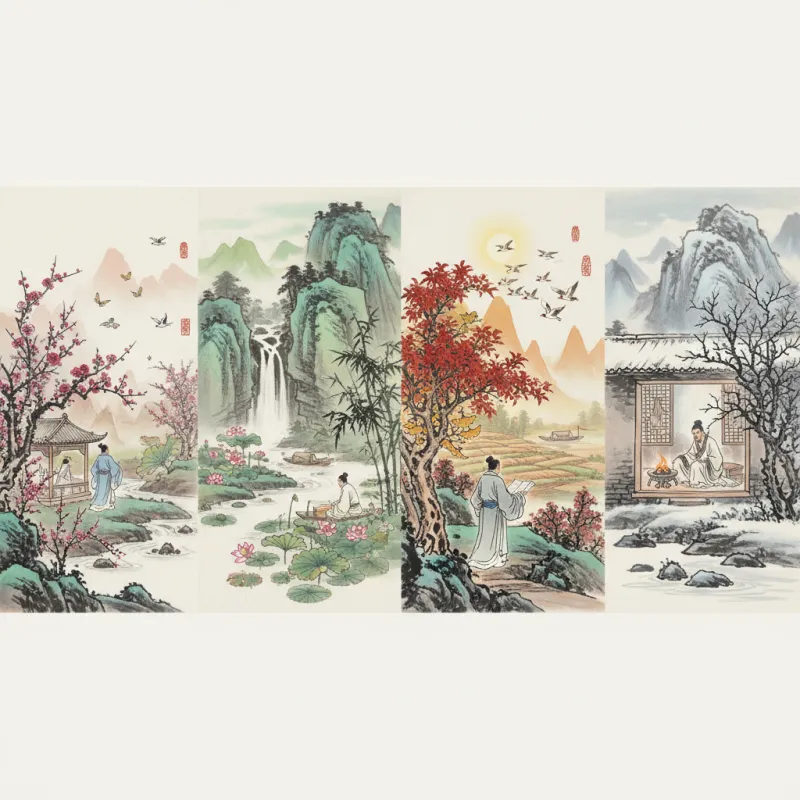
The plum blossoms outside Wang Wei's window opened in the dead of winter, and he knew exactly what they meant. Not "spring is coming" in some vague, hopeful sense — but a precise emotional coordinate that every reader in 8th-century Chang'an could locate instantly. Chinese poetry operates on a seasonal grammar so strict that getting the season wrong is like using the wrong tense. The flowers aren't just scenery. They're syntax.
This isn't metaphor in the loose Western sense. It's a systematic encoding of emotion onto the calendar, refined over two thousand years until it became second nature. Spring means longing. Autumn means melancholy. Winter means endurance. Summer — well, summer is the odd one out, and we'll get to why. But first, understand that this system is rigid, ancient, and so deeply embedded in classical Chinese literature that poets could evoke entire emotional landscapes with a single seasonal reference.
Spring: The Season of Beautiful Anxiety (春 Chūn)
Spring in Tang and Song poetry is not renewal. It's panic. The flowers are blooming, yes — but they're already dying. Every petal that opens is a countdown to its fall. This is why Du Fu (杜甫, Dù Fǔ), watching spring blossoms in 757 during the An Lushan Rebellion, wrote "the nation broken, mountains and rivers remain; spring in the city, grass and trees grow deep" (国破山河在,城春草木深). The spring isn't consolation. It's accusation. Everything is growing except human order.
The emotional charge is 惜春 (xī chūn) — "cherishing spring" or more accurately "mourning spring while it's still here." It's anticipatory grief. Li Shangyin (李商隐, Lǐ Shāngyǐn) perfected this in the 9th century with poems so drenched in spring anxiety that scholars still argue about whether he's talking about lost love, lost political favor, or just lost time. Probably all three. Spring in Chinese poetry is the season when everything beautiful is also temporary, and you're painfully aware of both facts simultaneously.
Women poets like Xue Tao (薛涛, Xuē Tāo) and Li Qingzhao (李清照, Lǐ Qīngzhào) weaponized spring's emotional instability. Li Qingzhao's "Spring at Wuling" (武陵春, Wǔlíng Chūn) opens with "the wind stops, the dust carries the fragrance of fallen flowers" — spring is already over in the first line, and she's just getting started on the grief. This is spring's function in the seasonal system: it makes longing concrete. Not longing for something specific, but longing as a state of being.
Summer: The Forgotten Season (夏 Xià)
Here's the strange thing: summer barely exists in classical Chinese poetry. Oh, there are summer poems — but summer doesn't have the emotional weight of the other three seasons. It's hot. Cicadas are loud. Lotus flowers bloom. And then... what?
The problem is that summer doesn't fit the emotional calendar. Spring is longing, autumn is melancholy, winter is endurance — but summer? Summer is just present. It doesn't point backward or forward. It doesn't ache. The Tang poet Bai Juyi (白居易, Bái Jūyì) wrote summer poems about being hot and annoyed, which is realistic but not particularly profound. Summer is the season when the emotional machinery of Chinese poetry stalls out.
When summer does appear in major poems, it's usually as a setting for something else. Meng Haoran's (孟浩然, Mèng Hàorán) "Summer Day in the South Pavilion Thinking of Xin" uses summer heat as a backdrop for political frustration — he's not writing about summer, he's writing about stagnation, and summer happens to be there. The lotus flowers in nature imagery carry their own symbolic weight, but summer itself remains emotionally neutral.
This is why the Chinese seasonal system is really a three-season system with summer as an intermission. The emotional arc goes: spring (anxiety) → summer (pause) → autumn (melancholy) → winter (endurance) → spring again. Summer is where the cycle catches its breath.
Autumn: The Season of Proper Sadness (秋 Qiū)
If spring is anxious sadness, autumn is resigned sadness. This is the season that Chinese poetry was made for. The emotional fit is so perfect that "autumn" (秋) and "sorrow" (愁, chóu) are near-homophones, and poets exploited this constantly. Liu Yuxi (刘禹锡, Liú Yǔxī) in the 9th century wrote "since ancient times, autumn is a time of loneliness and sorrow" (自古逢秋悲寂寥) — and then immediately contradicted it, because the rule was so established that breaking it made a point.
Autumn sadness is different from spring sadness. Spring mourns what hasn't died yet. Autumn mourns what's already gone. The leaves are falling, the geese are flying south, the year is ending. There's no anxiety because there's no hope. It's clean, aesthetic melancholy. Du Fu's autumn poems are masterpieces of this mode: "ten thousand miles of sad autumn, always a wanderer; a hundred years of illness, alone I climb the tower" (万里悲秋常作客,百年多病独登台). The autumn isn't causing the sadness — it's the proper container for it.
Women poets again found ways to intensify the system. Li Qingzhao's autumn poems are so saturated with melancholy that they feel like they might collapse under their own emotional weight. "Thin mist, thick clouds, worrying about the eternal day" (薄雾浓云愁永昼) — she's not describing autumn weather, she's describing autumn as a state of consciousness. The season becomes indistinguishable from the feeling.
The imagery of falling leaves in autumn poetry isn't just about death. It's about the rightness of death. Things fall in autumn because that's what they're supposed to do. There's a comfort in that, even as it's sad. This is why autumn is the season of exile poetry — when you're far from home, autumn makes the distance feel appropriate rather than wrong.
Winter: Endurance and Integrity (冬 Dōng)
Winter in Chinese poetry is the season of character. Not emotional character — moral character. The plum blossoms (梅花, méihuā) that bloom in snow aren't beautiful because they're pretty. They're beautiful because they're stubborn. They bloom when they're not supposed to, which makes them symbols of integrity in adversity.
This is why winter is the season of the recluse and the loyal official. Wang Wei's winter poems are about withdrawal — not sad withdrawal, but principled withdrawal. The snow covers everything, which means you can't see the corruption of the court or the chaos of the world. Winter is clarity through subtraction. Lu You (陆游, Lù Yóu) in the 12th century wrote winter poems about plum blossoms that are really about refusing to compromise with the Jin dynasty. The flowers aren't metaphors. They're arguments.
The emotional tone of winter is 坚忍 (jiānrěn) — "firm endurance." Not passive suffering, but active resistance through persistence. This is why winter poems often have a harder edge than autumn poems. Autumn accepts loss. Winter refuses it. The bamboo bends under snow but doesn't break. The pine stays green when everything else is dead. These aren't observations about nature — they're positions in an ongoing debate about how to live when everything is terrible.
Winter is also the season when the seasonal system itself becomes most visible. Because winter is harsh and uncomfortable, poets who write about winter beauty are making a statement about their values. They're saying: I find meaning in difficulty, not in ease. This is the opposite of spring's anxious beauty or autumn's aesthetic sadness. Winter beauty is earned.
Reading Across Seasons: The Emotional Calendar in Practice
Here's how the system works in practice. When Du Fu writes "spring hopes" (春望, Chūn Wàng) during the rebellion, the "spring" in the title tells you immediately that this is a poem about longing and loss, not about military strategy or political analysis. The season is the emotional key signature. When Su Shi (苏轼, Sū Shì) writes "Mid-Autumn Moon" (中秋月, Zhōngqiū Yuè), you know before reading a word that this will be about separation and melancholy, because that's what autumn does.
This is why translation is so difficult. English readers see "spring" and think "rebirth." Chinese readers see "春" and think "things falling apart beautifully." The emotional content is in the season itself, not in what the poet says about it. A good Chinese poem uses the seasonal framework to say things without saying them. The season does half the work.
The system also creates possibilities for irony and subversion. When Liu Yuxi writes that autumn can be better than spring, he's not just making an aesthetic claim — he's challenging the entire emotional calendar. When Li Bai (李白, Lǐ Bái) writes cheerful spring poems, he's being deliberately weird, and contemporary readers would have noticed. The seasonal system is so strong that breaking it is itself meaningful.
Why This Matters for Reading Chinese Poetry
You can't read Tang and Song poetry without understanding this seasonal grammar. It's not background information — it's the structure. When a poet mentions falling flowers, you need to know that's spring anxiety. When they mention geese flying south, that's autumn separation. When they mention snow on plum blossoms, that's winter integrity. These aren't decorative details. They're the emotional architecture of the poem.
This is also why Chinese poetry can be so compressed. A seven-character line can contain an entire emotional landscape because the seasonal reference does so much work. "Spring river flowers moon night" (春江花月夜, Chūn Jiāng Huā Yuè Yè) — that's five nouns, but it's also a complete emotional statement about longing, beauty, time, and transience. The "spring" tells you how to read everything else.
Modern readers sometimes find this system restrictive. Shouldn't poets be free to feel however they want about seasons? But that misses the point. The restriction is the art. Working within the seasonal system is like working within a poetic form — the constraints create possibilities. When every educated reader shares the same seasonal vocabulary, poets can communicate with extraordinary precision and subtlety. They can evoke complex emotions with a single image because the emotional content of that image is already established.
The seasonal system in Chinese poetry isn't a set of symbols to decode. It's a shared language of feeling, refined over centuries until it became instinctive. Spring is longing. Autumn is melancholy. Winter is endurance. Summer is... well, summer is still figuring itself out. But the other three seasons form an emotional calendar that structures not just individual poems but the entire tradition of classical Chinese verse. Get the season right, and half your poem is already written. Get it wrong, and you've broken the emotional logic that makes the whole system work.
Related Reading
- The Harmony of Nature in Chinese Classical Poetry: Tang, Song, and Yuan Dynasties
- Mountain and Water Poetry (山水诗): When Landscape Becomes Literature
- Nature Poetry in Chinese Literature: Seeing the World as the Poets Saw It
- The Moon in Chinese Poetry: 50 Ways to Say 'I Miss You'
- The Art of Nature in Tang, Song, and Yuan Dynasty Poetry: A Literary Exploration
- Daoist Poetry: Finding the Way Through Nature
- Modern Chinese Poetry: From Classical Forms to Free Verse
- Ouyang Xiu and The Drunkard's Pavilion: Getting Drunk on Mountains
Explore Chinese Culture
- Explore the Tang dynasty's golden age
- Explore Daoist themes in classical poetry
- Explore Chinese literary traditions