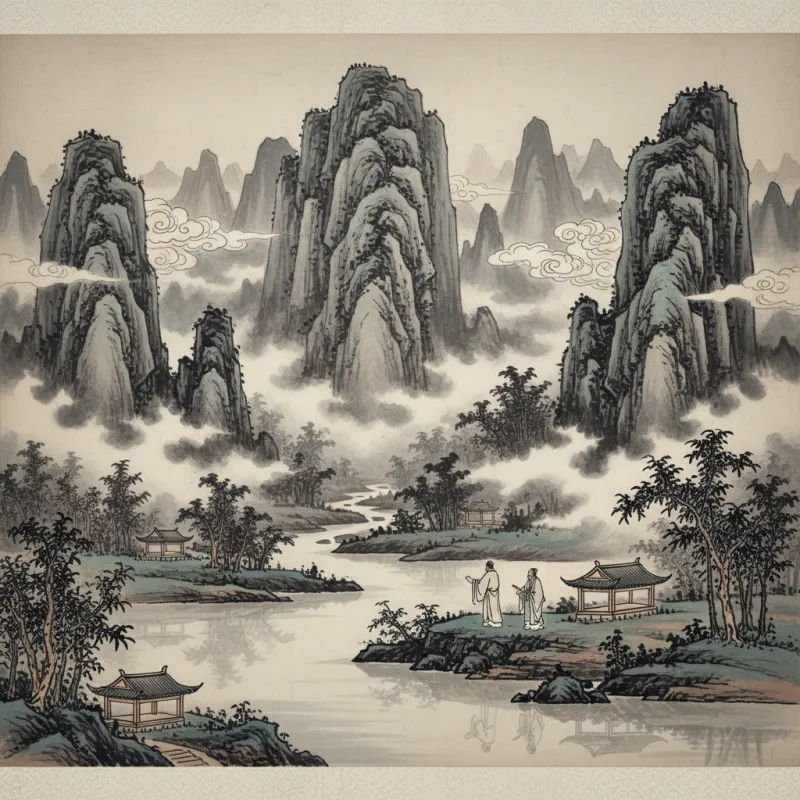
Picture this: A disgraced aristocrat, stripped of his court position and exiled to a backwater province, straps on custom-made wooden clogs with retractable spikes and disappears into the mountains for days at a time. His servants think he's lost his mind. His political enemies assume he'll fade into obscurity. Instead, Xie Lingyun (谢灵运 Xiè Língyùn, 385-433 CE) invents an entire literary genre that will dominate Chinese poetry for the next thousand years.
That genre is shanshui poetry (山水诗 shānshuǐ shī) — literally "mountain-water poetry" — and it's not what you think. This isn't nature poetry in the Western sense, where poets gaze at daffodils and feel feelings. This is landscape as spiritual technology, a systematic method for achieving what the Daoists called "forgetting" and what we might call transcendence.
The Philosophy Behind the Mountains
The Chinese term for landscape itself tells you everything: shanshui (山水 shānshuǐ), "mountain-water." Not "scenery." Not "wilderness." Mountain and water, the two fundamental forces that shape the earth. Mountains represent yang (阳 yáng) — vertical, solid, unchanging, masculine. Water embodies yin (阴 yīn) — horizontal, flowing, adaptive, feminine. Put them together and you have a complete cosmological system in two syllables.
This matters because shanshui poets weren't describing pretty views. They were mapping the structure of reality itself. When Wang Wei (王维 Wáng Wéi) writes about a mountain stream in the 8th century, he's not being picturesque — he's demonstrating how consciousness moves through the world, how the solid and fluid aspects of existence interact, how a human mind can dissolve into landscape and emerge transformed.
The philosophical foundation comes from Daoism and Buddhism, particularly the concept of wuwei (无为 wúwéi) — "non-action" or "effortless action." Mountains don't try to be mountains. Water doesn't try to flow. They simply are, and in their being, they're perfect. The shanshui poet's job is to observe this perfection so closely that the boundary between observer and observed disappears.
Xie Lingyun's Revolutionary Clogs
Back to our aristocrat in his mountain clogs. Xie Lingyun didn't just write about mountains — he was obsessed with them in a way that made his contemporaries deeply uncomfortable. He'd vanish into the wilderness for weeks, climbing peaks that had never been climbed, following streams to their sources, sleeping in caves. His famous "Xie clogs" (谢公屐 Xiègōng jī) had removable front and back teeth so you could adjust them for climbing up or down steep slopes. The man was serious.
His poetry reflects this physical intimacy with landscape. Earlier poets had mentioned mountains in passing, as backdrop or metaphor. Xie Lingyun made them the subject. His poems are dense, technical, almost geological in their precision. He names specific peaks, describes the exact quality of light at different altitudes, catalogs plants and rock formations. Reading him is like reading field notes from a spiritual expedition.
Take his poem "Climbing the Highest Peak of Stone Gate Mountain" (登石门最高顶 Dēng Shímén Zuìgāo Dǐng). It's not a meditation on nature's beauty. It's a step-by-step account of an actual climb, complete with details about the trail conditions, the changing vegetation zones, and the physical exhaustion of the ascent. Only at the very end does he achieve the moment of transcendence he's been climbing toward — and even then, he describes it in concrete, visual terms rather than abstract philosophy.
This was revolutionary. Xie Lingyun proved that landscape itself could be the entire content of a poem, that you didn't need a political allegory or moral lesson or romantic subplot. The mountain was enough.
The Golden Age: Wang Wei and the Poet-Painters
By the Tang Dynasty (618-907 CE), shanshui poetry had evolved into something more refined and more radical. Wang Wei, who lived in the 8th century, was both a master poet and an accomplished painter — and he approached landscape with a painter's eye for composition and a Buddhist's understanding of emptiness.
Wang Wei's innovation was silence. His poems are famous for what they don't say, for the spaces between words. In his "Deer Park" (鹿柴 Lù Zhài), one of the most celebrated poems in Chinese literature, almost nothing happens: empty mountains, a human voice echoing, sunlight touching moss. That's it. But the effect is profound — you feel the vastness of the space, the quality of the silence, the way consciousness expands to fill emptiness.
This connects directly to Chan (Zen) Buddhism's concept of sunyata (空 kōng) — emptiness or void. Wang Wei's landscapes aren't full of things; they're full of absence. Mountains appear through mist and disappear again. Sounds emerge from silence and return to it. The poet himself is barely present, just another element in the composition, no more important than the moss or the deer.
His contemporary Meng Haoran (孟浩然 Mèng Hàorán, 689-740) took a different approach, focusing on the intimate scale of rural landscapes — small gardens, village streams, the view from a farmer's window. Where Wang Wei painted vast mountain vistas, Meng Haoran sketched domestic scenes. But both shared the same fundamental insight: landscape is a mirror for consciousness, and by observing it closely enough, you can see through the illusion of self.
The Recluse Tradition and Political Subtext
Here's what Western readers often miss: shanshui poetry is deeply political, even when it seems to be about nothing but mountains and streams. In imperial China, retreating to the mountains was a coded statement about your relationship to power. It meant you were either too principled to serve a corrupt government, too disappointed by political failure to continue, or too enlightened to care about worldly success.
The figure of the yinshi (隐士 yǐnshì) — the recluse or hermit — haunts shanshui poetry. These weren't just poets who liked hiking. They were men (almost always men, unfortunately) who had opted out of the official examination system, the bureaucratic career ladder, the whole machinery of Confucian social obligation. Living in the mountains was a form of protest, a way of saying: I refuse to participate in your corrupt system.
Tao Yuanming (陶渊明 Táo Yuānmíng, 365-427), who predates Xie Lingyun slightly, set the template. He quit his government job, went back to his farm, and wrote poems about growing chrysanthemums and drinking wine. His "Returning to Dwell in Gardens and Fields" (归园田居 Guī Yuántián Jū) series became the founding text of the recluse tradition. The message was clear: real freedom exists outside the system, in direct contact with the natural world.
This political dimension adds weight to even the most seemingly innocent landscape description. When a Tang Dynasty poet writes about a remote mountain valley, he's not just describing scenery — he's imagining an alternative to the imperial court, a space where different values prevail. The mountain becomes a utopia, a place where you can be fully human without the compromises required by civilization.
Technical Mastery: How Shanshui Poems Actually Work
Let's talk craft. Shanshui poetry developed specific technical features that distinguish it from other genres. First, there's the use of parallel couplets (对仗 duìzhàng), where two lines mirror each other in grammatical structure while contrasting in content. A typical example might pair "green mountains" with "white clouds," "ancient trees" with "new springs," creating a sense of balance and completeness that mirrors the yin-yang philosophy underlying the whole genre.
Second, shanshui poets mastered the art of the "eye" (眼 yǎn) — the single character or image that brings an entire scene into focus. In Wang Wei's poetry, this might be a single bird call, a patch of sunlight, a moment of stillness. The eye isn't the most dramatic element; it's the detail that makes everything else cohere, the point where observation becomes insight.
Third, there's the technique of "borrowed scenery" (借景 jièjǐng), where distant elements are incorporated into the composition. A shanshui poem might begin with what's immediately visible — a garden, a window, a courtyard — then gradually expand to include distant mountains, clouds, the horizon. This creates a sense of infinite depth, of consciousness expanding outward until it encompasses everything.
The best shanshui poets also understood rhythm and pacing. They knew when to slow down and linger on a single image, when to speed up and cover ground quickly, when to pause and let silence speak. Reading a great shanshui poem is like watching a scroll painting unfold — you move through the landscape at a carefully controlled pace, seeing exactly what the poet wants you to see in exactly the right sequence.
The Song Dynasty Refinement
By the Song Dynasty (960-1279), shanshui poetry had become so established that poets could play with its conventions, subvert them, push them in new directions. Su Shi (苏轼 Sū Shì, 1037-1101), better known as Su Dongpo, brought philosophical depth and personal emotion back into landscape poetry, which had become perhaps too refined, too impersonal under Wang Wei's influence.
Su Shi's "Red Cliff Odes" (赤壁赋 Chìbì Fù) are technically prose-poems rather than pure poetry, but they represent the culmination of the shanshui tradition. He takes a specific historical site — the Red Cliffs where a famous battle occurred — and uses it to meditate on time, mortality, the relationship between human history and natural permanence. The landscape becomes a lens for examining the biggest questions: What endures? What matters? How should we live knowing we'll die?
This more philosophical approach influenced later poets like Yang Wanli (杨万里 Yáng Wànlǐ, 1127-1206), who developed a style called chengzhai ti (诚斋体 chéngzhāi tǐ) — "Chengzhai style," named after his studio. Yang Wanli's innovation was to focus on tiny, overlooked details: insects, weeds, the way light hits a puddle. He proved that shanshui poetry didn't need grand mountains and mighty rivers — a backyard could contain the entire cosmos if you looked closely enough.
Why This Matters Now
Fifteen centuries after Xie Lingyun strapped on his climbing clogs, shanshui poetry still has something to teach us. Not because it's exotic or ancient, but because it solved a problem we're still struggling with: how to be present in the world without constantly narrating our experience, how to observe without immediately judging, how to let landscape speak without drowning it out with our own voices.
The shanshui poets understood that nature isn't a resource to be used or a backdrop for human drama. It's a teacher, a mirror, a path to understanding consciousness itself. When Wang Wei writes about mountains and water, he's not being poetic — he's being precise. He's describing exactly what happens when you stop trying to control your experience and simply let it unfold.
This connects to contemporary concerns about mindfulness and meditation in classical poetry, about finding ways to slow down and pay attention in an accelerated world. The shanshui tradition offers a tested methodology, a thousand years of experimentation in how to use landscape as a tool for transformation.
And here's the thing: it works. You don't need to read classical Chinese or understand Buddhist philosophy to benefit from the shanshui approach. You just need to find your mountain and your water — whatever that means for you — and pay attention. Watch how light changes. Notice how water moves. Observe without commentary. The rest follows naturally, the way water flows downhill, the way mountains simply stand there being mountains.
That's the final lesson of shanshui poetry: transformation doesn't require effort. It requires attention. The landscape does the work. You just have to show up and watch.
Related Reading
- Nature Poetry in Chinese Literature: Seeing the World as the Poets Saw It
- The Harmony of Nature in Chinese Classical Poetry: Tang, Song, and Yuan Dynasties
- The Moon in Chinese Poetry: 50 Ways to Say 'I Miss You'
- The Four Seasons in Chinese Poetry: A Seasonal Reading Guide
- Nature Poetry in the Tang Dynasty: Mountains, Rivers, and the Art of Seeing
- Qu Yuan: The First Named Poet in Chinese History
- Confucian Values in Classical Chinese Poetry: Duty, Loyalty, and the Weight of the World
- Frontier Poetry (边塞诗): War and Glory at the Empire's Edge
Explore Chinese Culture
- Explore the Tang dynasty's golden age
- Explore Daoist themes in classical poetry
- Explore Chinese literary traditions