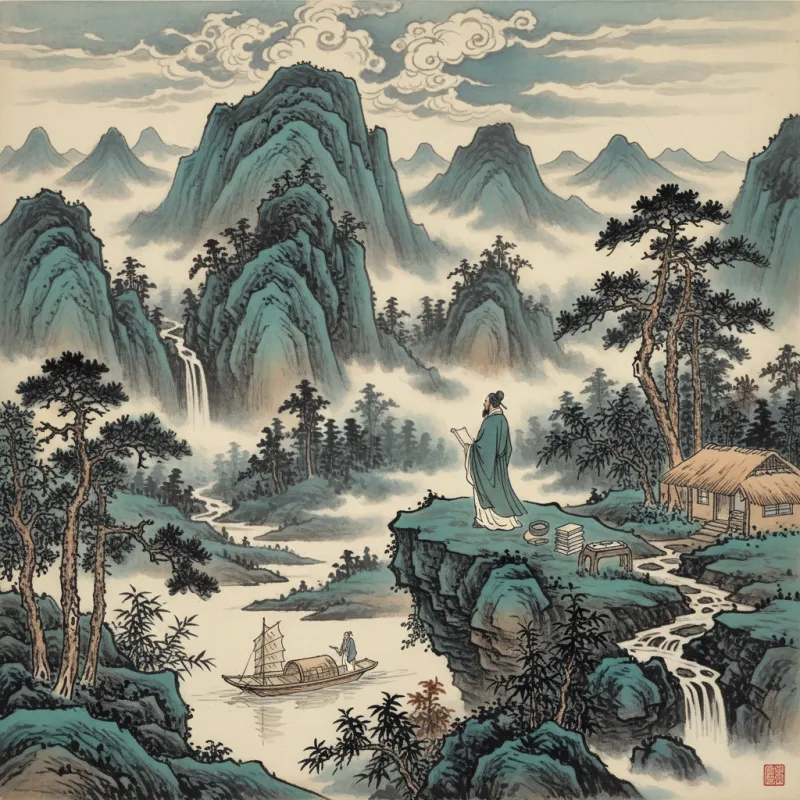
When Su Shi stood on the shores of Hainan Island in 1097, staring at the waves that separated him from everything he knew, he was 62 years old and certain he would die there. The Song Dynasty court had banished him to what was then considered the edge of civilization—a malarial, typhoon-battered rock where even criminals feared to go. Yet within months, he was writing some of the most serene, profound poetry of his career. "I ask the waves and the moon," he wrote, "and they answer with silence more eloquent than any court memorial." This wasn't despite his exile. It was because of it.
Chinese political history runs on a peculiar engine: brilliant officials speak truth to power, emperors take offense, banishment follows, and then—almost inevitably—great literature emerges. It happened so consistently that exile poetry (贬谪诗, biǎnzhé shī) became its own recognized genre, with conventions, expectations, and a canon of masterworks that rivals any other category in classical Chinese literature. The pattern is so reliable it's almost comedic: want to write your best work? Anger the emperor.
The Paradox of Productive Punishment
The logic seems backwards. How does political failure produce artistic success? How does losing everything—position, influence, proximity to power—create the conditions for literary immortality?
The answer lies in what exile actually meant for Tang and Song Dynasty officials. These weren't just poets who happened to work in government. They were Confucian scholars whose entire identity was built on service to the state. Their purpose was to advise the emperor, implement policy, and maintain social harmony. Exile didn't just remove them from court—it severed them from their reason for existing.
But it also freed them. At court, every word was calculated, every poem a potential political statement. In exile, thousands of miles from the capital, with no hope of immediate return, they could finally write without strategy. The result was poetry of startling honesty. Li Bai's wandering verses captured this freedom, though his exile was more self-imposed than court-mandated.
Qu Yuan: Inventing the Genre
Qu Yuan (屈原, c. 340-278 BCE) established the template. As a minister in the state of Chu during the Warring States period, he advocated for resistance against the expanding Qin state. His rivals convinced the king he was disloyal, and Qu Yuan was banished. He wandered the southern wilderness for years, and during that time wrote Li Sao (离骚, "Encountering Sorrow")—a 373-line masterpiece that remains one of the longest poems in classical Chinese.
Li Sao is hallucinatory, mythological, and deeply personal. Qu Yuan imagines himself flying through the heavens on a dragon-drawn chariot, seeking a ruler worthy of his service. He converses with shamans and spirits. He compares himself to fragrant herbs trampled by weeds. The poem's imagery is so dense and strange that scholars still debate its meaning, but its emotional core is unmistakable: this is what it feels like when loyalty is rewarded with rejection.
Qu Yuan eventually drowned himself in the Miluo River. The Dragon Boat Festival commemorates his death, and for two millennia, Chinese poets have looked to him as the archetype of the wronged official whose suffering produced transcendent art.
The Tang Dynasty: Exile as Career Stage
By the Tang Dynasty (618-907 CE), exile had become almost routine. The bureaucracy was vast, factions were vicious, and emperors were capricious. A single misstep—a poem that could be read as criticism, an association with the wrong official, a policy recommendation that failed—could result in banishment.
Liu Zongyuan (柳宗元, 773-819 CE) was exiled to Yongzhou in 805 CE after backing the wrong side in a succession dispute. He was 33 years old, at the peak of his career, and suddenly found himself governing a backwater prefecture in what is now Hunan province. He spent a decade there, and his essays and poems from that period—especially his "Eight Records of Yongzhou" (永州八记)—are considered masterpieces of Tang prose. He described the landscape with scientific precision and philosophical depth, finding in small streams and forgotten ponds the same patterns that governed the empire.
Liu Yuxi (刘禹锡, 772-842 CE) was exiled alongside Liu Zongyuan and spent 23 years in various remote posts. His poem "Humble Room Inscription" (陋室铭) became one of the most famous pieces of Chinese literature—a meditation on how a wise person can find contentment anywhere. "If the room is humble, my virtue makes it fragrant," he wrote, turning his shabby exile quarters into a philosophical statement.
Su Shi: The Master of Exile
No one embodied exile poetry more completely than Su Shi (苏轼, 1037-1101 CE), better known by his courtesy name Su Dongpo. He was exiled three times—to Huangzhou, Huizhou, and finally Hainan—and each banishment produced a distinct body of work.
The Huangzhou exile (1080-1084) came after Su Shi wrote poems that were interpreted as mocking the New Policies of Wang Anshi. He was nearly executed but was instead sent to a minor post in what is now Hubei province. There, he built a small farm on the eastern slope (东坡, dōngpō—hence his name), brewed wine, and wrote some of the most beloved poems in Chinese literature. His "Red Cliff Rhapsodies" (赤壁赋) meditate on history, impermanence, and the consolations of nature with a lightness that belies their philosophical depth.
The Hainan exile was harsher. Su Shi was 62, in poor health, and convinced he would never return. Yet his letters and poems from this period show remarkable equanimity. He learned to eat local foods, made friends with indigenous people, and wrote about oysters with the same attention he once gave to court politics. "I've been to the edge of the world," he wrote, "and found it surprisingly pleasant."
Why Exile Worked
The productivity of exile wasn't accidental. It created specific conditions that fostered great writing:
Distance from politics. At court, every word mattered. In exile, poets could write without calculating consequences. They could be honest about their feelings, critical of policies, and philosophical about failure.
Confrontation with nature. Exiled officials were sent to places the court considered barbarous—mountains, rivers, tropical islands. But these landscapes were often spectacular, and poets trained in Daoist and Buddhist thought found in them sources of consolation and insight. The relationship between landscape and emotion became central to the genre.
Time. Court life was busy. Exile was often boring. With no administrative duties worth mentioning and no social obligations, exiled poets had nothing but time to write, revise, and refine.
Suffering as credential. In Confucian thought, suffering tests character. An official who maintained dignity and produced beautiful work in exile proved their moral worth. The poems themselves became evidence of virtue.
The Legacy
Exile poetry shaped Chinese literary aesthetics in lasting ways. It established that the best art comes from genuine emotion, not courtly artifice. It validated landscape as a subject worthy of serious attention. It created a vocabulary for discussing failure, disappointment, and resilience that later poets would draw on for centuries.
The genre also created a strange incentive structure. By the Song Dynasty, some officials seemed almost eager for exile—it was a path to literary fame that success at court could never provide. Being banished meant you had principles. Staying in favor might mean you were a sycophant.
Modern Chinese writers still reference exile poetry when discussing the relationship between political persecution and artistic creation. The pattern Qu Yuan established—that suffering can produce transcendent art—remains powerful, even as the specific circumstances of Tang and Song Dynasty banishment have vanished. The poems remain, testaments to the strange alchemy that turned punishment into poetry, and failure into immortality.
Related Reading
- Su Shi in Exile: Making the Best of Banishment
- Su Shi in Exile: How Banishment Produced China's Greatest Prose
- Political Poetry: When Poets Challenged Emperors
- The Melancholy of Exile: A Journey Through Tang, Song, and Yuan Poetry
- Qu Yuan: The First Named Poet in Chinese History
- Unveiling the Essence of Chinese Classical Poetry: Insights from Tang, Song, and Yuan Poets
- Confucian Values in Classical Chinese Poetry: Duty, Loyalty, and the Weight of the World
- Nature Poetry in the Tang Dynasty: Mountains, Rivers, and the Art of Seeing
Explore Chinese Culture
- Explore the Tang dynasty's golden age
- Explore Daoist themes in classical poetry
- Explore Chinese literary traditions