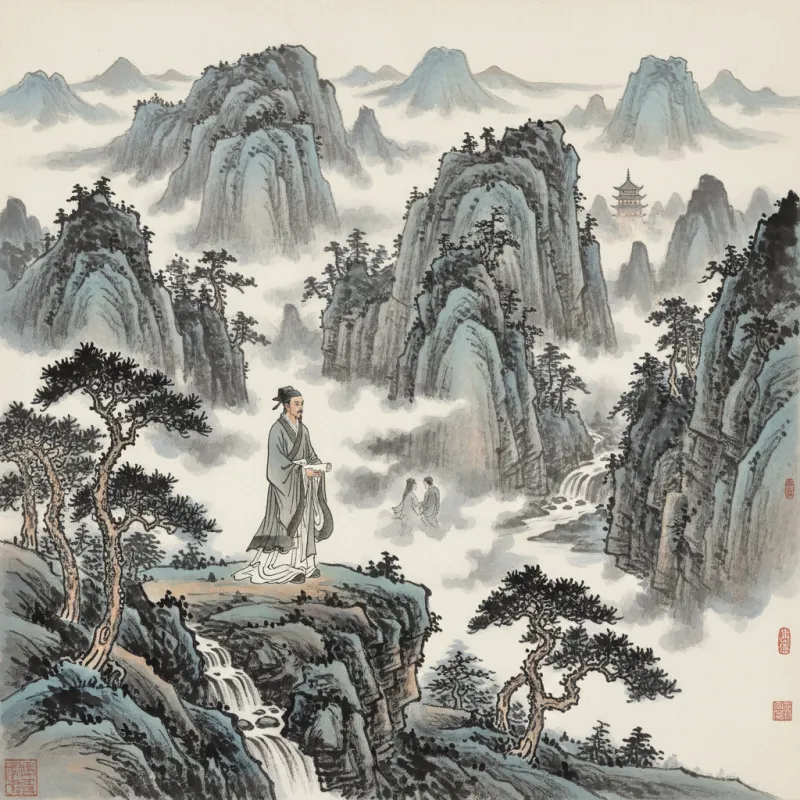
When Li Shangyin wrote "锦瑟 (Jǐn Sè, The Brocade Zither)," he created what would become the most debated poem in Chinese literary history—scholars have been arguing about its meaning for over a thousand years. Was it about lost love? Political disillusionment? A meditation on the poet's entire life? The answer is: probably all of these, and that's exactly what makes Li Shangyin the undisputed master of romantic ambiguity in Tang dynasty poetry.
The Poet Who Refused to Explain Himself
Li Shangyin (李商隐, Lǐ Shāngyǐn, 813-858 CE) lived during the late Tang dynasty, when the empire's golden age was crumbling into factional politics and military chaos. Unlike his contemporary Du Mu, who wrote with crystalline clarity about courtesans and autumn scenery, Li Shangyin wrapped his meanings in layers of allusion, symbol, and deliberate obscurity. He never explained his poems, never provided helpful notes for confused readers, and seemed to take perverse pleasure in leaving everyone guessing.
This wasn't accidental. Li Shangyin was caught between two powerful political factions—the Niu and Li cliques—that dominated late Tang court politics. His patron belonged to one faction, his wife's family to the other. Writing directly about politics could get you exiled or worse. So Li developed a poetic style so allusive and multilayered that even today, scholars can't agree on what many of his poems actually mean. Was he writing about romantic love, or using romance as a metaphor for political loyalty? Yes.
The Untitled Poems: Love Letters to Unknown Recipients
Li Shangyin wrote dozens of poems titled simply "无题 (Wú Tí, Untitled)," a move that was either brilliantly mysterious or frustratingly evasive, depending on your perspective. These poems are saturated with romantic longing, but we rarely know who the beloved is—or if there even was a specific person. Consider his most famous untitled poem, which opens:
"相见时难别亦难 (Xiāng jiàn shí nán bié yì nán)"—"Meeting is difficult, parting is difficult too"
The poem describes silkworms spinning silk until death and candles burning to ash, images of devotion that consume the lover entirely. But is this about his wife? A courtesan? A political patron? An idealized figure who never existed? Li Shangyin isn't telling, and that ambiguity is the point. The poem works on every level simultaneously.
What makes these untitled poems so powerful is their emotional authenticity despite—or because of—their referential vagueness. You don't need to know who inspired them to feel the ache of separation, the frustration of barriers between lovers, the sense that time is running out. Li Shangyin understood that the most universal emotions are often the most personal, and that by refusing to specify, he allowed every reader to project their own experiences onto his verse.
Symbolism So Dense You Need a Decoder Ring
Reading Li Shangyin requires familiarity with an entire library of classical Chinese literature, mythology, and historical allusion. He references the goddess of the Xiang River, the jade palace of immortals, the ancient kingdom of Shu, and dozens of other figures and places that would have been immediately recognizable to educated Tang readers but require footnotes for modern audiences. His poem "嫦娥 (Cháng'é)" about the moon goddess contains at least four layers of meaning packed into just four lines.
This density isn't showing off—it's technique. By invoking these allusions, Li Shangyin could suggest complex emotional states and political situations without stating them directly. When he writes about the goddess who stole the elixir of immortality and now lives alone on the moon, he's simultaneously talking about isolation, the price of ambition, the loneliness of the imperial court, and possibly his own marriage. The allusions create resonance, like overtones in music.
Compare this to Wang Wei, whose Buddhist-influenced poetry aimed for simplicity and directness. Li Shangyin went the opposite direction, creating poems that were puzzles, riddles, and emotional Rorschach tests all at once.
The Brocade Zither: A Masterpiece of Deliberate Confusion
"锦瑟 (Jǐn Sè)" is Li Shangyin's most famous poem and the one that best exemplifies his aesthetic of productive ambiguity. The title refers to a decorated zither with fifty strings, but the poem itself is a cascade of images: Zhuangzi's butterfly dream, the ancient king who made cuckoos weep blood, mermaids crying pearls, jade warming in the sun. What does it all mean?
Scholars have proposed at least twenty different interpretations. Some say it's about his deceased wife. Others argue it's a political allegory. Some think it's about the poet's entire career, with each couplet representing a different phase of his life. The most honest answer is that it's probably about all of these things, and Li Shangyin deliberately structured it so that no single interpretation could be definitive.
The genius of "Jǐn Sè" is that it captures the feeling of looking back on your life and finding it both beautiful and incomprehensible, full of moments that seemed meaningful but whose significance you can't quite articulate. The final line—"此情可待成追忆,只是当时已惘然 (Cǐ qíng kě dài chéng zhuī yì, zhǐ shì dāng shí yǐ wǎng rán)"—roughly translates to "These feelings could have become memories to cherish, but even at the time I was already lost and confused." That's the human condition in fourteen characters.
Love, Politics, and the Art of Plausible Deniability
Li Shangyin's career was marked by frustration. He passed the imperial examinations relatively late, at age twenty-five, and never rose to high office. He spent years in minor provincial posts, separated from his wife, watching less talented men advance through political connections. His poetry reflects this disappointment, but always obliquely.
When he writes about abandoned palace ladies or neglected concubines, is he really writing about women, or is he using them as metaphors for his own political marginalization? When he describes passionate love affairs, is he talking about romance or about the intense loyalty between patron and client in Tang political culture? The answer is both, and that's what makes the poems so rich.
This technique of using romantic imagery to discuss politics had precedents in Chinese poetry—the "Classic of Poetry (詩經, Shījīng)" from a thousand years earlier did the same thing. But Li Shangyin perfected it, creating poems that work equally well as love poetry and as political commentary, where the two meanings enhance rather than contradict each other.
Why Li Shangyin Still Matters
In an age of social media where everyone overshares and nothing is left to the imagination, Li Shangyin's poetry feels almost subversive. He understood that some emotions are too complex for direct statement, that ambiguity can be more truthful than clarity, and that what's left unsaid is often more powerful than what's explicit.
His influence on later Chinese poetry was enormous. The Song dynasty ci poetry tradition, with its emphasis on romantic longing and emotional subtlety, owes a huge debt to Li Shangyin. Even modern Chinese poets reference his work, using his techniques of layered allusion and deliberate ambiguity to navigate their own complicated political and emotional landscapes.
Reading Li Shangyin is like looking at one of those optical illusions where you can see either a vase or two faces, depending on how you focus your eyes. His poems shift meaning depending on how you approach them, revealing new layers with each reading. You'll never pin down exactly what he meant—and that's not a bug, it's a feature. In a world that demands everything be explained and categorized, Li Shangyin's poetry remains gloriously, frustratingly, beautifully unclear.
Related Reading
- Tao Yuanming: The Recluse Who Found Paradise
- Women Poets of China: Voices Across Three Millennia
- Du Fu: The Conscience of Chinese Poetry
- Bai Juyi: The Song of Everlasting Sorrow
- The Great Poets of China: Li Bai, Du Fu, and the Rivalry That Never Was
- Delving into the Techniques of Chinese Classical Poetry: Insights from Tang, Song, and Yuan Poets
- Love and Longing in Chinese Classical Poetry: Tang, Song, and Yuan Dynasties Explored
- Why Some Chinese Poems Are Untranslatable: The Beauty That Gets Lost
Explore Chinese Culture
- Explore the Tang dynasty's golden age
- Explore Daoist themes in classical poetry
- Explore Chinese literary traditions