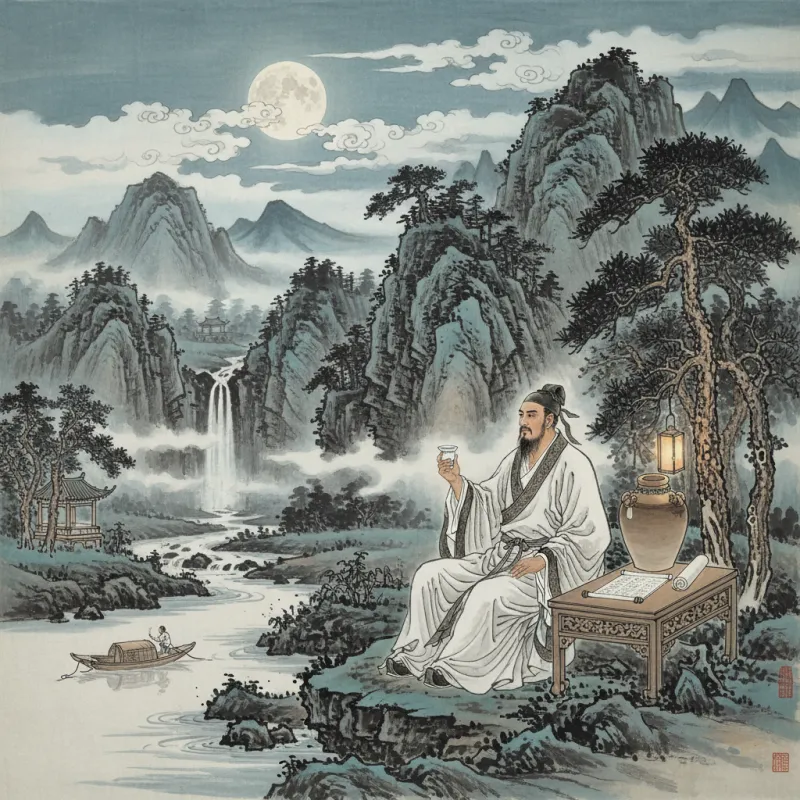
Picture this: It's 742 CE, and China's greatest poet is drunk again. Li Bai (李白, Lǐ Bái) staggers through the imperial gardens, raises his wine cup to the moon, and declares it his drinking companion. His shadow dances beside him. Together, the three of them—man, moon, and shadow—form the most famous drinking party in Chinese literary history. This wasn't just poetic whimsy. For Li Bai, wine was the gateway to transcendence, the liquid bridge between the mundane world and the realm of immortals.
Wine as Spiritual Practice
Li Bai didn't drink to forget. He drank to remember—to remember who he truly was beneath the constraints of Tang dynasty society. While Confucian officials sipped their wine with measured propriety, Li Bai guzzled it with abandon. His contemporaries called him the "Banished Immortal" (谪仙人, zhé xiān rén), suggesting he was a celestial being exiled to earth for some heavenly transgression. Wine, in this cosmology, wasn't an escape but a return ticket.
The Daoist undercurrents in Li Bai's drinking poems are impossible to miss. Daoism celebrated spontaneity, naturalness, and the dissolution of artificial boundaries—exactly what alcohol provided. When Li Bai wrote "I drink alone, no friend in sight" (独酌无相亲, dú zhuó wú xiāng qīn), he wasn't lamenting loneliness. He was celebrating liberation from social performance. The moon and his shadow became better companions than any human precisely because they demanded nothing, judged nothing, and simply existed alongside him in pure, unfiltered presence.
The Architecture of Solitude
"Drinking Alone Under the Moon" (月下独酌, Yuè Xià Dú Zhuó) remains Li Bai's most iconic wine poem, and its genius lies in how it transforms isolation into abundance. The opening line—"Among the flowers, a pot of wine" (花间一壶酒, huā jiān yī hú jiǔ)—establishes a scene of sensory richness. He's not drinking in some dingy tavern but surrounded by spring blossoms, nature's own celebration.
Then comes the pivot: "I raise my cup to invite the bright moon; / With my shadow, we make three" (举杯邀明月,对影成三人, jǔ bēi yāo míng yuè, duì yǐng chéng sān rén). This is mathematical alchemy. One lonely drinker becomes a trio through sheer imaginative force. But Li Bai immediately undercuts his own fantasy: "The moon doesn't know how to drink; / My shadow merely follows me" (月既不解饮,影徒随我身, yuè jì bù jiě yǐn, yǐng tú suí wǒ shēn). He's fully aware these companions are projections, yet he chooses to embrace the illusion anyway. This self-aware playfulness distinguishes Li Bai from mere drunken sentimentality.
The poem's middle section—"I sing—the moon wavers. / I dance—my shadow staggers" (我歌月徘徊,我舞影零乱, wǒ gē yuè pái huái, wǒ wǔ yǐng líng luàn)—captures the physical reality of intoxication while elevating it to cosmic choreography. The moon doesn't actually waver; Li Bai's drunken perception makes it seem so. His shadow doesn't stagger independently; it mirrors his own unsteady movements. Yet by attributing agency to these natural phenomena, he creates a universe that responds to human emotion, a cosmos that dances with the poet rather than remaining coldly indifferent.
The Wine Immortal Persona
Li Bai cultivated his drinking reputation deliberately. The "Eight Immortals of the Wine Cup" (饮中八仙, Yǐn Zhōng Bā Xiān), a group of Tang dynasty poets and officials famous for their alcohol consumption, counted Li Bai among their number. Du Fu (杜甫, Dù Fǔ), Li Bai's friend and rival, immortalized this crew in a poem that describes Li Bai as someone who "writes a hundred poems after a dou of wine" (斗酒诗百篇, dǒu jiǔ shī bǎi piān)—a dou being roughly ten liters. Whether literally true or not, the image stuck: Li Bai as the poet who needed wine to access his genius.
But this wasn't simple alcoholism romanticized. Li Bai's drinking poems operate on multiple registers simultaneously. On the surface, they're celebrations of pleasure and spontaneity. Dig deeper, and they're critiques of Confucian sobriety and political conformity. Go deeper still, and they're meditations on mortality, time, and the human condition. In "Waking from Drunkenness on a Spring Day" (春日醉起言志, Chūn Rì Zuì Qǐ Yán Zhì), he writes: "Life in the world is but a big dream; / I will not spoil it by any labor or care" (处世若大梦,胡为劳其生, chǔ shì ruò dà mèng, hú wéi láo qí shēng). Wine becomes the tool for seeing through the dream, not deepening it.
Moon, Wine, and Cosmic Loneliness
The moon appears in Li Bai's poetry with obsessive frequency—over 320 times across his collected works. It's never just scenery. The moon represents the eternal witness, the unchanging constant against which human transience plays out. When Li Bai drinks with the moon, he's drinking with time itself, with the same celestial body that shone on ancient sages and will shine on future generations long after he's dust.
This cosmic perspective infuses his drinking poems with a peculiar melancholy. Yes, he celebrates wine's pleasures, but always with the awareness that pleasure is fleeting. "Pleasure must be seized in spring" (行乐须及春, xíng lè xū jí chūn) isn't hedonistic advice—it's existential urgency. Spring passes. Youth passes. Life passes. Wine offers not escape from this reality but full-bodied engagement with it. You drink because you're mortal, not despite it.
Compare this to Du Fu's poetry, which grounds itself in social observation and historical moment. Du Fu drinks too, but his drinking poems often lament poverty, war, and separation. Li Bai's drinking transcends circumstance. Whether he's wealthy or poor, favored at court or wandering in exile, wine remains his constant companion and his gateway to something beyond the immediate situation.
The Technique Behind the Intoxication
Li Bai's drinking poems succeed because they're technically brilliant, not just emotionally resonant. His use of the seven-character line (七言, qī yán) in "Drinking Alone Under the Moon" creates a rhythm that mimics the swaying of a drunk—longer than the five-character line, with more room for elaboration and digression, yet still structured enough to avoid collapsing into incoherence.
His parallelism is masterful. "I sing—the moon wavers. / I dance—my shadow staggers" creates perfect symmetry: subject-verb in both lines, celestial object paired with earthly object, movement paired with movement. This formal control exists in tension with the content's celebration of abandon. The poem is simultaneously drunk and sober, wild and disciplined—much like Li Bai himself, who could dash off verses while intoxicated that lesser poets couldn't produce after months of sober revision.
The closing couplet—"Forever bound in passionless friendship, / We'll meet again in the distant Milky Way" (永结无情游,相期邈云汉, yǒng jié wú qíng yóu, xiāng qī miǎo yún hàn)—elevates the entire poem from earthly drinking scene to cosmic covenant. "Passionless friendship" (无情游, wú qíng yóu) is paradoxical: how can friendship be passionless? But Li Bai means something specific: a relationship free from human emotional demands, from neediness and expectation. The moon and shadow ask nothing of him. Their companionship is pure, uncomplicated by the messy entanglements of human relationships.
Wine's Dark Undercurrent
We should acknowledge what Li Bai's poetry sometimes obscures: alcohol likely contributed to his death. The most popular legend claims he drowned while drunkenly trying to embrace the moon's reflection in the Yangtze River—a story so perfectly aligned with his poetic persona that it's almost certainly apocryphal. More reliable accounts suggest he died of illness, possibly alcohol-related, around age 61.
His drinking poems don't hide this darkness entirely. Beneath the celebration runs a current of desperation, a sense that wine is necessary rather than merely enjoyable. "I drink alone" isn't always triumphant solitude—sometimes it's just loneliness. The moon doesn't drink back. The shadow doesn't speak. For all his cosmic companionship, Li Bai remained fundamentally alone, and he knew it.
Yet this awareness doesn't diminish the poems' power. If anything, it deepens them. Li Bai's drinking poems work because they're honest about what wine provides and what it can't. Wine grants temporary transcendence, momentary escape from the self, brief communion with something larger. But temporary is the operative word. Dawn always comes. The hangover always follows. And yet—and this is Li Bai's great insight—the temporary transcendence is still transcendence. The brief escape is still escape. Better to have drunk with the moon than never to have looked up at all.
Legacy and Influence
Li Bai's drinking poems established a template that Chinese poets have followed, subverted, and reimagined for over a millennium. When later poets write about wine, they're inevitably in conversation with Li Bai, either embracing his model or rejecting it. The Song dynasty poet Su Shi explicitly invokes Li Bai in his own drinking poems, while others use wine to signal their connection to this literary tradition.
But Li Bai's influence extends beyond poetry. His wine-soaked persona has become inseparable from Chinese cultural identity's romantic, rebellious strain. He represents the road not taken by Confucian officials, the life unlived by dutiful sons and loyal bureaucrats. In a culture that often prizes conformity and social harmony, Li Bai offers permission to be excessive, spontaneous, and gloriously impractical.
His drinking poems remind us that poetry isn't just about craft—it's about finding language for experiences that resist language. Intoxication, transcendence, loneliness, joy: these states exist beyond words, yet Li Bai found words for them anyway. He raised his cup to the moon, and the moon—silent, distant, eternal—somehow raised its cup back. That's the magic of his poetry: it makes the impossible feel not just possible but inevitable, as natural as spring flowers and as necessary as wine.
Related Reading
- Li Bai's Moonlight Poems: Drinking Alone Under the Moon
- Wang Wei: The Poet-Painter of Nature
- Du Fu's War Poems: Witnessing the An Lushan Rebellion
- 10 Greatest Tang Poems Every Reader Should Know
- The Complete Guide to Chinese Classical Poetry: From Tang Poems to Song Ci
- Unraveling the Essence of Drinking Poetry in Tang, Song, and Yuan Eras
- Delving into the Techniques of Chinese Classical Poetry: Insights from Tang, Song, and Yuan Poets
- Ezra Pound and Chinese Poetry: Beautiful Mistakes
Explore Chinese Culture
- Explore the Tang dynasty's golden age
- Explore Daoist themes in classical poetry
- Explore Chinese literary traditions