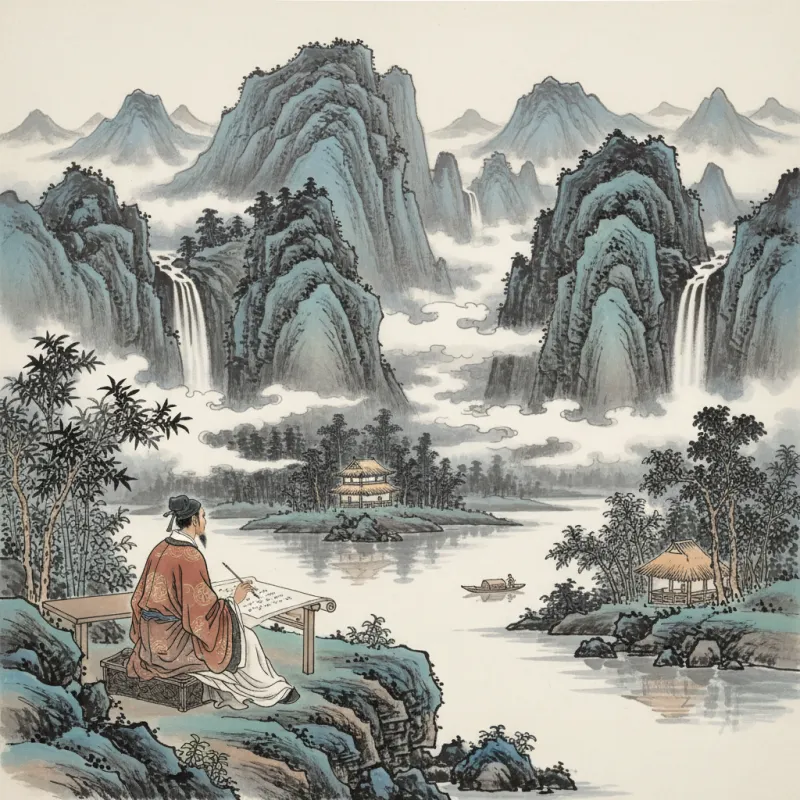
Picture this: a government official in 8th-century China couldn't get promoted without writing excellent poetry. Diplomats exchanged verses instead of business cards. Friends parted ways by composing poems on the spot, sometimes while drunk. This wasn't a quirky cultural footnote—this was the Tang Dynasty, where poetry wasn't just art, it was the currency of civilization itself.
The Dynasty That Made Poetry Matter
The Tang Dynasty (618-907 CE) produced over 48,000 surviving poems from more than 2,200 poets. To put that in perspective, that's roughly equivalent to the entire collected works of Shakespeare multiplied by 240. But sheer volume doesn't explain why Tang poetry (唐诗, Tángshī) remains the undisputed pinnacle of Chinese literature, studied obsessively by students even today, 1,300 years later.
The Tang succeeded where other dynasties failed because it made poetry structurally essential to power. Emperor Taizong (reigned 626-649) didn't just appreciate poetry—he institutionalized it. The imperial examination system (科举, kējǔ) required candidates to compose regulated verse under time pressure. Imagine if modern civil service exams demanded you write a sonnet in iambic pentameter to qualify for a government job. That's essentially what happened, and it transformed Chinese culture.
The Forms That Defined an Era
Tang poets didn't write free verse. They worked within strict formal constraints that would make a haiku look loose by comparison. The two dominant forms were regulated verse (律诗, lǜshī) and quatrains (绝句, juéjù), both governed by complex tonal patterns that exploited the musical qualities of Classical Chinese.
A standard regulated verse consisted of eight lines, each with either five or seven characters. But here's where it gets interesting: characters in positions 2, 4, and 6 had to follow prescribed tonal patterns—level tones (平声, píngshēng) alternating with deflected tones (仄声, zèshēng). The middle two couplets required strict parallelism: if line three mentioned "mountain," line four needed a corresponding natural feature. If you used a verb in position three of line five, you needed a verb in the same position of line six.
These weren't arbitrary rules. Classical Chinese is a tonal language where pitch distinguishes meaning, and these patterns created a musical rhythm that's impossible to replicate in English translation. When you read Tang poetry in the original, you're essentially reading scored music. This is why understanding classical Chinese poetic forms matters—the constraints weren't limitations, they were the instrument.
The Big Three (And Why That's Misleading)
Ask any Chinese person to name Tang poets, and you'll hear three names: Li Bai (李白, Lǐ Bái, 701-762), Du Fu (杜甫, Dù Fǔ, 712-770), and Wang Wei (王维, Wáng Wéi, 699-759). This trinity dominates anthologies, textbooks, and cultural memory. But here's what's interesting: they represent radically different approaches to poetry.
Li Bai was the romantic drunk, famous for allegedly drowning while trying to embrace the moon's reflection in a river. His poetry explodes with imagination—he writes about riding whales, conversing with mountains, and drinking with the moon as his companion. Reading Li Bai feels like watching fireworks: dazzling, spontaneous, slightly dangerous.
Du Fu was the opposite: meticulous, socially conscious, technically perfect. While Li Bai partied, Du Fu documented the An Lushan Rebellion (755-763), wrote about starving peasants, and perfected the regulated verse form. His poetry is architecture—every character precisely placed, every tonal pattern flawless. Later critics called him the "Poet Sage" (诗圣, shīshèng), and they meant it as the highest compliment.
Wang Wei painted with words. A devout Buddhist and accomplished landscape painter, his poems create visual scenes so precise you can almost sketch them. His famous line "Empty mountain, no one seen / But human voices heard" (空山不见人,但闻人语响) captures an entire aesthetic philosophy in ten characters.
The problem with the "Big Three" framework is that it obscures hundreds of other brilliant poets. Bai Juyi (白居易, Bái Jūyì, 772-846) wrote poetry so accessible that illiterate peasants could memorize it. Li Shangyin (李商隐, Lǐ Shāngyǐn, 813-858) crafted verses so allusive and complex that scholars still debate their meanings. And then there's the courtesan-poet Xue Tao (薛涛, Xuē Tāo, 768-831), whose work proves that Tang poetry wasn't exclusively a male domain, even if the historical record tried to make it seem that way.
Poetry as Social Technology
Here's what makes Tang poetry fundamentally different from Western poetry: it wasn't primarily about self-expression or artistic innovation. It was social infrastructure.
When a Tang official received a promotion and had to leave his post, his colleagues would gather for a farewell banquet. Everyone present was expected to compose a poem on the spot. These weren't casual verses—they were carefully crafted pieces that demonstrated your education, emotional depth, and social grace. Failing to produce a good poem was like showing up to a modern business meeting without knowing how to use PowerPoint.
Diplomatic missions exchanged poems. Monks wrote poems to demonstrate enlightenment. Lovers communicated through poetry because direct emotional expression was considered crude. The emperor himself composed verses and expected his officials to respond in kind. Poetry wasn't a hobby or a profession—it was the operating system of elite Tang society.
This social function explains why Tang poetry often feels impersonal to Western readers. When Li Bai writes about saying goodbye to a friend, he's not necessarily expressing his unique personal feelings—he's performing a social ritual that his culture had refined over centuries. The genius lies not in raw emotional honesty but in how skillfully he manipulates conventional imagery and form to create something that feels both traditional and fresh.
What Gets Lost in Translation
Every English translation of Tang poetry is a beautiful lie. The problem isn't translator incompetence—it's that the source material is fundamentally untranslatable.
Take Li Bai's most famous poem, "Quiet Night Thought" (静夜思, Jìng Yè Sī). In Chinese, it's twenty characters arranged in four lines of five characters each. The tonal patterns create a musical rhythm. The characters themselves carry visual weight—the character for "moon" (月) looks like a crescent moon. Multiple meanings collapse into single characters through centuries of literary allusion.
English translations typically render it as something like: "Before my bed, the bright moonlight / Like frost upon the ground / I lift my head to watch the bright moon / Lower my head and think of home." That's accurate enough, but it's like describing a symphony by listing the notes. The music is gone. The visual poetry is gone. The allusive depth is gone.
This is why serious students of Tang poetry eventually learn Classical Chinese. Not because they're masochists, but because there's simply no other way to experience what makes these poems great. The translations give you the plot summary; the originals give you the actual experience.
Why Tang Poetry Still Matters
In contemporary China, educated people can still recite dozens of Tang poems from memory. Children learn them in elementary school. Politicians quote them in speeches. Calligraphers practice them. This isn't nostalgia—it's living tradition.
Tang poetry matters because it represents a civilization that took poetry more seriously than any other in human history. For three centuries, the most powerful empire on earth organized itself around the principle that the ability to write beautiful verse was essential to good governance. That's a remarkable cultural achievement, regardless of whether you think the principle was correct.
But it also matters because Tang poetry solved problems that still challenge poets today: how to work within strict formal constraints while remaining emotionally authentic, how to balance tradition with innovation, how to make art that's both socially functional and aesthetically profound. The major Tang Dynasty poets weren't just writing pretty verses—they were conducting experiments in what poetry could do and be.
The Tang Dynasty ended in 907 CE, fragmenting into chaos. The poetry survived. That tells you something about what lasts and what doesn't. Empires collapse, but a perfectly crafted eight-line poem about moonlight and homesickness can outlive dynasties. The Tang poets knew this. That's why they worked so hard to get every character right.
Related Reading
- Du Fu's War Poems: Witnessing the An Lushan Rebellion
- Wang Wei: The Poet-Painter of Nature
- Tang Poetry: Why the Tang Dynasty Was Poetry's Golden Age
- Li Bai's Drinking Poems: Wine, Moon, and the Soul of Chinese Poetry
- 10 Greatest Tang Poems Every Reader Should Know
- Li Bai vs Du Fu: The Rivalry That Defined Chinese Poetry
- Poetic Forms: The Rules That Made Chinese Poetry Great
- How to Read a Chinese Poem: A Practical Guide for English Speakers
Explore Chinese Culture
- Explore the Tang dynasty's golden age
- Explore Daoist themes in classical poetry
- Explore Chinese literary traditions