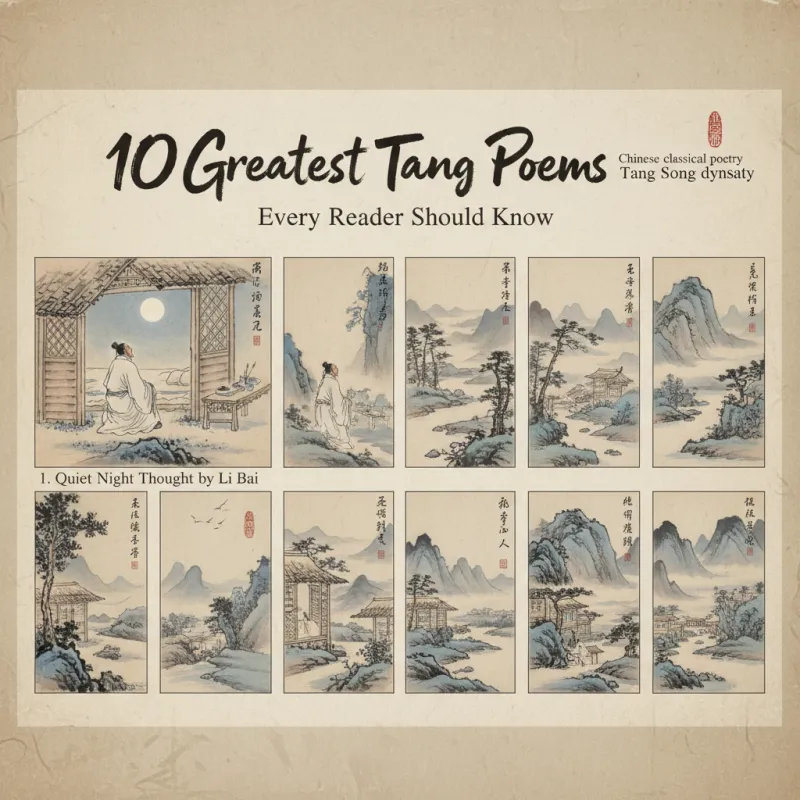
Picture this: a traveler wakes in an unfamiliar inn, sees moonlight pooling on the floor, and for one disorienting moment thinks it's frost. That split-second confusion—captured in just twenty characters by Li Bai—has echoed through 1,300 years of Chinese consciousness. It's the poem every Chinese child learns first, the one that grandmothers recite while folding dumplings, the four lines that somehow contain the entire weight of exile, longing, and the moon's cold comfort.
The Tang Dynasty (618-907 CE) produced roughly 50,000 poems that survive today. But if you forced a billion Chinese speakers to name just ten—the ones that matter, the ones that shaped how an entire civilization thinks about beauty, loss, and the natural world—you'd get remarkable consensus. These aren't museum pieces. They're living texts, quoted in text messages, referenced in pop songs, embedded so deeply in the culture that people use them without thinking, the way English speakers say "to be or not to be" without consciously invoking Shakespeare.
The Poem Everyone Knows First
Li Bai's (李白, Lǐ Bái) "Quiet Night Thought" (静夜思, Jìng Yè Sī) is deceptively simple. Twenty characters. Four lines. A child can memorize it in five minutes. But that simplicity is the point—it's a poem about the most basic human experience: being far from home and wanting to go back.
床前明月光,疑是地上霜。
举头望明月,低头思故乡。
Moonlight before my bed—perhaps frost on the ground.
I lift my eyes to the bright moon, lower them and think of home.
The genius is in that moment of confusion: 疑是 (yí shì)—"perhaps," "seems like," "I mistake it for." Li Bai doesn't just see moonlight. He sees it wrong first, thinks it's frost, and in that cognitive stumble, we feel his disorientation. He's not fully present. His mind is already elsewhere, already home. The poem enacts homesickness rather than describing it. For more on Li Bai's relationship with the moon, see Li Bai's Drinking Poems: Wine, Moon, and the Soul of Chinese Poetry.
The Morning After
Meng Haoran (孟浩然, Mèng Hàorán) gives us something different in "Spring Dawn" (春晓, Chūn Xiǎo)—the lazy, half-awake realization that spring is happening whether you're paying attention or not.
春眠不觉晓,处处闻啼鸟。
夜来风雨声,花落知多少。
In spring sleep, I didn't notice dawn.
Everywhere, birds singing.
Last night—wind and rain.
How many blossoms have fallen?
This is the poem of someone who slept through the alarm, who missed the moment, who wakes to find the party already started. The birds are loud. The storm has passed. And somewhere out there, petals are scattered on wet ground—but how many? The question hangs unanswered because Meng Haoran isn't getting out of bed to count them. He's going to lie there and wonder, which is somehow more poignant than knowing.
Saying Goodbye at Yellow Crane Tower
Li Bai shows up again with "Seeing Off Meng Haoran at Yellow Crane Tower" (黄鹤楼送孟浩然之广陵, Huáng Hè Lóu Sòng Mèng Hàorán Zhī Guǎnglíng)—yes, the same Meng Haoran from "Spring Dawn." They were friends. This is Li Bai watching his friend's boat disappear downriver.
故人西辞黄鹤楼,烟花三月下扬州。
孤帆远影碧空尽,唯见长江天际流。
My old friend leaves Yellow Crane Tower in the west,
In the mist and flowers of third month, going down to Yangzhou.
The lonely sail's distant shadow vanishes into blue emptiness,
I see only the Yangtze flowing to the sky's edge.
The last line is what makes this poem unforgettable. Li Bai doesn't look away when the boat disappears. He keeps watching the river—the same river that carried his friend away—flowing on and on toward the horizon. It's a poem about the aftermath of goodbye, the empty space where someone used to be, and the world's indifference to your personal loss. The Yangtze doesn't care. It just keeps flowing.
The Frontier and Its Discontents
Wang Changling (王昌龄, Wáng Chānglíng) wrote the definitive frontier poem with "Out of the Frontier" (出塞, Chū Sài), and it's angry in a way that Tang poetry rarely allows itself to be.
秦时明月汉时关,万里长征人未还。
但使龙城飞将在,不教胡马度阴山。
The moon of Qin times, the passes of Han times,
Ten thousand li of campaigning, and the soldiers haven't returned.
If only the Flying General of Dragon City were still here,
He wouldn't let barbarian horses cross Yin Mountain.
This is 742 CE, and China is still sending young men to die on the same frontiers it was defending a thousand years earlier. Wang Changling's point is brutal: nothing has changed. Same moon, same mountain passes, same pointless wars, same families waiting for sons who will never come home. The "Flying General" he references is Li Guang, a legendary Han Dynasty commander—but he's been dead for 900 years. That's the poem's bitter joke: we're still wishing for heroes from ancient history because our current leaders are useless.
The Hermit's Refusal
Wang Wei (王维, Wáng Wéi) perfected the art of the polite "no" in "Deer Park" (鹿柴, Lù Zhài), a poem so quiet you can hear the silence.
空山不见人,但闻人语响。
返景入深林,复照青苔上。
Empty mountains, no one in sight,
But I hear echoes of people's voices.
Returning light enters the deep forest,
Shining again on the green moss.
Wang Wei was a Buddhist, a painter, and a government official who spent as much time as possible not being a government official. This poem is his aesthetic manifesto: emptiness, distance, the natural world doing its thing without human interference. The voices are far away. The light is indirect, filtered through trees. Even the moss—the lowest, most overlooked form of plant life—gets its moment of illumination. For more on Tang Dynasty nature poetry, explore Tang Poetry and the Natural World.
The Soldier's Wife
Du Fu (杜甫, Dù Fǔ)—often called China's greatest poet—gives us "Moonlit Night" (月夜, Yuè Yè), written while he was separated from his family during the An Lushan Rebellion (755-763 CE).
今夜鄜州月,闺中只独看。
遥怜小儿女,未解忆长安。
香雾云鬟湿,清辉玉臂寒。
何时倚虚幌,双照泪痕干。
Tonight, the moon over Fuzhou—in her chamber, she watches alone.
From afar I pity my young children, too small to remember Chang'an.
Fragrant mist dampens her cloud-like hair, clear light chills her jade arms.
When will we lean together by the sheer curtain, its light drying both our tears?
Du Fu doesn't write from his own perspective. He imagines his wife looking at the same moon, thinking of him, while their children—too young to understand—play nearby. It's almost unbearably tender, this act of imaginative empathy, this attempt to see himself through her eyes. The physical details—damp hair, cold arms—make her real in a way that abstraction never could.
The Eternal Parting
Bai Juyi (白居易, Bái Jūyì) wrote "Song of Everlasting Regret" (长恨歌, Cháng Hèn Gē), an 840-line narrative poem about Emperor Xuanzong and his beloved concubine Yang Guifei. But his most famous short poem is "Grass on the Ancient Plain" (赋得古原草送别, Fù Dé Gǔ Yuán Cǎo Sòng Bié):
离离原上草,一岁一枯荣。
野火烧不尽,春风吹又生。
Boundless grass on the ancient plain,
Each year it withers and flourishes.
Wildfire cannot burn it all,
Spring wind blows and it grows again.
Bai Juyi was sixteen when he wrote this. It's a poem about resilience, about the things that survive us, about grass—stupid, ordinary grass—outlasting empires. The wildfire line became proverbial in Chinese, used to describe any movement or idea that keeps coming back no matter how hard you try to suppress it.
The Recluse's Invitation
Wang Wei appears again with "Answering Vice Magistrate Zhang" (答张五弟, Dá Zhāng Wǔ Dì), though it's often known by its first line:
晚年唯好静,万事不关心。
自顾无长策,空知返旧林。
In my later years I love only stillness,
Ten thousand affairs no longer concern me.
I know I have no grand strategies,
I only know to return to the old forest.
This is the poem of every burned-out professional who's ever fantasized about quitting their job and moving to the woods. Wang Wei actually did it—bought property in the Zhongnan Mountains and built a retreat where he could paint, write poetry, and ignore the imperial court's increasingly desperate summons. The poem's power is in its unapologetic withdrawal: I have nothing to offer you. Leave me alone.
The Drinker's Lament
Li Bai's "Drinking Alone Under the Moon" (月下独酌, Yuè Xià Dú Zhuó) is longer than most poems on this list, but its opening stanza is essential:
花间一壶酒,独酌无相亲。
举杯邀明月,对影成三人。
Among the flowers, a pot of wine,
I drink alone, no one close to me.
I raise my cup to invite the bright moon,
With my shadow we become three.
Li Bai is so lonely he has to invent drinking companions—the moon and his own shadow. It's funny and desperately sad at the same time, which is very Li Bai. He was famous for his drinking, his arrogance, his refusal to bow to authority, and his absolute conviction that poetry mattered more than politics. He supposedly drowned while drunk, trying to embrace the moon's reflection in a river. It's probably not true, but it should be.
Why These Ten?
These poems survive because they're useful. Chinese speakers quote them in wedding toasts, text them to friends who've moved away, write them in calligraphy as gifts, reference them in business meetings to make a point about persistence or loss or the passage of time. They're not museum artifacts. They're living language, tools for articulating experiences that haven't changed in 1,300 years: missing home, saying goodbye, watching seasons change, wondering if your life matters, wanting to be left alone, drinking too much and feeling sorry for yourself.
The Tang poets wrote in a language that's now archaic, about a world that's vanished. But somehow—through translation, through cultural transmission, through sheer emotional precision—these poems still work. They still make you feel something. That's not magic. That's craft. That's what happens when someone pays enough attention to their own experience to render it in words that transcend the moment of their creation.
Read these ten poems, and you'll understand something essential about Chinese culture. But more than that, you'll understand something about being human—about the universal experiences of longing, loss, beauty, and the stubborn refusal to let those experiences go unrecorded.
Related Reading
- Wang Wei: The Poet-Painter of Nature
- Du Fu's War Poems: Witnessing the An Lushan Rebellion
- Tang Poetry: Why the Tang Dynasty Was Poetry's Golden Age
- The Complete Guide to Chinese Classical Poetry: From Tang Poems to Song Ci
- Translating Chinese Poetry: Why Every Translation Is Wrong (And Why That Is Fine)
- The Harmony of Nature in Chinese Classical Poetry: Tang, Song, and Yuan Dynasties
- Frontier Poetry (边塞诗): War and Glory at the Empire's Edge
Explore Chinese Culture
- Explore the Tang dynasty's golden age
- Explore Daoist themes in classical poetry
- Explore Chinese literary traditions