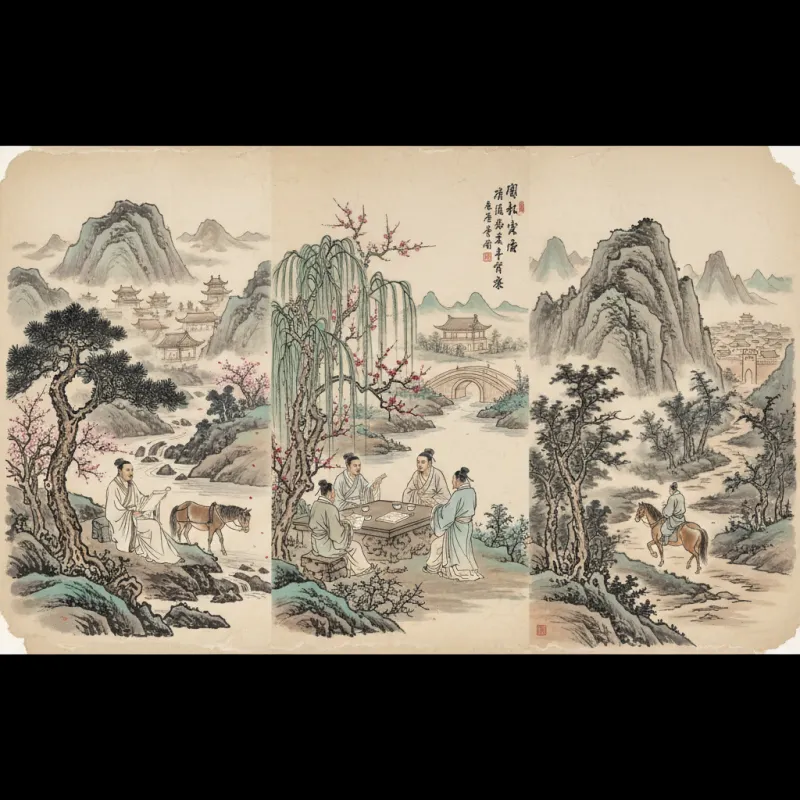
When Li Bai (李白, Lǐ Bái) drunkenly declared himself "banished immortal," he wasn't just being theatrical—he was articulating a fundamental tension that would define Chinese classical poetry for centuries. The distance between earthly disappointment and transcendent aspiration, between the wine cup and the moon's reflection within it, became the emotional geography that Tang, Song, and Yuan poets would map with obsessive precision.
The Architecture of Longing: Separation and Distance
Chinese classical poetry is fundamentally a literature of absence. The theme of li bie (离别, lí bié, separation) permeates nearly every major collection, but it's far more than simple homesickness. When Wang Wei (王维, Wáng Wéi) writes "I urge you to drink one more cup of wine / West of Yang Pass, there are no old friends," he's not just describing a farewell—he's crystallizing the Tang dynasty's entire bureaucratic reality, where talented men spent careers being shuffled between remote postings, always distant from home, always temporary.
The Song dynasty intensified this theme through the ci (词, cí) form, which allowed for more intimate emotional expression than the rigid shi (诗, shī) forms of the Tang. Li Qingzhao (李清照, Lǐ Qīngzhào), writing after the fall of Northern Song, transformed separation into a gendered experience of historical trauma. Her famous line "searching, searching, cold, cold, clear, clear, sorrowful, sorrowful, grieved, grieved" uses repetition not as poetic ornament but as the actual sound of a mind circling its loss, unable to escape.
Nature as Psychological Mirror
Western readers often mistake Chinese nature poetry for simple landscape description, but this fundamentally misreads the tradition. When Du Fu (杜甫, Dù Fǔ) writes "the nation broken, mountains and rivers remain," nature isn't backdrop—it's the measure of human failure. The permanence of mountains throws the impermanence of dynasties into sharp relief.
Tang poets developed an entire vocabulary of natural imagery that functioned as emotional shorthand. Falling flowers always suggest the passage of time and lost youth. The autumn moon invariably evokes separation and longing. Wild geese flying south carry messages that never arrive. This wasn't cliché in their hands—it was a sophisticated shared language that allowed poets to evoke complex emotional states with extraordinary economy.
The Song dynasty, particularly through Su Shi (苏轼, Sū Shì), complicated this relationship. Su's famous "Red Cliff Ode" uses the unchanging river to mock human ambition, but then pivots to celebrate the very transience it seemed to lament. This philosophical sophistication—drawing on both Buddhist impermanence and Daoist acceptance—gave Song poetry a reflective depth that sometimes surpassed Tang's more immediate emotional power. For more on how natural imagery evolved across dynasties, see Nature and Landscape in Classical Poetry.
The Burden of Service: Political Disillusionment
Nearly every major Chinese poet was also a government official, and this dual identity created the tradition's central tension. The Confucian ideal demanded service to the state, but the reality of court politics—factional intrigue, corrupt eunuchs, incompetent emperors—made that service a source of profound disillusionment.
Du Fu's poetry chronicles this disappointment with unflinching honesty. His "Ballad of the Army Carts" doesn't just describe military conscription—it indicts the entire system that grinds peasants into dust for imperial ambition. When he writes "officials come to seize my son," the bureaucratic euphemism "seize" does brutal work, revealing how the state treats its own people as plunder.
The Yuan dynasty, under Mongol rule, transformed political disillusionment into something darker: the question of whether to serve at all. Chinese literati faced an impossible choice—collaborate with foreign rulers or abandon the Confucian duty to serve. Many chose a third path: retreat into poetry that encoded political criticism in increasingly oblique natural imagery. The sanqu (散曲, sǎnqǔ) form that flourished during Yuan allowed for more colloquial, sometimes bitter expression of this predicament.
Wine, Moon, and Transcendence
If political life was disappointing, Chinese poets found transcendence in three recurring images: wine, the moon, and mountains. But these weren't mere escapism—they represented alternative value systems to Confucian duty.
Li Bai's drinking poems are the tradition's most famous example, but they're often misread as simple celebration of intoxication. When he writes "Heaven gave me talent, it must be used / scatter a thousand gold, it all comes back," he's articulating a Daoist philosophy that directly challenges Confucian careerism. Drunkenness becomes a form of clarity, revealing the absurdity of conventional ambition.
The moon, particularly in Tang poetry, functions as a symbol of unattainable perfection and connection across distance. Li Bai's "Quiet Night Thought"—probably the most memorized poem in Chinese history—uses the moon to collapse the distance between exile and home in a single moment of recognition. The moon sees both places simultaneously, offering a cosmic perspective that transcends human geography.
Women's Voices: Constraint and Subversion
Chinese classical poetry was overwhelmingly male-dominated, but the women who did write—often courtesans or aristocrats—brought distinctive perspectives shaped by their constrained social positions. The theme of gui yuan (闺怨, guī yuàn, boudoir lament) gave women poets a sanctioned space to express longing, but the best practitioners subverted this convention.
Li Qingzhao, the Song dynasty's greatest woman poet, used the expected themes of separation and loneliness but infused them with intellectual sophistication and historical consciousness. Her later poems, written after the Jin invasion destroyed her life's work, transform personal loss into national tragedy without losing intimate emotional power.
The ci form, originally associated with entertainment quarters, paradoxically gave women more expressive freedom than the more prestigious shi forms. The persona of the abandoned woman waiting for her lover could encode all kinds of political and personal disappointments, creating a space where emotional honesty was possible precisely because it was supposedly "just" women's poetry. For deeper exploration of gender in classical poetry, see Women Poets of the Tang and Song.
Impermanence and Buddhist Influence
Buddhism's arrival in China fundamentally altered classical poetry's emotional register. The theme of wu chang (无常, wú cháng, impermanence) gave poets a philosophical framework for understanding loss that was more accepting than Confucian stoicism or Daoist transcendence.
Wang Wei, who was both accomplished poet and devout Buddhist, pioneered a poetry of emptiness that influenced centuries of later work. His famous "Deer Park" doesn't just describe a quiet mountain scene—it enacts the Buddhist concept of kong (空, kōng, emptiness), where the absence of human noise allows perception of deeper reality.
Song dynasty poets, particularly Su Shi, synthesized Buddhist impermanence with Confucian engagement in ways that created new philosophical possibilities. Su's "First Ode on the Red Cliff" uses the unchanging river to illustrate Buddhist impermanence, but then argues that if everything is impermanent, we might as well enjoy the moment—a conclusion that's simultaneously Buddhist, Daoist, and distinctly Song in its sophisticated eclecticism.
The Yuan Synthesis: Colloquial Grief
The Yuan dynasty's sanqu form represented a dramatic break from earlier poetic conventions. Written in more colloquial language and freed from strict tonal requirements, sanqu allowed poets to express disillusionment with unprecedented directness.
Ma Zhiyuan's (马致远, Mǎ Zhìyuǎn) "Autumn Thoughts" is the form's masterpiece, compressing an entire landscape of loss into nine lines: "Withered vines, old trees, evening crows / small bridge, flowing water, people's homes / ancient road, west wind, lean horse." The paratactic structure—just nouns and adjectives, no verbs—creates a world where nothing happens anymore, where history has stopped. The final line, "heartbroken man at sky's edge," doesn't need to explain why he's heartbroken. The entire preceding landscape has already told us.
Yuan poetry's themes weren't new—separation, political disappointment, impermanence—but the directness of expression was revolutionary. After centuries of increasingly refined classical forms, sanqu felt like someone finally speaking plainly about what everyone already knew: the world was broken, and poetry couldn't fix it, but it could at least stop pretending otherwise.
Legacy: Why These Themes Endure
The themes of Chinese classical poetry—separation, nature, political disillusionment, transcendence, impermanence—endure because they articulate universal human experiences through culturally specific forms. When contemporary readers encounter Li Bai's loneliness or Du Fu's anger or Li Qingzhao's grief, the emotional recognition is immediate, even across centuries and cultures.
But these themes also reveal something specific about Chinese literary culture: its insistence that personal emotion and political reality are inseparable, that landscape is never just scenery, that the smallest lyric moment can contain historical consciousness. This integration of public and private, cosmic and intimate, gives Chinese classical poetry its distinctive density—every image carries multiple resonances, every theme opens onto others.
The progression from Tang's emotional immediacy through Song's philosophical sophistication to Yuan's colloquial directness shows a tradition continually reinventing itself while maintaining thematic continuity. Modern Chinese poetry still grapples with these same themes, suggesting they touch something fundamental about the human experience of time, loss, and the search for meaning in an impermanent world. For contemporary perspectives on these enduring themes, explore Classical Poetry's Influence on Modern Chinese Literature.
Related Reading
- Love and Longing in Chinese Poetry: The Art of Missing Someone
- Friendship and Farewell: Poems of Parting
- The Four Seasons in Chinese Poetry: Spring Sorrow, Summer Heat, Autumn Grief, Winter Silence
- Nature and Seasons in Chinese Poetry
- Exile and Homesickness: The Wanderer's Lament
- Frontier Poetry (边塞诗): War and Glory at the Empire's Edge
- Su Shi's Red Cliff Odes: Philosophy in Poetry
- Buddhist Poetry in Chinese Literature: Enlightenment in Twenty Characters
Explore Chinese Culture
- Explore the Tang dynasty's golden age
- Explore Daoist themes in classical poetry
- Explore Chinese literary traditions