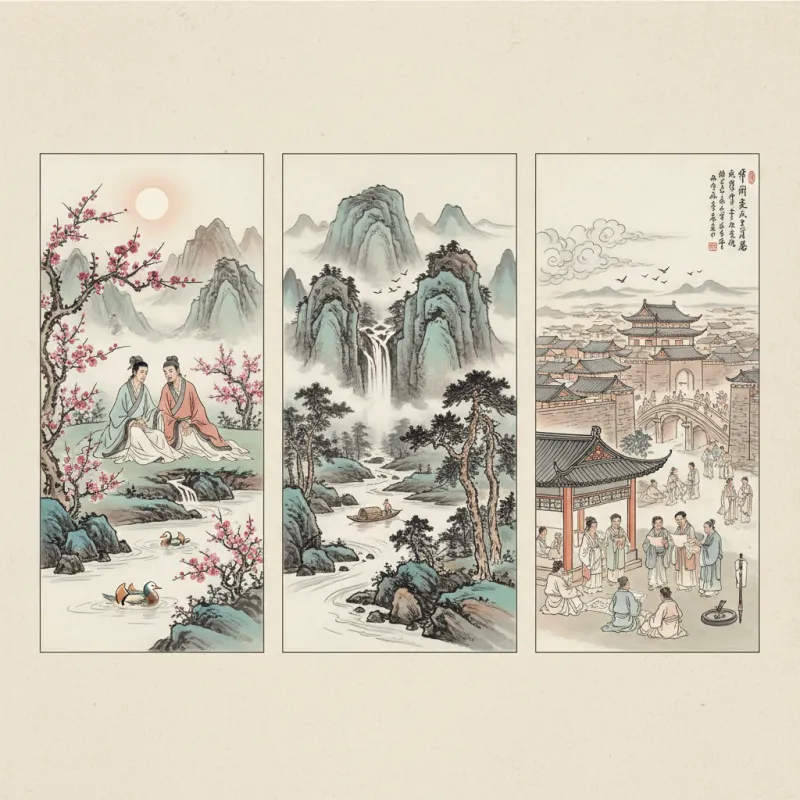
When Li Bai stumbled drunk beneath the moon, reaching out to embrace its reflection in the Yangtze River—a gesture that legend claims led to his death—he wasn't just composing poetry. He was crystallizing a thousand-year tradition where love, nature, and society intertwined so completely that separating them feels like trying to untangle moonlight from water. Chinese classical poetry doesn't treat these themes as distinct categories but as facets of a single mirror reflecting the human condition.
The Intoxication of Romantic Love
Love in Chinese classical poetry rarely announces itself with grand declarations. Instead, it whispers through coded imagery—the mandarin ducks swimming in pairs, the red beans (相思豆, xiāngsī dòu) that symbolize longing, the willow branches exchanged at parting. During the Tang dynasty (618-907), poets developed an entire vocabulary of desire that spoke volumes while saying little directly.
Li Shangyin's enigmatic love poems remain puzzles even today. His "Untitled" poems (无题诗, wútí shī) layer meaning upon meaning, where "the spring silkworm spins until death, its silk exhausted" becomes both a meditation on obsessive love and political frustration. This ambiguity wasn't accidental—it was survival. When expressing forbidden love or dangerous political opinions, poets learned to hide their true subjects behind nature imagery and classical allusions.
The Song dynasty (960-1279) brought a shift toward more explicit emotional expression, particularly in the ci (词) form. Li Qingzhao, perhaps China's greatest female poet, wrote with a directness that still startles: "I'm thinner than the yellow flowers" she declares after her husband's death, transforming physical deterioration into a measure of grief. Her work demonstrates how women poets navigated a literary tradition dominated by men, often by mastering its conventions so thoroughly they could bend them to new purposes.
Nature as Mirror and Medicine
Chinese poets didn't observe nature—they inhabited it. The distinction matters. When Wang Wei writes about his mountain retreat at Wangchuan, he's not describing scenery for aesthetic pleasure. He's documenting a philosophical practice, a deliberate withdrawal from the corruption of court life into a landscape that reflects Buddhist and Daoist principles of harmony and emptiness.
The Tang dynasty perfected what scholars call "landscape poetry" (山水诗, shānshuǐ shī), but this label undersells the genre's ambition. These poems function as portable meditation spaces. Du Fu's "Spring View" written during the An Lushan Rebellion (755-763) opens with "The nation shattered, mountains and rivers remain"—a line that captures how nature persists beyond human catastrophe, offering both consolation and reproach.
Seasonal imagery carries precise emotional weight. Autumn, with its falling leaves and migrating geese, inevitably signals separation and decline. Spring's blossoms promise renewal but also remind viewers of beauty's brevity. The plum blossom (梅花, méihuā), blooming in winter's harshest months, becomes a symbol of resilience and integrity—qualities prized by scholars facing political persecution. These weren't arbitrary associations but a shared cultural language refined over centuries.
The relationship between poet and landscape also reflects class dynamics. Wealthy literati could afford mountain retreats and leisure for contemplation. Peasant poets like Meng Haoran wrote from a different position, their nature poetry inflected with awareness of agricultural labor and economic precarity. When he describes "opening the window to face the threshing floor and garden," he's grounding his pastoral vision in the reality of rural work.
The Weight of Social Responsibility
Chinese poets carried an impossible burden: they were expected to be both artists and moral exemplars, entertainers and political critics. The Confucian tradition demanded that literature serve society, that beauty have purpose beyond itself. This tension between aesthetic pleasure and social duty runs through classical poetry like a fault line.
Du Fu embodied this conflict more than any other poet. While Li Bai wandered mountains and wrote about wine and moonlight, Du Fu documented war's devastation, official corruption, and the suffering of common people. His "Ballad of the Army Carts" depicts conscription's brutality with journalistic precision: "At fifteen, they went north to guard the river / At forty, they're still farming the frontier." This wasn't abstract social commentary—Du Fu wrote from experience, having fled the An Lushan Rebellion and witnessed its aftermath firsthand.
The examination system (科举, kējǔ) shaped how poets approached social themes. Success in the imperial examinations required mastery of classical forms and orthodox Confucian values. Poets learned to encode criticism in historical allusions, praising ancient virtuous rulers while implicitly condemning current ones. This created a poetry of indirection, where political commentary hid behind seemingly innocent descriptions of palace ruins or abandoned capitals.
Women poets faced additional constraints. Their social criticism often focused on domestic spaces and gender restrictions. Xue Tao, a Tang courtesan-poet, wrote about the silk she wove and the letters she sent, but these mundane subjects carried subversive weight. By documenting women's labor and emotional lives, she claimed literary territory traditionally reserved for male scholars.
The Intersection of Themes
The most sophisticated classical poems refuse to separate love, nature, and society into neat categories. They understand these themes as interconnected aspects of human experience. When Li Bai writes "Quiet Night Thought"—perhaps the most famous Chinese poem—he moves seamlessly from moonlight on his floor to homesickness to cosmic loneliness in just twenty characters.
Consider how exile poetry combines all three themes. Banished officials wrote about distant landscapes (nature), separation from loved ones (love), and the injustice of their punishment (society) in single poems. Liu Zongyuan, exiled to remote Guangxi, wrote sparse poems about empty mountains and cold rivers that simultaneously expressed personal desolation, aesthetic appreciation, and political critique.
The Song dynasty ci form particularly excelled at thematic layering. Su Shi's "Prelude to Water Melody" ostensibly celebrates the Mid-Autumn moon while missing his brother, but it also meditates on Buddhist impermanence and the impossibility of perfect happiness. The poem's famous line—"People have sorrows and joys, partings and reunions / The moon has darkness and light, waxing and waning"—parallels human and natural cycles, suggesting both are governed by the same inexorable patterns.
Buddhist and Daoist Influences
Religious philosophy fundamentally shaped how poets approached these themes. Buddhism introduced concepts of impermanence and emptiness that transformed nature poetry. When Wang Wei writes "In the empty mountains, no one is seen / Only the sound of human voices heard," he's not just describing a quiet forest—he's illustrating Buddhist teachings about the illusory nature of perception.
Daoism contributed different insights, particularly the idea of spontaneity (自然, zìrán) and non-action (无为, wúwéi). Daoist-influenced poets like Li Bai celebrated drunkenness and wildness as paths to authentic experience, rejecting Confucian propriety. This created a productive tension in the tradition between social responsibility and individual freedom, between cultivation and spontaneity.
The interplay between these philosophies allowed poets to hold contradictory positions simultaneously. Du Fu could write Confucian poems about duty and loyalty while also composing Daoist-inflected verses celebrating wine and friendship. This philosophical flexibility gave classical poetry its depth and complexity, preventing it from hardening into dogma.
Legacy and Modern Resonance
These themes didn't remain static. Each dynasty reinterpreted them according to contemporary concerns. Yuan dynasty poets, writing under Mongol rule, developed new ways to express cultural resistance through classical forms. Ming and Qing poets looked back to Tang and Song masters while addressing their own era's challenges.
The themes of Chinese classical poetry continue resonating because they address fundamental human experiences: how we love, how we relate to the natural world, how we navigate social obligations. Modern Chinese poets still grapple with this tradition, sometimes embracing it, sometimes rebelling against it, but never entirely escaping its gravitational pull.
What makes these themes enduring isn't their universality—Chinese classical poetry is deeply specific to its cultural context—but their capacity for reinterpretation. Each generation finds new meanings in Li Bai's moonlight, Du Fu's social conscience, and Li Qingzhao's grief. The poems remain alive because they're flexible enough to accommodate changing perspectives while maintaining their essential character.
Reading Classical Poetry Today
Approaching these poems requires understanding their original context while remaining open to personal interpretation. The historical circumstances that produced them—dynastic politics, examination systems, gender hierarchies—matter enormously. But so does the immediate emotional and aesthetic experience of reading them.
Modern readers often encounter classical Chinese poetry through translation, which inevitably transforms it. The compressed language, tonal patterns, and cultural allusions that give the originals their power rarely survive intact. Yet something essential often comes through—a mood, an image, a moment of recognition. The best translations, like those by David Hinton or Burton Watson, try to preserve both literal meaning and poetic effect, though perfect fidelity remains impossible.
For those willing to engage deeply, classical Chinese poetry offers rewards beyond beautiful language. It provides a window into how another culture understood fundamental aspects of human existence. The themes of love, nature, and society that preoccupied Tang and Song poets remain urgent today, even as the specific forms they take have changed. In an era of environmental crisis, political turmoil, and social fragmentation, these ancient poems speak with surprising relevance, reminding us that humans have always struggled to balance personal desire, natural harmony, and social obligation—and that poetry remains one of our most powerful tools for navigating these tensions.
Related Reading
- Friendship and Farewell: Poems of Parting
- War and Exile in Chinese Poetry: The Literature of Survival
- Love and Longing in Chinese Poetry: The Art of Missing Someone
- Exile and Homesickness: The Wanderer's Lament
- Unraveling Themes in Chinese Classical Poetry: Insights from Tang, Song, and Yuan Dynasties
- Political Poetry: When Poets Challenged Emperors
- Unveiling the Essence of Chinese Classical Poetry: Insights from Tang, Song, and Yuan Poets
- Li Qingzhao: The Greatest Female Poet in Chinese History
Explore Chinese Culture
- Explore the Tang dynasty's golden age
- Explore Daoist themes in classical poetry
- Explore Chinese literary traditions