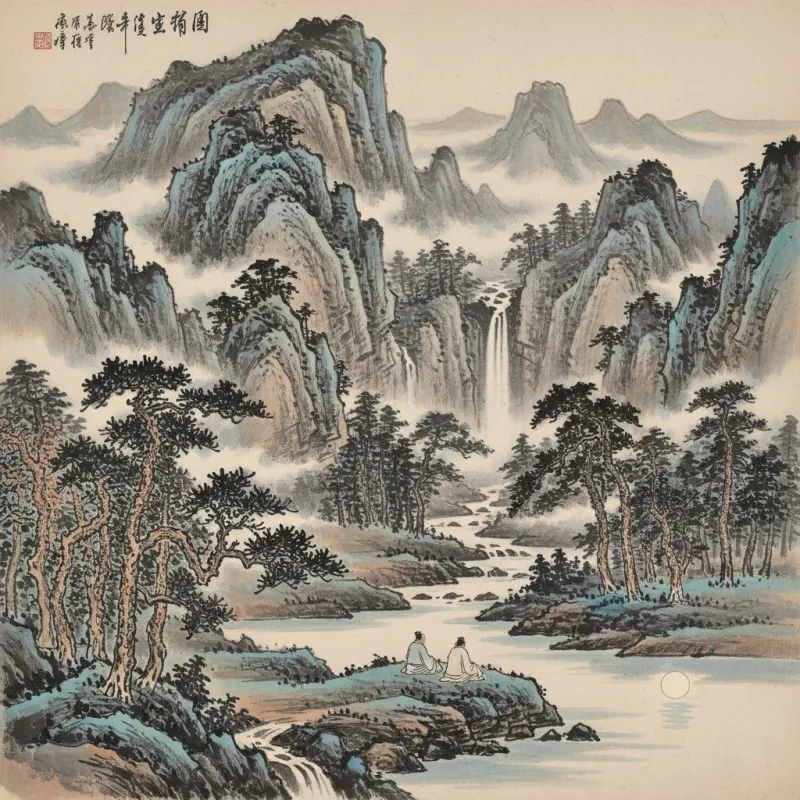
When Wang Wei wrote "Empty mountain, no one in sight" (空山不見人 kōng shān bù jiàn rén), he wasn't describing loneliness. He was describing enlightenment. This is the radical difference at the heart of Chinese nature poetry: the landscape isn't a metaphor for human emotion — human emotion is a metaphor for landscape. Mountains don't symbolize permanence; permanence is what mountains are, and we borrow their language to understand ourselves.
Mountains and Water as Philosophical Grammar
The Chinese term for landscape painting and poetry is 山水 (shānshuǐ) — literally "mountains and water." But this pairing isn't arbitrary decoration. It's cosmology compressed into two characters. Mountains represent yang (陽): the solid, the enduring, the vertical thrust toward heaven. Water embodies yin (陰): the flowing, the adaptive, the horizontal embrace of earth. Together they form the fundamental dialectic of existence, the breathing rhythm of the Dao (道).
This philosophical framework emerged from Daoism and was refined by centuries of Buddhist thought, particularly Chan Buddhism (禪宗 Chán zōng), which arrived from India around the 6th century. The Daoist text Zhuangzi (莊子) had already established nature as the ultimate teacher: "Heaven and earth have great beauty but do not speak." By the Tang Dynasty (618-907), poets had internalized this so completely that describing a mountain stream became indistinguishable from describing the movement of consciousness itself.
Consider Meng Haoran's (孟浩然) famous couplet: "Spring sleep, unaware of dawn / Everywhere I hear singing birds" (春眠不覺曉,處處聞啼鳥 chūn mián bù jué xiǎo, chùchù wén tí niǎo). Western readers often miss what's happening here. The poet isn't observing birds from outside. The boundary between sleeper and spring, between consciousness and birdsong, has dissolved. This is nature poetry as meditation practice.
The Empty Mountain Tradition
Wang Wei (王維, 699-759) essentially invented a genre: the poetry of emptiness. His "Deer Park" (鹿柴 Lù Zhài) is twenty characters that generations of Chinese readers have memorized:
"Empty mountain, no one in sight / Yet I hear human voices echoing / Returning sunlight enters the deep forest / Again shining on the green moss" (空山不見人,但聞人語響。返景入深林,復照青苔上 kōng shān bù jiàn rén, dàn wén rén yǔ xiǎng. Fǎn jǐng rù shēn lín, fù zhào qīng tái shàng).
What makes this revolutionary isn't the imagery — it's the structure of attention. The poem moves from absence (no people) to trace (voices) to light (which is both presence and absence) to moss (which grows in shadow). Each line empties out the previous one. The mountain isn't a symbol of solitude; it's a demonstration of how consciousness works when you stop filling it with yourself.
This "empty mountain" (空山 kōng shān) became a recurring motif in Chinese poetry, but it's often misunderstood. The emptiness isn't loneliness or desolation. It's the Buddhist concept of śūnyatā (空 kōng) — the recognition that phenomena have no fixed, independent existence. When the mountain is empty of human projection, it can finally be itself. And paradoxically, that's when the poet can finally encounter it.
Rivers as the Measure of Time
If mountains represent stillness, rivers represent the one thing that makes stillness meaningful: change. The river poem is Chinese poetry's way of thinking about time, mortality, and the strange persistence of pattern within flux.
Li Bai (李白, 701-762) wrote: "The waters of the Yellow River come from heaven / Rushing to the sea, never to return" (黃河之水天上來,奔流到海不復回 Huáng Hé zhī shuǐ tiān shàng lái, bēn liú dào hǎi bù fù huí). This isn't melancholy about transience — it's exhilaration. The river's refusal to return is what makes each moment unrepeatable and therefore sacred. Li Bai, famously drunk in many of his poems, understood that the river's flow and wine's flow and time's flow are the same flow, and the only sane response is to join it rather than resist it.
Du Fu (杜甫, 712-770), Li Bai's contemporary and temperamental opposite, wrote about rivers differently. His "Gazing at Spring" (春望 Chūn Wàng) begins: "The nation shattered, mountains and rivers remain" (國破山河在 guó pò shān hé zài). Here the river's permanence isn't comforting — it's devastating. Human kingdoms rise and fall, but the Yellow River keeps flowing, indifferent to our catastrophes. This is nature poetry as historical witness, the landscape outlasting every dynasty that claimed to rule it.
The Song Dynasty (960-1279) poet Su Shi (蘇軾) synthesized these approaches in his "Red Cliff Rhapsody" (赤壁賦 Chìbì Fù), where he watches the Yangtze River and realizes: "From the perspective of change, heaven and earth cannot last even a moment. From the perspective of changelessness, both things and I are inexhaustible." The river is simultaneously proof of impermanence and proof of eternity. This paradox is the heart of Chinese nature philosophy.
Seasonal Markers as Emotional Precision
Chinese poetry developed an extraordinarily refined vocabulary of seasonal imagery, where specific natural phenomena carry precise emotional and philosophical associations. This isn't symbolism in the Western sense — it's more like a shared language of attention, a collective agreement about what's worth noticing and when.
Autumn (秋 qiū) is the season of Chinese poetry. While Western poetry often celebrates spring's renewal, Chinese poets gravitated toward autumn's clarity and decline. The autumn wind (秋風 qiū fēng) appears in thousands of poems, almost always carrying a sense of separation, aging, or clear-eyed acceptance. When Liu Yuxi (劉禹錫, 772-842) wrote "Since ancient times, autumn has been a time of sadness and loneliness / I say autumn surpasses spring in clarity" (自古逢秋悲寂寥,我言秋日勝春朝 zì gǔ féng qiū bēi jì liáo, wǒ yán qiū rì shèng chūn zhāo), he was arguing against the entire tradition — and proving how deeply embedded that tradition was.
The wild geese (雁 yàn) flying south in autumn became shorthand for separation and longing, because they migrate in formation and their calls sound mournful to Chinese ears. The plum blossom (梅花 méi huā) blooming in late winter represents resilience and purity, because it flowers in snow. The willow (柳 liǔ) at parting represents sorrow, because 柳 (liǔ) sounds like 留 (liú, "to stay"). These aren't arbitrary associations — they're the accumulated attention of centuries of poets noticing the same things at the same moments and finding the same resonances.
This system reached its peak sophistication in Song Dynasty ci poetry, where the chosen tune title often predetermined which seasonal images would appear. The tune "Butterflies Lingering Over Flowers" (蝶戀花 Dié Liàn Huā) practically required spring imagery; "The River Is Red" (滿江紅 Mǎn Jiāng Hóng) called for autumn. The form itself was a seasonal calendar, a way of organizing human emotion according to nature's rhythms.
The Moon as Mirror
No natural image appears more frequently in Chinese poetry than the moon (月 yuè). But the Chinese poetic moon isn't the Western romantic moon — it's not a symbol of mystery or feminine power. It's a mirror. Literally and philosophically.
The moon's reflective quality made it the perfect image for Buddhist and Daoist ideas about consciousness. Just as the moon reflects sunlight without generating its own, consciousness reflects phenomena without adding anything to them. Just as the same moon appears in countless bodies of water simultaneously, the same reality appears in countless minds. The moon in the water (水中月 shuǐ zhōng yuè) became a standard Buddhist metaphor for the illusory nature of phenomena — beautiful, apparently real, but ultimately empty of inherent existence.
Li Bai's "Drinking Alone Beneath the Moon" (月下獨酌 Yuè Xià Dú Zhuó) plays with this: "Among the flowers, a jug of wine / I drink alone, no companion / I raise my cup to invite the bright moon / With my shadow we become three" (花間一壺酒,獨酌無相親。舉杯邀明月,對影成三人 huā jiān yī hú jiǔ, dú zhuó wú xiāng qīn. Jǔ bēi yāo míng yuè, duì yǐng chéng sān rén). The poem multiplies solitude — one person becomes three through moon and shadow — but this multiplication doesn't cure loneliness. It demonstrates that even companionship is a kind of projection, a conversation with reflections.
The full moon (滿月 mǎn yuè) became associated with reunion and completeness, which made it painful during separation. The Mid-Autumn Festival (中秋節 Zhōngqiū Jié) generated countless poems of longing, because families traditionally gathered to view the full moon together. Su Shi's famous "Water Melody" (水調歌頭 Shuǐ Diào Gē Tóu) asks the moon: "People have sorrow and joy, separation and reunion / The moon has clouds and clarity, waxing and waning / This matter has never been perfect since ancient times" (人有悲歡離合,月有陰晴圓缺,此事古難全 rén yǒu bēi huān lí hé, yuè yǒu yīn qíng yuán quē, cǐ shì gǔ nán quán). The moon's phases become a way of accepting imperfection — not as failure, but as the nature of existence itself.
Nature as Practice, Not Description
The fundamental difference between Chinese nature poetry and most Western nature writing is this: Chinese poets weren't describing nature. They were practicing it. The act of writing the poem was itself a form of meditation, a way of aligning consciousness with natural processes.
This is why so many Chinese nature poems feel understated to Western readers. They're not trying to impress you with vivid description or emotional intensity. They're trying to transmit a quality of attention, a way of being present to the world. When Wang Wei writes about an empty mountain or Meng Haoran writes about spring sleep, they're not reporting on experiences they had. They're creating experiences you can have by reading the poem with the right quality of attention.
The landscape poetry tradition influenced everything that came after it — not just poetry, but painting, garden design, even the arrangement of rocks and water in temple courtyards. The aesthetic principle of 意境 (yìjìng, "artistic conception" or "realm of feeling") emerged from this tradition: the idea that art should create a space where the boundary between inner and outer, between consciousness and world, becomes permeable.
This is why Chinese nature poetry still matters. Not because it offers beautiful descriptions of mountains and rivers — though it does — but because it offers a technology of attention, a way of experiencing consciousness as continuous with the natural world rather than separate from it. In an age of climate crisis and digital distraction, this might be the most valuable thing classical Chinese poetry has to teach us: that nature isn't something we look at. It's something we participate in, whether we realize it or not. The only question is whether we do it consciously or unconsciously, with attention or with distraction. The poets chose attention. Their poems are invitations to do the same.
Related Reading
- Unraveling Themes in Chinese Classical Poetry: Insights from Tang, Song, and Yuan Dynasties
- Exploring the Themes of Love, Nature, and Society in Chinese Classical Poetry
- Exile and Homesickness: The Wanderer's Lament
- Love and Longing in Chinese Poetry: The Art of Missing Someone
- Moonlight in Chinese Poetry: Why the Moon Means Everything
- Unraveling the Essence of Drinking Poetry in Tang, Song, and Yuan Eras
- Exploring Chinese Classical Poetry: Tang, Song, and Yuan Poets’ Literary Legacy
- How to Read a Chinese Poem: A Practical Guide for English Speakers
Explore Chinese Culture
- Explore the Tang dynasty's golden age
- Explore Daoist themes in classical poetry
- Explore Chinese literary traditions