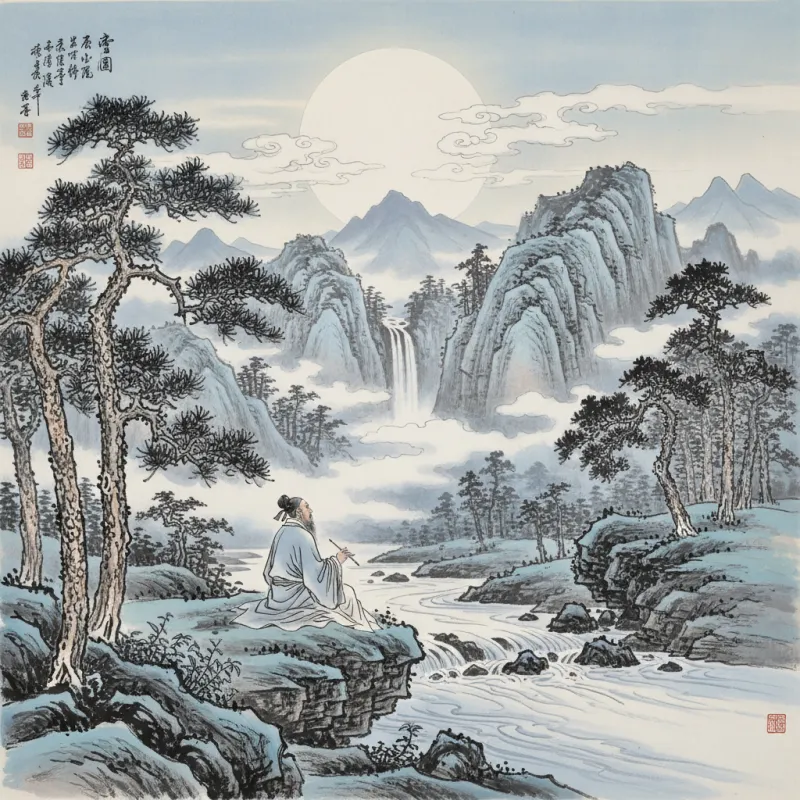
Li Bai was drunk when he drowned. At least, that's what the legend says. The greatest poet of the Tang Dynasty saw the moon's reflection in the Yangtze River, reached out to embrace it, and fell in. Whether this actually happened is beside the point. The story persists because it's perfect — it captures everything about how Chinese poets have related to the moon for two thousand years. The moon isn't just something you look at. It's something you reach for, something you try to hold, something that breaks your heart because you can never quite grasp it.
No other literary tradition has made the moon work this hard. In English poetry, the moon shows up, does its job, and leaves. In Chinese poetry, it carries the entire emotional weight of a civilization. It means homesickness, lost love, the passage of time, philosophical truth, political allegory, spiritual transcendence, and crushing loneliness — sometimes all in the same poem. The moon is the Swiss Army knife of Chinese poetic imagery, and somehow it never feels overused.
The Mid-Autumn Festival and the Architecture of Longing
The obsession starts with the calendar. The Mid-Autumn Festival (中秋节, Zhōngqiū Jié) falls on the fifteenth day of the eighth lunar month, when the moon is at its fullest and brightest. This is the second most important holiday in the Chinese calendar after Spring Festival, and it's entirely built around moon-gazing. Families gather, eat mooncakes, and stare at the sky together.
But here's the thing: the holiday exists because families can't always gather. The Mid-Autumn Festival is fundamentally about absence. It's about the people who should be there but aren't — the son studying for the imperial examinations in the capital, the daughter married off to a distant province, the husband serving on the frontier. The full moon becomes a shared reference point, a way of being together while apart. You look at the moon in Beijing, I look at the same moon in Guangzhou, and for a moment we're connected.
This is why Su Shi's (苏轼) "Prelude to Water Melody" (水调歌头, Shuǐdiào Gētóu) from 1076 became the definitive Mid-Autumn poem. He wrote it while drunk and missing his brother Su Zhe, whom he hadn't seen for seven years. The famous lines go: "People have sorrow and joy, separation and reunion / The moon has clouds and clear skies, waxing and waning / This matter has never been perfect since ancient times" (人有悲欢离合,月有阴晴圆缺,此事古难全). It's not a happy poem. It's a poem about accepting that happiness is always incomplete, that the full moon only reminds you of everything that's missing.
Li Bai and the Invention of Moon-Drunk Poetry
But Su Shi was building on a foundation laid three centuries earlier by Li Bai (李白, 701-762), who wrote more moon poems than any sane person should. "Drinking Alone Under the Moon" (月下独酌, Yuè Xià Dú Zhuó) is the prototype: Li Bai sits by himself with a jar of wine, invites the moon and his shadow to join him, and proceeds to get spectacularly drunk with his two silent companions. "The moon doesn't know how to drink / My shadow follows my body in vain" (月既不解饮,影徒随我身). It's funny and desperately sad at the same time.
Li Bai's genius was making the moon personal. Before him, the moon in poetry was mostly decorative or symbolic in predictable ways. Li Bai turned it into a drinking buddy, a confidant, a mirror for his own loneliness. In "Quiet Night Thought" (静夜思, Jìng Yè Sī), probably the most famous poem in the Chinese language, he wakes up and sees moonlight on the floor, mistakes it for frost, looks up at the moon, and thinks of home. Twenty words, four lines, and it's been memorized by every Chinese schoolchild for twelve hundred years.
The poem works because it's so simple it's almost stupid. Moonlight looks like frost. This makes me homesick. That's it. But the simplicity is deceptive — Li Bai is collapsing the distance between the visual and the emotional, making the moon do double duty as both thing and feeling. The moon isn't a symbol of homesickness; it is homesickness, made visible and concrete.
The Moon as Philosophical Mirror
The Buddhist and Daoist traditions added another layer. The moon became a metaphor for enlightenment — something that illuminates without effort, that reflects without distortion, that waxes and wanes without attachment. The famous Chan Buddhist metaphor goes: "The finger pointing at the moon is not the moon." Words and concepts are just fingers; the truth is the moon itself, beyond language.
This philosophical dimension shows up everywhere in Tang and Song poetry. Wang Wei (王维, 699-759), the great Buddhist poet, uses the moon as a marker of emptiness and clarity. In "Bamboo Grove House" (竹里馆, Zhú Lǐ Guǎn), he sits alone in a bamboo grove, playing his zither, and the moon shines on him. That's the whole poem. The moon isn't doing anything except being there, and that's enough. It's the poetic equivalent of sitting meditation.
The Daoist angle is slightly different. The moon represents the natural order, the way things are when you stop trying to control them. Zhuangzi's butterfly dream gets echoed in countless moon poems where the boundary between self and world dissolves. You're not looking at the moon; you're participating in moonlight. The subject-object distinction collapses, and what's left is just luminosity.
Women Poets and the Moon of Separation
The moon takes on different meanings in the hands of women poets, who were often writing from positions of enforced separation. Li Qingzhao (李清照, 1084-1155), the greatest woman poet of the Song Dynasty, uses the moon to mark time and loss. After her husband's death, she writes: "This year's moon is not last year's moon / But I am still the same person, my tears soaking my silk sleeves" (今年月,去年月,人是去年人,泪湿春衫袖).
The moon becomes a measure of what's changed and what hasn't. The moon is the same, but everything else is different. Or worse: everything else is the same, but the moon reminds you of what's missing. For women poets writing within the constraints of the inner chambers, the moon was often the only "outside" they could access freely. You can't leave the house, but you can look at the moon, and the moon connects you to the larger world.
Yu Xuanji (鱼玄机, 844-868), the Tang Dynasty courtesan-poet, writes about watching the moon from her window and thinking about the man who abandoned her. The moon is both companion and tormentor — it keeps her company, but it also reminds her she's alone. This double-edged quality runs through women's moon poetry: the moon is freedom and prison, connection and isolation, all at once.
Political Moons and Imperial Metaphors
The moon also does political work. In the tradition of allegorical poetry (比兴, bǐxìng), the moon can represent the emperor — distant, luminous, the source of all light and order. When the moon is obscured by clouds, it's a metaphor for corrupt officials blocking the ruler's virtue. When the moon shines clearly, it's a sign of good governance.
Du Fu (杜甫, 712-770), Li Bai's great contemporary and rival, uses the moon this way in his war poems. During the An Lushan Rebellion, when the Tang Dynasty nearly collapsed, Du Fu writes about the moon shining on battlefields, on ruined cities, on refugees. The moon is constant while everything else falls apart. It's both comfort and accusation — the moon keeps shining, indifferent to human suffering, and that indifference is itself a kind of judgment.
The moon can also represent the poet's own integrity in a corrupt world. When you're in exile, when your advice is ignored, when the court is full of sycophants, you can still look at the moon. The moon doesn't lie, doesn't flatter, doesn't compromise. It's the one thing that remains pure, and by extension, so do you. This is why so many exile poems feature the moon prominently — it's a way of asserting moral authority from a position of political powerlessness.
The Technical Side: Why the Moon Works in Chinese
There's also a purely technical reason the moon dominates Chinese poetry: the character 月 (yuè) is incredibly versatile. It's one syllable, it rhymes with lots of other important words (雪 xuě "snow," 别 bié "separation," 绝 jué "severed"), and it fits easily into the strict tonal patterns of regulated verse (律诗, lǜshī). You can drop 月 into almost any line and it works both sonically and semantically.
The moon also pairs well with other standard images. Moon and wine (月酒). Moon and mountains (月山). Moon and water (月水). Moon and autumn (月秋). These combinations become formulaic, but in the hands of a skilled poet, they're endlessly renewable. The formula provides structure; the individual poet provides variation.
Compare this to English, where "moon" is two syllables, doesn't rhyme with much useful (June, soon, tune — not exactly the building blocks of profound poetry), and carries less cultural freight. English poets have to work harder to make the moon mean something. Chinese poets inherit two thousand years of accumulated meaning every time they write the character 月.
The Moon Today: Continuity and Change
The moon hasn't lost its power in modern Chinese poetry, but it's become more self-conscious. Contemporary poets know they're working in the shadow of Li Bai and Su Shi. They can't just write a straightforward moon poem without acknowledging the weight of tradition.
Bei Dao (北岛), the great modernist poet, writes: "The moon is a metaphor / for what we've lost" (月亮是隐喻/我们失去的东西). He's both using the traditional moon imagery and commenting on it, making the metaphor itself the subject. The moon means loss, but it also means the tradition of using the moon to mean loss, and that tradition is itself something we're losing as China modernizes.
This is the paradox of the moon in contemporary Chinese poetry: it's simultaneously the most traditional and the most modern image. It connects contemporary poets to the Tang Dynasty, but it also marks the distance. We're still looking at the same moon Li Bai saw, but we're looking at it through twelve hundred years of accumulated poetry, and that changes everything.
The moon in Chinese poetry isn't just an image. It's a technology for transmitting emotion across time and space. When you read a Tang Dynasty moon poem, you're not just reading about the moon — you're participating in the same act of looking, longing, and loss that the poet experienced. The moon makes you contemporary with the past. It collapses the distance between eighth-century Chang'an and twenty-first-century wherever-you-are. You look up, the moon is there, and for a moment you understand exactly what Li Bai meant when he reached for that reflection in the river.
Related Reading
- Exile and Homesickness: The Wanderer's Lament
- Unraveling Themes in Chinese Classical Poetry: Insights from Tang, Song, and Yuan Dynasties
- Nature in Chinese Poetry: Mountains, Rivers, and the Mirror of the Soul
- Nature and Seasons in Chinese Poetry
- Friendship and Farewell: Poems of Parting
- Du Fu: The Conscience of Chinese Poetry
- Li Qingzhao: China's Greatest Female Poet
- The Timeless Art of Song Poets: A Deep Dive into Classical Chinese Poetry
Explore Chinese Culture
- Explore the Tang dynasty's golden age
- Explore Daoist themes in classical poetry
- Explore Chinese literary traditions