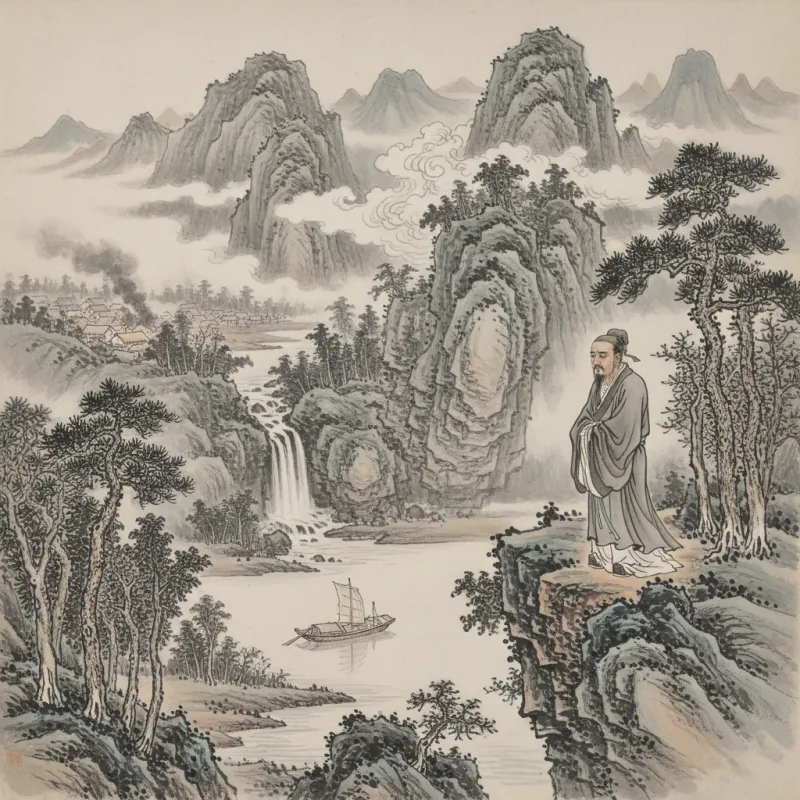
The poet Du Fu stands on a riverbank in Kuizhou, a thousand miles from the capital he once called home. He's fifty-four years old, sick, poor, and watching the autumn wind scatter leaves across the Yangtze. He writes: "A wanderer hears the drums signaling battle—autumn's first wild goose. Dew turns white tonight; the moon is brighter over my old home." This isn't just nostalgia. This is exile—the peculiar agony of being alive in the wrong place, of breathing air that doesn't belong to you.
Chinese classical poetry didn't invent homesickness, but it perfected the art of expressing it. From the Tang Dynasty (618-907) through the Song (960-1279), poets transformed personal displacement into a literary tradition so powerful that even today, the phrase "思乡" (sīxiāng, longing for home) carries the weight of a thousand poems behind it.
The Political Machine That Manufactured Wanderers
Exile in imperial China wasn't usually about chains and prison cells. It was bureaucratic, almost mundane in its cruelty. An official would criticize the wrong policy, align with the losing faction, or simply be too talented for comfort. The punishment? Reassignment to some godforsaken prefecture on the empire's edge—Lingnan in the tropical south, the northwestern deserts, anywhere that wasn't the cultural heartland of the Yellow River valley.
Li Bai (701-762), perhaps the most famous poet in Chinese history, spent years wandering after being expelled from the imperial court. His crime? Allegedly, he drunkenly offended a powerful eunuch. Su Shi (1037-1101) was exiled three times, bouncing between Huangzhou, Huizhou, and finally Hainan Island—each location progressively more remote, each exile a political statement about his reformist ideas.
The system created a peculiar class of literary figures: educated, cultured men forced to live among people who didn't read their poems, in landscapes that felt alien, under skies that seemed to mock their learning. Their response was to write. Obsessively.
The Geography of Longing
Chinese exile poetry is obsessed with specific images, and they're not random. The wild goose (雁, yàn) appears constantly because these birds migrate south in autumn—the same direction many exiles traveled. When Du Fu writes about geese, he's not being poetic for poetry's sake. He's watching actual birds that will fly over his homeland while he remains stuck.
The moon becomes another fixation. It's the same moon that shines on the capital, on the poet's family, on his childhood home. Li Bai's "Quiet Night Thought" (静夜思, Jìng Yè Sī) is probably the most memorized poem in Chinese history: "Bright moonlight before my bed / I think it's frost on the ground / Lifting my head, I gaze at the mountain moon / Lowering it, I think of my old home." Four lines, twenty characters in Chinese, and an entire emotional universe.
Rivers and mountains take on symbolic weight. The Yangtze River flows east toward the ocean and the poet's home—it can go where he cannot. Mountains block the view, creating a physical barrier that mirrors the political one. When Wang Wei (701-761) writes about mountains in his landscape poetry, he's often writing about obstacles, not scenery.
The Temporal Trap: Festivals and Seasons
Exile becomes most acute during festivals. The Double Ninth Festival (重阳节, Chóngyáng Jié), celebrated on the ninth day of the ninth lunar month, traditionally involved climbing mountains with family and drinking chrysanthemum wine. Wang Wei's poem "On the Mountain Holiday Thinking of My Brothers in Shandong" captures the torture of celebrating alone: "Alone in a strange land, a stranger / On every holiday I miss my family more / I know my brothers are climbing high / Wearing dogwood sprigs—but one person is missing."
That last line is devastating. He imagines his family performing the ritual without him, and the absence—his absence—becomes the central fact of the celebration. The festival doesn't connect him to home; it emphasizes the distance.
Autumn appears repeatedly in exile poetry, and not just because it's pretty. Autumn is when officials received their reassignments, when the imperial examination results were announced, when political fortunes shifted. It's the season of change, and for exiled poets, change meant hoping for recall while fearing another transfer further from home. The falling leaves, the migrating birds, the cooling weather—all of it mirrors the poet's declining fortunes.
The Craft of Complaint: How Exile Poetry Actually Works
These poems aren't just emotional outbursts. They're carefully constructed using specific techniques that amplify the sense of displacement. The regulated verse forms (律诗, lǜshī) popular during the Tang Dynasty imposed strict tonal patterns and parallelism requirements. Poets had to express their grief within rigid formal constraints—which somehow made the grief more powerful, like watching someone cry while maintaining perfect posture.
Parallelism (对仗, duìzhàng) became a way to emphasize contrasts. Du Fu writes: "The nation broken, mountains and rivers remain / Spring in the city, grass and trees grow deep." The first line's destruction is mirrored by the second line's growth, creating a tension between human disaster and natural indifference. This technique appears throughout Tang Dynasty verse, but exile poets weaponized it.
Allusion (用典, yòngdiǎn) allowed poets to connect their personal suffering to historical precedents. When Su Shi references Qu Yuan (340-278 BCE), the ancient poet-official who drowned himself after exile, he's not just showing off his education. He's placing himself in a tradition of wronged intellectuals, suggesting that his exile is part of a larger pattern of political injustice.
The Paradox of Exile Literature
Here's the strange thing: exile produced some of the greatest poetry in Chinese literature. Su Shi's best work came from his years of banishment. Du Fu's Kuizhou period, when he was sick and displaced, generated poems that scholars still analyze centuries later. Li Bai's wandering years gave us his most memorable verses.
Why? Partly because exile provided time. These men weren't busy with court duties or political maneuvering. They had hours to observe, to remember, to refine their craft. But more importantly, exile provided perspective. Distance from the capital meant distance from its assumptions, its hierarchies, its certainties. The poets could see their culture from the outside, which paradoxically allowed them to understand it more deeply.
There's also something about suffering that sharpens language. Comfortable people write comfortable poetry. Displaced people, people who've lost everything except their ability to arrange characters on paper, write with urgency. Every word matters when words are all you have left.
The Emotional Architecture of Homesickness
Chinese exile poetry distinguishes between different types of longing. There's "思乡" (sīxiāng), the general homesickness for one's native place. There's "怀人" (huáirén), missing specific people—family, friends, lovers. There's "伤别" (shāngbié), the grief of parting. Each has its own emotional texture, its own set of images and conventions.
The poems rarely offer resolution. Unlike Western exile narratives that might end with return or acceptance, Chinese exile poetry tends to sit in the discomfort. The poet doesn't get over it. He doesn't find a new home. He remains suspended between the place he is and the place he should be, and the poem exists in that suspension.
This refusal of closure might be the most honest thing about these poems. Real exile doesn't end cleanly. Even if the poet is eventually recalled, the years can't be recovered. The children have grown up without him. The parents have aged or died. The landscape of home has changed. The exile returns to find that home has become another kind of foreign country.
Legacy: Why These Poems Still Matter
Modern readers might wonder what a Tang Dynasty official's complaints about provincial assignments have to do with contemporary life. But exile poetry isn't really about geography. It's about the universal experience of being in the wrong place, of feeling that your real life is happening somewhere else, of watching time pass while you're stuck.
Anyone who's moved for work, left family behind, or felt like an outsider in their own city understands what Du Fu meant when he wrote about the moon being brighter over his old home. The moon isn't actually brighter there. But memory and longing make it so.
These poems also remind us that displacement isn't new. The specific circumstances change—we have airplanes instead of riverboats, video calls instead of letters that take months to arrive—but the emotional reality remains. We're still writing the same poem Du Fu wrote on that riverbank in Kuizhou, still trying to capture the peculiar pain of being alive in the wrong place, still hoping that somehow, putting the feeling into words will make it bearable.
Related Reading
- Nature in Chinese Poetry: Mountains, Rivers, and the Mirror of the Soul
- Moonlight in Chinese Poetry: Why the Moon Means Everything
- Unraveling Themes in Chinese Classical Poetry: Insights from Tang, Song, and Yuan Dynasties
- The Four Seasons in Chinese Poetry: Spring Sorrow, Summer Heat, Autumn Grief, Winter Silence
- War and Exile in Chinese Poetry: The Literature of Survival
- Tonal Patterns Explained: The Music Inside Chinese Poetry
- AI vs. Human Translation of Chinese Poetry: A 2024 Comparison
- Unveiling the Rich Tapestry of Chinese Classical Poetry: Insights from Tang, Song, and Yuan Dynasties
Explore Chinese Culture
- Explore the Tang dynasty's golden age
- Explore Daoist themes in classical poetry
- Explore Chinese literary traditions