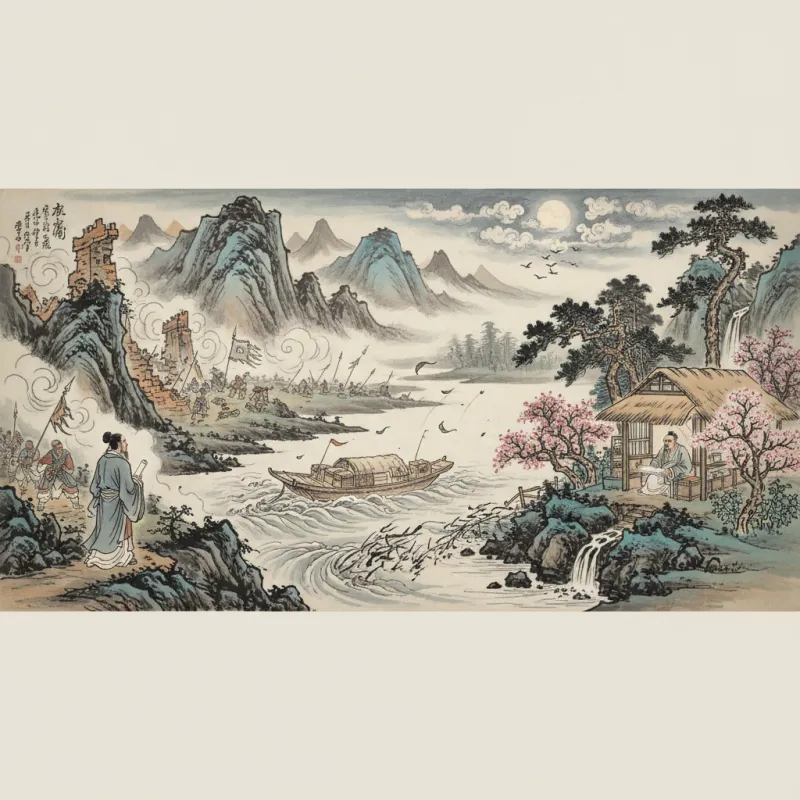
The poet Du Fu was fifty-three years old when he watched Chang'an burn. He'd spent months hiding in the ruins of the capital, eating wild plants and dodging rebel patrols, while the An Lushan Rebellion tore the Tang Dynasty apart. When he finally escaped and rejoined the loyalist court, he wrote "Spring View" (春望 Chūn Wàng), one of the most famous war poems in Chinese literature: "The nation is broken; mountains and rivers remain. / Spring comes to the city; grass and trees grow deep." The poem isn't about heroism or strategy. It's about what's left when everything else is gone — and how a man keeps writing when his world has ended.
This is the essence of Chinese war and exile poetry: not the literature of conquest, but the literature of survival. While European epic poetry celebrated warriors and battles, Chinese poets documented displacement, hunger, separation, and the slow erosion of hope. They wrote from occupied cities, refugee camps, and lonely border posts. They wrote about watching their children starve, burying friends in unmarked graves, and wondering if they'd ever see home again. The result is a body of work that's almost unbearably intimate — and absolutely essential to understanding how Chinese civilization survived its own repeated destruction.
The Invention of Witness Poetry
War poetry existed before Du Fu, but he transformed it into something new. Earlier poets like Cao Cao (曹操 Cáo Cāo) wrote about military campaigns with a certain detachment, even when describing devastation. Du Fu made it personal. His An Lushan poems don't just describe the rebellion — they record his own terror, confusion, and grief with forensic precision. In "Mourning the Prince" (哀王孫 Āi Wáng Sūn), he describes meeting a young imperial prince fleeing through the streets, too traumatized to speak. In "The Conscription Officer at Shihao Village" (石壕吏 Shíháo Lì), he hides in a farmhouse while soldiers drag an old woman away to fill conscription quotas, her sons already dead at the front.
What makes these poems revolutionary isn't their anti-war sentiment — plenty of poets opposed war. It's their refusal to look away from specific, individual suffering. Du Fu names villages. He describes the exact sound of a mother's wailing. He records the price of rice and the number of corpses in the street. This documentary impulse would become the defining characteristic of Chinese war poetry, distinguishing it from the more mythologized traditions of other cultures. Chinese poets weren't interested in making war beautiful or meaningful. They wanted to make sure someone remembered what actually happened.
The technique Du Fu pioneered — what we might call "witness poetry" — became the template for every major war poet who followed. When the Song Dynasty faced invasion by the Jurchen Jin, poets like Li Qingzhao (李清照 Lǐ Qīngzhào) and Lu You used Du Fu's methods to document their own catastrophes. When the Ming fell to the Qing, poets like Qu Dajun (屈大均 Qū Dàjūn) wrote resistance poetry that was simultaneously political manifesto and personal diary. The form proved infinitely adaptable because it was rooted in something universal: the human need to testify, to say "I was there, this happened, someone should know."
Exile as Spiritual Geography
If war poetry is about witnessing destruction, exile poetry is about mapping absence. Chinese poets developed an entire vocabulary for describing what it feels like to be separated from home — not just physically, but spiritually and temporally. The word "乡愁" (xiāngchóu), usually translated as "homesickness," literally means "village sorrow," and it carries connotations of ancestral graves, childhood landscapes, and a whole cosmology of belonging that can never be recovered once you leave.
The greatest exile poets understood that you don't have to cross borders to be exiled. Li Bai (李白 Lǐ Bái), who spent much of his life wandering, wrote exile poetry even when he was technically free to go anywhere. His famous "Quiet Night Thought" (静夜思 Jìng Yè Sī) — "Moonlight before my bed / I think it's frost on the ground / I lift my head to watch the bright moon / Lower it, thinking of home" — captures the peculiar loneliness of the perpetual outsider. The poem is only twenty characters long, but it contains an entire philosophy of displacement: the confusion between moonlight and frost suggests a man who no longer knows where he is, and the final gesture of lowering his head implies both reverence and defeat.
But the most devastating exile poetry came from poets who were forcibly separated from their homeland by conquest. When the Song Dynasty lost its northern territories to the Jin, an entire generation of poets found themselves writing about places they could never return to. Xin Qiji (辛弃疾 Xīn Qìjí), who escaped from Jin territory as a young man, spent forty years writing poems about the north — not as it was, but as he remembered it, a landscape increasingly mythologized by distance and time. His ci poems (词 cí) are full of military imagery and frustrated martial energy, but they're really about the impossibility of going home. The north in his poems becomes less a place than a state of mind, a permanent wound that won't heal.
This transformation of geography into psychology is one of the great achievements of Chinese exile poetry. Poets learned to write about landscapes they couldn't see, using memory and imagination to construct alternative maps of belonging. The result is a literature that's simultaneously concrete and abstract, rooted in specific places but ultimately about the universal experience of loss. When you read Li Qingzhao's late poems, written after she fled south during the Jin invasion, you're not just reading about the Song Dynasty — you're reading about what it means to carry your entire world inside your head because the physical world has been taken from you.
The Aesthetics of Survival
There's a paradox at the heart of Chinese war and exile poetry: the worse things get, the more beautiful the poems become. This isn't escapism or denial. It's a deliberate aesthetic strategy, a way of asserting human dignity in the face of dehumanizing circumstances. When Du Fu writes about starving refugees, he uses the same refined diction and complex prosody he'd use for a court banquet poem. When Lu You writes about military defeat, he crafts perfect regulated verse (律诗 lǜshī) with flawless tonal patterns. The message is clear: catastrophe doesn't give you permission to write badly. If anything, it demands your best work.
This commitment to formal excellence under extreme conditions produced some of the most technically accomplished poetry in Chinese literature. Consider Wen Tianxiang (文天祥 Wén Tiānxiáng), the Song loyalist who was captured by the Mongols and spent three years in prison before his execution. His "Song of Righteousness" (正气歌 Zhèngqì Gē), written in captivity, is a masterpiece of regulated verse that catalogs historical examples of moral courage while simultaneously asserting the poet's own refusal to surrender. The poem's formal perfection isn't incidental to its political message — it is the political message. By maintaining aesthetic standards in prison, Wen Tianxiang demonstrates that the Mongols can control his body but not his mind or his art.
This aesthetic philosophy connects war and exile poetry to broader themes in Chinese literature, particularly the relationship between artistic refinement and moral cultivation. Chinese poets believed that maintaining formal discipline in poetry was analogous to maintaining moral discipline in life. When the world falls apart, the ability to write a perfect couplet becomes a form of resistance, a way of proving that civilization survives even when its institutions don't. This is why so many Chinese war poems are simultaneously heartbreaking and beautiful — the beauty isn't a distraction from the suffering, it's the proof that suffering hasn't destroyed the poet's humanity.
Women's Voices in the Literature of Catastrophe
War and exile poetry is often treated as a masculine genre, but some of the most powerful examples were written by women. Li Qingzhao, arguably the greatest ci poet in Chinese history, wrote her most famous works after fleeing the Jin invasion. Her late poems document not just political catastrophe but personal devastation — her husband's death, the loss of their art collection, her own descent into poverty and obscurity. What makes her work extraordinary is its refusal to separate public and private grief. When she writes about the fall of the north, she's also writing about her marriage. When she writes about lost artworks, she's writing about lost time, lost youth, lost possibilities.
Her poem "Slow Slow Song" (声声慢 Shēng Shēng Màn), written in exile, is one of the most formally innovative works in the ci tradition. It opens with a series of reduplicative characters — "寻寻觅觅,冷冷清清,凄凄惨惨戚戚" (xún xún mì mì, lěng lěng qīng qīng, qī qī cǎn cǎn qī qī) — that create a stuttering, almost broken rhythm, as if language itself is struggling to function under the weight of grief. The poem describes a woman alone in her room, unable to find comfort in wine, poetry, or sleep, haunted by memories of better times. It's ostensibly about personal loneliness, but the historical context — written during the Song's greatest crisis — makes it impossible to read as purely private. Li Qingzhao discovered what many women poets would later confirm: that domestic space and national space are never truly separate, and that the literature of survival must account for both.
Other women poets used war and exile as opportunities to claim literary authority. Zhu Shuzhen (朱淑真 Zhū Shūzhēn), writing during the Southern Song, used military metaphors to describe her own constrained life, implicitly comparing her domestic imprisonment to political exile. Qiu Jin (秋瑾 Qiū Jǐn), the revolutionary poet executed in 1907, wrote explicitly political poetry that drew on the war poetry tradition to justify armed resistance. These poets understood that the literature of catastrophe wasn't just about recording suffering — it was about claiming the right to speak, to interpret, to shape the historical narrative. In a culture that often silenced women's voices, war and exile created spaces where women could write with unprecedented authority about matters of public importance.
The Border Garrison Tradition
Not all war poetry came from catastrophe. The frontier garrison poem (边塞诗 biānsài shī) developed as a distinct subgenre during the Tang Dynasty, when Chinese armies were actively expanding into Central Asia. These poems, written by soldiers and officials stationed at remote border posts, occupy an interesting middle ground between war poetry and exile poetry. The poets aren't fleeing invasion or documenting destruction — they're serving the empire, often voluntarily. But they're still separated from home, still living in harsh conditions, still confronting the possibility of death far from family and civilization.
The best garrison poems, like those by Wang Changling (王昌龄 Wáng Chānglíng) and Cen Can (岑参 Cén Cān), capture the strange mixture of boredom, beauty, and terror that characterizes military life. Wang Changling's "Out of the Frontier" (出塞 Chū Sài) — "The bright moon of Qin, the passes of Han / Ten thousand li march, men have not returned" — compresses centuries of border warfare into four lines, suggesting that individual soldiers are just the latest iteration of an endless cycle. Cen Can's poems about the Western Regions describe landscapes so alien they seem almost extraterrestrial: deserts where the sand sings, mountains made of jade, winds that can freeze a man solid in minutes. These aren't metaphors — Cen Can actually served in the far west and wrote from direct observation — but they read like science fiction, as if the poets have traveled to another planet.
The garrison tradition influenced later war poetry by establishing certain conventions: the use of landscape to reflect psychological states, the emphasis on separation and distance, the mixture of martial imagery with domestic longing. When Du Fu wrote his war poems, he was drawing on garrison poetry's vocabulary while inverting its values. Garrison poets wrote about serving the empire; Du Fu wrote about the empire's failure to protect its people. Garrison poets celebrated military expansion; Du Fu documented its human cost. The dialogue between these traditions — between poetry that justifies war and poetry that questions it — runs through the entire history of Chinese war literature.
Legacy and Modern Resonance
The tradition of war and exile poetry didn't end with the classical period. Twentieth-century Chinese poets, facing Japanese invasion, civil war, and political persecution, returned to Du Fu and Li Qingzhao as models for how to write about catastrophe. Ai Qing (艾青 Ài Qīng), writing during the Second Sino-Japanese War, explicitly invoked Du Fu's witness poetry in his own documentary-style poems about refugee columns and bombed villages. Bei Dao (北岛 Běi Dǎo), exiled after Tiananmen, wrote poems that echo the Song Dynasty exile poets' sense of permanent displacement.
What makes the classical tradition still relevant is its refusal to offer easy consolations. Chinese war and exile poetry doesn't promise that suffering has meaning, that sacrifice will be rewarded, or that history bends toward justice. It only promises to remember — to record what happened, who suffered, what was lost. This might seem like a modest ambition, but in the context of catastrophe, it's revolutionary. When empires collapse and populations are displaced, the first casualty is usually memory. Official histories get rewritten, inconvenient facts disappear, individual stories get absorbed into nationalist narratives. Poetry resists this erasure by insisting on specificity, on the irreducible reality of individual experience.
The connection between classical war poetry and broader themes of memory and historical consciousness helps explain why these poems remain so powerful. They're not just historical documents — they're arguments about what matters, about what deserves to be remembered, about whose voices count. When Du Fu writes about an old woman conscripted to cook for soldiers, he's making a claim about historical importance: that her suffering matters as much as any general's victory. When Li Qingzhao writes about her lost art collection, she's arguing that cultural destruction is as significant as military defeat. These are radical positions, and they remain radical today.
Reading War Poetry Now
Modern readers sometimes struggle with Chinese war and exile poetry because it doesn't match our expectations for war literature. We expect either anti-war polemic or patriotic celebration, either bitter irony or noble sacrifice. Chinese war poetry offers something different: a literature of endurance that's neither optimistic nor despairing, neither heroic nor defeatist. It simply records what it's like to keep living when the world has ended, to keep writing when there's no audience, to keep hoping when hope makes no rational sense.
This emotional complexity is the tradition's greatest strength and its greatest challenge. The poems don't resolve into simple messages or clear moral lessons. They sit with ambiguity, contradiction, and unresolved grief. Du Fu can write about the beauty of spring flowers in the same poem where he describes corpses in the street. Lu You can express fierce patriotism while acknowledging that his side is losing. Li Qingzhao can mourn her personal losses while recognizing that millions suffered worse. This refusal to simplify or sentimentalize makes the poems difficult but also makes them true — true to the actual experience of catastrophe, which is always more complicated than our narratives about it.
If you want to understand Chinese civilization's remarkable ability to survive repeated destruction, you have to read its war and exile poetry. Not because the poems explain survival — they don't — but because they demonstrate it. Every poem written during catastrophe is proof that something survived, that someone kept writing, that the tradition continued even when continuation seemed impossible. The poems are themselves acts of survival, and reading them seven hundred or thirteen hundred years later, we become witnesses to that survival. We join the chain of readers and writers who refused to let these voices disappear, who insisted that what happened mattered, who kept the conversation going across centuries of catastrophe and renewal. That's not just literary history. That's how civilizations survive.
Related Reading
- Exile and Homesickness: The Wanderer's Lament
- Love and Longing in Chinese Poetry: The Art of Missing Someone
- The Four Seasons in Chinese Poetry: Spring Sorrow, Summer Heat, Autumn Grief, Winter Silence
- Moonlight in Chinese Poetry: Why the Moon Means Everything
- Nature in Chinese Poetry: Mountains, Rivers, and the Mirror of the Soul
- Poetic Forms: The Rules That Made Chinese Poetry Great
- Why Some Chinese Poems Are Untranslatable: The Beauty That Gets Lost
- Poetry as Philosophy: How Chinese Poets Think
Explore Chinese Culture
- Explore the Tang dynasty's golden age
- Explore Daoist themes in classical poetry
- Explore Chinese literary traditions