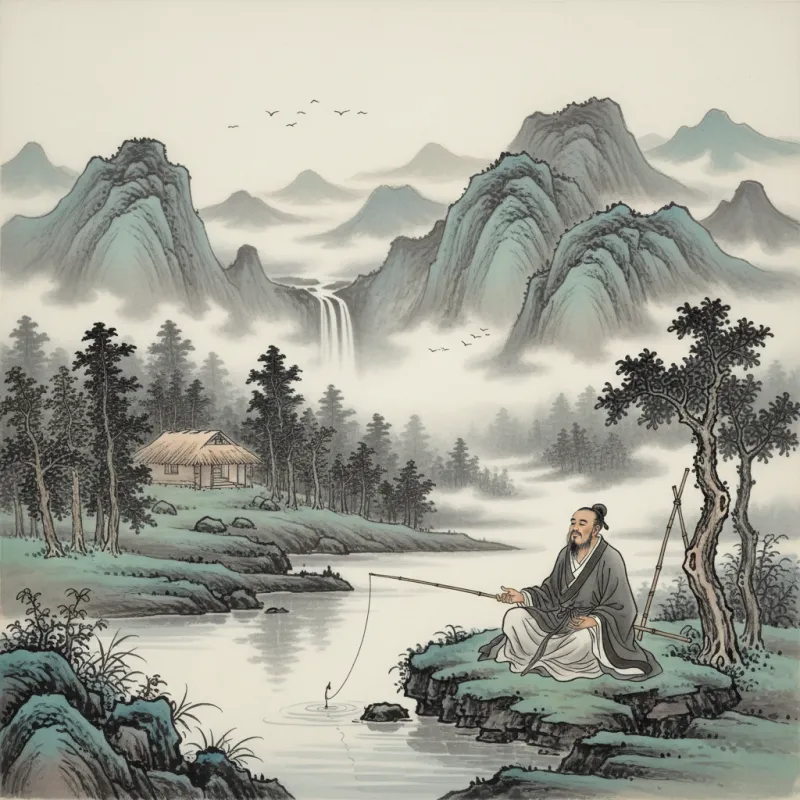
A man sits by a stream doing absolutely nothing. Not meditating. Not contemplating nature. Not even "being present." Just sitting there, watching water move around rocks. To a Confucian bureaucrat hurrying past with his scrolls and appointments, this looks like laziness. To a Daoist poet, it's the highest form of activity.
This is the central paradox that animates Daoist poetry: the most profound action is non-action, wuwei (无为, wúwéi). And the poets who tried to capture this paradox in words created some of the strangest, most beautiful verse in Chinese literature. They weren't writing about doing nothing. They were trying to do nothing with language itself — to let words flow like water, to make poems that happened rather than poems that were made.
The Impossible Task
The Dao De Jing (道德经, Dào Dé Jīng) opens with what amounts to a literary suicide note: "The Dao that can be spoken is not the true Dao" (道可道,非常道, Dào kě dào, fēi cháng Dào). Laozi, whether he was one person or a committee, basically told every future poet: whatever you write about this, you're wrong.
But poets being poets, they took this as a challenge rather than a warning. The Tang and Song dynasties produced hundreds of poets who spent their careers trying to write about the unwriteable. What's remarkable is that many of them succeeded — not by solving the paradox, but by embodying it. Their poems don't describe wuwei. They perform it.
Take Wang Wei (王维, Wáng Wéi, 699-759), who might be the most Daoist of all Tang poets even though he was officially a Buddhist. His famous quatrain "Deer Park" (鹿柴, Lù Zhài) does something extraordinary in just twenty characters:
空山不见人 (kōng shān bù jiàn rén) — Empty mountain, no one in sight 但闻人语响 (dàn wén rén yǔ xiǎng) — But hear human voices echoing 返景入深林 (fǎn jǐng rù shēn lín) — Returning light enters deep forest 复照青苔上 (fù zhào qīng tái shàng) — Again shines on green moss
Nothing happens in this poem. There's no narrative, no development, no point being made. It's just four observations that don't quite connect. And yet something profound occurs in the gap between those observations — in the space where the reader expects meaning but finds only presence. The poem enacts emptiness rather than describing it.
The Language of Not-Doing
Daoist poets developed specific techniques for making language do less. This sounds simple, but it's actually harder than making language do more. Anyone can pile on adjectives and metaphors. It takes real skill to strip a poem down until it's barely there.
One technique is radical simplicity. Li Bai (李白, Lǐ Bái, 701-762), famous for his wild, drunken persona, could also write with Daoist restraint. His poem "Sitting Alone at Jingting Mountain" (独坐敬亭山, Dú Zuò Jìngtíng Shān) ends with these lines:
相看两不厌 (xiāng kàn liǎng bù yàn) — Looking at each other, neither tires 只有敬亭山 (zhǐ yǒu Jìngtíng Shān) — Only Jingting Mountain
Who's looking at whom? Is Li Bai looking at the mountain, or is the mountain looking at Li Bai? The grammar deliberately refuses to clarify. Subject and object dissolve into each other. This isn't poetic ambiguity for its own sake — it's a grammatical performance of the Daoist idea that distinctions between self and world are artificial.
Another technique is strategic incompleteness. Daoist poems often feel unfinished, as if the poet got distracted mid-thought and wandered off. This isn't carelessness. It's a way of refusing to impose closure, to let the poem remain open and flowing rather than fixed and finished. The reader has to complete the poem, which means the poem never quite exists as a stable object. It's always in process, always becoming.
Mountains, Water, and the Hermit Ideal
If you read enough Daoist poetry, you start to notice the same images appearing over and over: mountains, streams, clouds, hermits in thatched huts, wine, the moon. This isn't because Daoist poets lacked imagination. It's because these images carry specific philosophical weight.
Mountains represent permanence and stillness, but also withdrawal from the social world. To "return to the mountains" (归山, guī shān) meant abandoning official life — the Confucian world of duty, hierarchy, and striving — for a life of natural simplicity. But here's the thing: most of the poets writing about mountain hermits weren't actually hermits. They were officials who spent their days in bureaucratic meetings and their evenings writing poems about escaping bureaucratic meetings.
This makes Daoist poetry sound hypocritical, but I think it's more interesting than that. The poems aren't lies about the poets' actual lives. They're experiments in alternative consciousness. When Wang Wei writes about sitting alone in a mountain pavilion, he's not claiming he does this all the time. He's creating a space where that kind of consciousness becomes possible, even if only for the duration of the poem.
Water is even more important than mountains. The Dao De Jing says "the highest good is like water" (上善若水, shàng shàn ruò shuǐ) because water is soft, yielding, and flows naturally to the lowest places — yet it can wear away stone. Daoist poets are obsessed with water. They watch it, listen to it, compare themselves to it, try to write like it.
Meng Haoran (孟浩然, Mèng Hàorán, 689-740) spent his whole career writing about water. His poem "Spring Dawn" (春晓, Chūn Xiǎo) is so famous that every Chinese schoolchild memorizes it, but it's worth looking at closely:
春眠不觉晓 (chūn mián bù jué xiǎo) — Spring sleep, unaware of dawn 处处闻啼鸟 (chù chù wén tí niǎo) — Everywhere hear birds crying 夜来风雨声 (yè lái fēng yǔ shēng) — Night came, wind and rain sounds 花落知多少 (huā luò zhī duō shǎo) — Flowers fell, who knows how many
The poem is about not-knowing. The speaker doesn't know when dawn came, doesn't know how many flowers fell. This ignorance isn't a problem to be solved. It's the point. The poem celebrates a consciousness that doesn't try to grasp and measure everything, that lets experience flow past without clutching at it.
Drunkenness and Spontaneity
Daoist poets drank. A lot. Li Bai supposedly drowned while drunk, trying to embrace the moon's reflection in a river. This is almost certainly a legend, but it's a legend that tells you something true about how Daoist poetry works.
Alcohol in Daoist poetry isn't about escapism or self-destruction. It's a technology for achieving spontaneity. The Daoist ideal is ziran (自然, zìrán), which literally means "self-so" — things being naturally themselves without effort or artifice. But how do you be spontaneous on purpose? How do you try not to try?
Drunkenness offered one answer. When you're drunk, you can't control yourself as precisely. Your words come out more loosely, more naturally. You say things you wouldn't say sober. For a poet trying to write without forcing, trying to let language flow naturally, alcohol was a practical tool.
This is why so many Daoist poems are about drinking or written from a drunk perspective. They're not just describing drunkenness — they're trying to capture the looseness, the spontaneity, the lack of self-consciousness that drunkenness enables. The poem itself becomes drunk, in a sense. It staggers, it digresses, it says things that don't quite make sense but somehow feel true.
The Politics of Doing Nothing
Here's something that doesn't get talked about enough: Daoist poetry is political. Not in an obvious way — these poems aren't manifestos or protests. But the choice to write about doing nothing, about withdrawing from society, about valuing uselessness, is itself a political statement in a Confucian world that valued service, duty, and usefulness above all else.
When Tao Yuanming (陶渊明, Táo Yuānmíng, 365-427), the grandfather of all Daoist poets, quit his government job and went back to farming, he wasn't just making a personal lifestyle choice. He was rejecting the entire Confucian system that said a man's worth was measured by his official rank and his service to the state. His poem "Returning to the Garden and Field" (归园田居, Guī Yuán Tián Jū) is a manifesto disguised as a nature poem.
The Tang dynasty poets inherited this tradition of principled uselessness. When they wrote about hermits and mountains and doing nothing, they were creating an alternative value system. In a world that measured success by how high you climbed in the bureaucracy, they celebrated failure. In a world that valued productivity, they praised idleness. In a world that demanded constant striving, they advocated for wuwei.
This is why Daoist poetry often has an edge of sadness or frustration beneath its surface calm. These poets weren't actually free to do nothing. They had families to support, social obligations to fulfill, careers to manage. The poems are often written from the gap between the life they're living and the life they imagine — between the Confucian world they inhabit and the Daoist world they dream of.
Reading Like Water
The real challenge of Daoist poetry isn't writing it. It's reading it. These poems resist the kind of active, analytical reading we're trained to do. They don't want to be interpreted or decoded. They want to be experienced, the way you experience weather or music.
This means reading more slowly, more receptively. It means not immediately asking "what does this mean?" but instead letting the images and sounds wash over you. It means being okay with not understanding, with not grasping, with not getting the point — because often there isn't a point to get.
The best Daoist poems create a kind of consciousness in the reader that mirrors the consciousness they describe. You finish reading and you're not quite sure what happened, but something has shifted. You're a little more relaxed, a little less grasping, a little more willing to let things be what they are.
This is what makes Daoist poetry relevant beyond its historical context. We live in a world that demands constant productivity, constant optimization, constant doing. These poems from a thousand years ago offer a different possibility: that sometimes the most profound thing you can do is nothing at all. That watching water move around rocks might be more valuable than any amount of striving and achieving.
The Daoist poets knew they couldn't capture the Dao in words. But they could create poems that pointed toward it, the way a finger points at the moon. The poems aren't the thing itself. They're just gestures in the direction of something that can't be said. And sometimes, if you read them right — which means reading them wrong, reading them loosely, reading them the way water flows — you catch a glimpse of what they're pointing at.
Not that you can say what it is. That would defeat the whole purpose.
Related Reading
- Poetry as Philosophy: How Chinese Poets Think
- Daoist Poetry: Finding the Way Through Nature
- Confucian Values in Classical Chinese Poetry: Duty, Loyalty, and the Weight of the World
- Zen Poetry: Enlightenment in Seventeen Syllables
- The Timeless Elegance of Chinese Classical Poetry: Tang, Song, and Yuan Eras
- Du Fu's War Poems: Witnessing the An Lushan Rebellion
- Fu: The Grand Rhapsody Form
- Wine Poetry: The Chinese Tradition of Drinking and Writing
Explore Chinese Culture
- Explore the Tang dynasty's golden age
- Explore Daoist themes in classical poetry
- Explore Chinese literary traditions