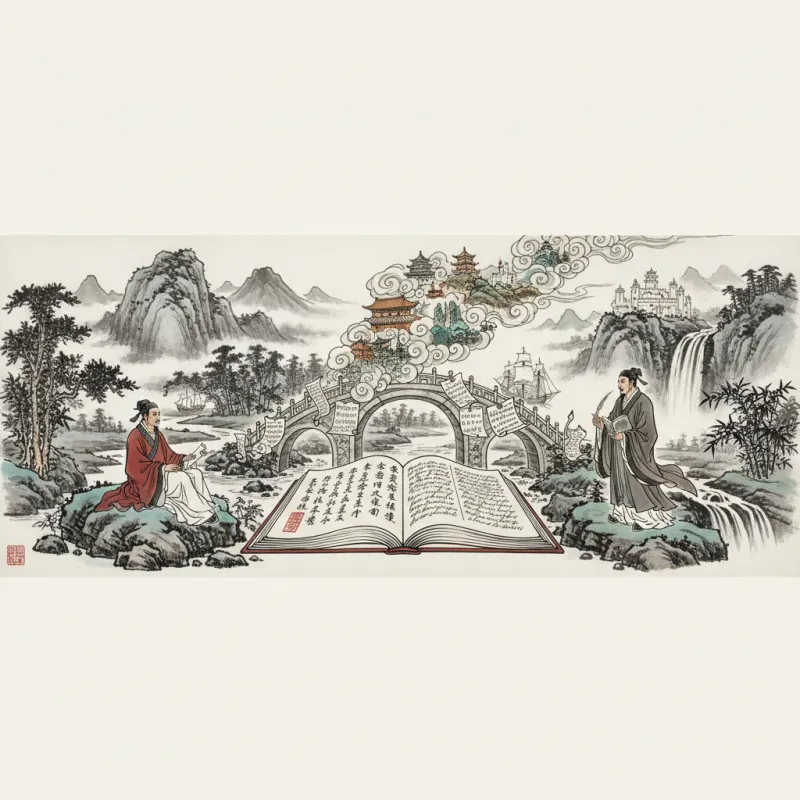
You open a bilingual edition of Li Bai's "Quiet Night Thought" and find three different English versions. One reads like a Victorian hymn. Another sounds like beat poetry. The third feels clinical, almost mathematical. They're all translating the same twenty characters—so why do they feel like completely different poems?
The answer reveals everything about what gets lost, and occasionally found, when Tang poetry crosses into English.
What Actually Disappears in Translation
Tang poetry (唐诗 Tángshī) operates in four dimensions that English simply doesn't have. First, the tonal patterns (平仄 píngzè)—the rising and falling pitches that create musical structure—vanish completely since English stress patterns work nothing like Chinese tones. Second, the visual architecture of characters dissolves into alphabet soup. When Du Fu (杜甫 Dù Fǔ) writes 月 (moon), Chinese readers see the radical for "flesh" embedded in the character, connecting moonlight to the body; English readers just see "moon." Third, the regulated verse forms (律诗 lǜshī) with their strict parallelism and tonal requirements become impossible to replicate. Fourth, the dense network of literary allusion—references to earlier poems, historical events, classical texts—requires footnotes that kill the reading experience.
Every translator makes different sacrifices. Understanding their choices helps you find the translation that matches what you're looking for.
Burton Watson: The Scholarly Standard
Watson treats Tang poetry like a puzzle to be solved accurately. His translations of Du Fu, Li Bai (李白 Lǐ Bái), and Wang Wei (王维 Wáng Wéi) read like elegant prose with the poetry drained out—but that's intentional. He wants you to understand what the poem says, not feel what it does. His Du Fu sounds like a thoughtful essayist: "Autumn wind breaks through the thatch on my roof, / rolls it up, scatters it across the river, hangs it in the treetops." Accurate? Absolutely. Musical? Not remotely.
Watson's strength is reliability. If you're studying Tang Dynasty poetry for academic purposes or want to grasp the literal content before exploring more adventurous versions, start here. His annotations are thorough without being pedantic. But don't expect to feel the gut-punch of the original.
Arthur Cooper: Reconstructing the Music
Cooper's approach in "Li Po and Tu Fu" is radically different—he tries to recreate the formal constraints of regulated verse in English. He counts syllables obsessively, forces parallel structures, and attempts tonal equivalents using stress patterns. The result sometimes works brilliantly and sometimes produces awkward English that feels like it's wearing shoes two sizes too small.
His Li Bai can be stunning: "Before my bed the bright moon's light— / I thought it frost upon the ground." The rhythm actually scans, the parallel structure holds, and you get a ghost of the original's music. But when the formal constraints clash with English syntax, Cooper chooses form over sense, producing lines that require multiple readings to parse.
If you care about experiencing the structural elegance of regulated verse forms, Cooper is essential. Just be prepared for occasional awkwardness in service of formal fidelity.
David Hinton: The Taoist Interpreter
Hinton's translations of Wang Wei, Li Bai, and Du Fu prioritize the philosophical and spiritual dimensions of Tang poetry. He's particularly strong with poems that engage Buddhist and Taoist themes, rendering them in spare, meditative English that feels like American modernist poetry. His Wang Wei sounds like Gary Snyder: "Empty mountains, no one in sight. / Only the sound of someone talking, / echoes returning deep into the forest / where light shines again on green moss."
Hinton takes liberties with literal meaning to capture what he sees as the poems' essential spirit. Sometimes this produces revelatory translations that feel more alive than more accurate versions. Sometimes it feels like he's projecting his own Zen aesthetics onto poems that had different concerns. His Du Fu is particularly controversial—critics argue he smooths over the political urgency and social criticism that define Du Fu's work, turning a Confucian moralist into a nature mystic.
Read Hinton when you want to feel the contemplative mood of Tang poetry, especially the landscape poems (山水诗 shānshuǐshī). Just remember you're getting Hinton's interpretation, not a neutral rendering.
Vikram Seth: The Poet's Approach
Seth's "Three Chinese Poets" takes a different gamble—he translates Wang Wei, Li Bai, and Du Fu into rhymed English verse. This sounds insane (the original Chinese doesn't rhyme in the same way), but Seth is a skilled poet who understands that English poetry needs its own music, not a failed imitation of Chinese prosody.
His versions are the most readable as English poems. They flow naturally, they rhyme without feeling forced, and they work on the page without footnotes. But they're also the furthest from the original in terms of literal accuracy. Seth will change images, add words, rearrange lines—whatever it takes to make the English poem succeed on its own terms.
This approach works best for readers who want to experience Tang poetry as poetry rather than as historical documents or cultural artifacts. Seth's Li Bai feels like a real poet speaking in English, not like a Chinese poet awkwardly dubbed into another language.
Red Pine: The Annotated Experience
Red Pine (Bill Porter) takes yet another approach in his translations of Wang Wei and Han Shan (寒山 Hán Shān)—he provides multiple layers of context. Each poem gets a literal translation, a literary translation, extensive notes on allusions and Buddhist terminology, and often commentary from classical Chinese critics. Reading Red Pine is like having a knowledgeable guide walk you through the poem's landscape.
His translations themselves tend toward the literal side, but the real value is in the apparatus. When Wang Wei references a specific Buddhist sutra or alludes to an earlier poem, Red Pine explains it clearly. This makes his books ideal for serious students who want to understand not just what the poem says but how educated Tang readers would have understood it.
The downside is that the reading experience becomes fragmented—you're constantly jumping to footnotes, breaking the poem's flow. But if you're willing to read slowly and carefully, Red Pine offers the deepest understanding of how these poems actually work.
Sam Hamill: The Accessible Middle Ground
Hamill's translations, particularly his "Crossing the Yellow River: Three Hundred Poems from the Chinese," aim for the sweet spot between accuracy and readability. He's less literal than Watson, less formally experimental than Cooper, less interpretive than Hinton, less free than Seth. His versions read like good contemporary American poetry without calling attention to themselves as translations.
This makes Hamill ideal for general readers who want to enjoy Tang poetry without becoming specialists. His Du Fu sounds urgent and human: "The nation shattered, mountains and rivers remain. / Spring in the city, grass and trees grow deep." It's not trying to recreate Chinese prosody or impose a particular philosophical reading—it's just trying to be a good poem in English.
Choosing Your Translation
The right translation depends on what you're looking for. If you're studying Tang poetry forms academically, start with Watson for accuracy and Cooper for formal analysis. If you're interested in the spiritual dimensions, try Hinton or Red Pine. If you want to read Tang poetry as living literature rather than historical artifact, go with Seth or Hamill.
Better yet, read multiple translations side by side. Comparing Watson's literal version with Seth's rhymed adaptation and Hinton's meditative rendering reveals more about the original poem than any single translation can. You start to see what's negotiable and what's essential, what survives translation and what doesn't.
The impossibility of translating Tang poetry turns out to be productive. Because no single English version can capture everything, we get multiple versions that illuminate different facets of the original. The best approach isn't finding the "right" translation—it's reading several and letting them triangulate toward something the original might have been.
Related Reading
- Why Some Chinese Poems Are Untranslatable: The Beauty That Gets Lost
- Translating Chinese Poetry: Why Every Translation Is Wrong (And Why That Is Fine)
- AI vs. Human Translation of Chinese Poetry: A 2024 Comparison
- Ezra Pound and Chinese Poetry: Beautiful Mistakes
- Drinking Poetry: Why Chinese Poets Wrote Their Best Work Drunk
- Sun Tzu's Art of War: The Complete Guide for Modern Readers
- The Resonance of War in Chinese Classical Poetry: Analyzing Tang, Song, and Yuan Poets
Explore Chinese Culture
- Explore the Tang dynasty's golden age
- Explore Daoist themes in classical poetry
- Explore Chinese literary traditions