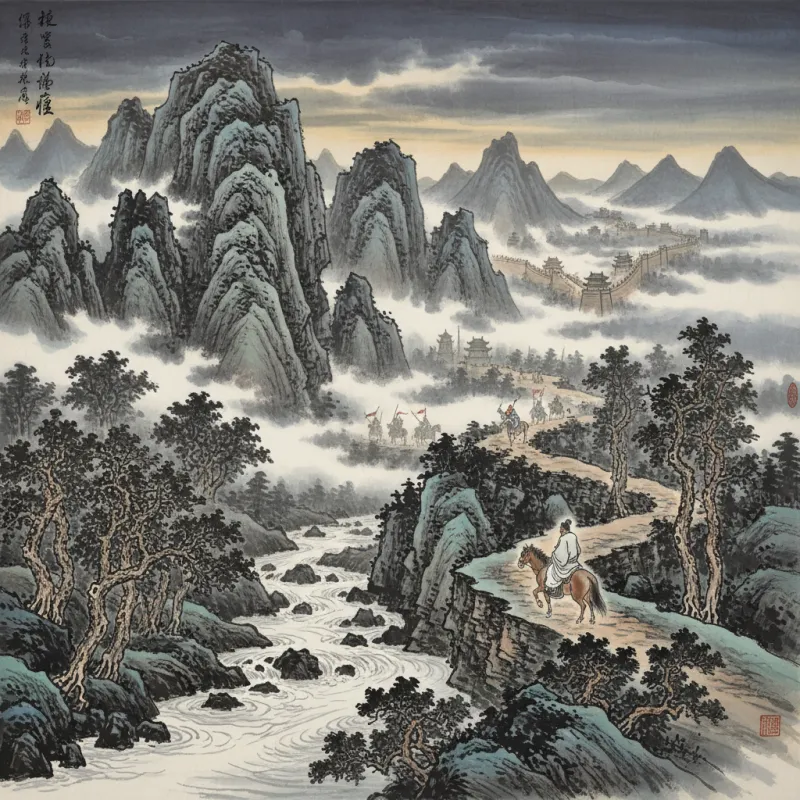
The battlefield stretches silent under moonlight, littered with broken arrows and the ghosts of ten thousand soldiers. This haunting image, painted by countless Chinese poets across three dynasties, reveals something profound: war poetry wasn't just about glorifying conquest or mourning defeat—it was the lens through which China's greatest literary minds examined what it means to be human when civilization collapses into violence.
The Tang Dynasty: When War Poetry Became Art
The Tang dynasty (618–907 CE) didn't invent war poetry, but it perfected it. What made Tang poets revolutionary wasn't their subject matter—Chinese literature had depicted battles for centuries—but their willingness to question the very premise of military glory. Li Bai (李白, Lǐ Bái), the "Immortal Poet," could write stirring verses about swords and heroism one moment, then pivot to devastating critiques of imperial ambition the next. His poem "Battle South of the City" doesn't celebrate victory; it catalogs the waste: "Last year we fought by the Sang-kan's source, / This year we fight on the Tsung-ho road."
But it's Du Fu (杜甫, Dù Fǔ) who truly revolutionized the genre. Living through the catastrophic An Lushan Rebellion (755–763), Du Fu witnessed the Tang's golden age shatter into civil war. His "Spring View" (春望, Chūn Wàng) contains one of Chinese literature's most devastating lines: "The nation is broken; mountains and rivers remain." Notice what he's saying—the political entity called "China" can be destroyed, but the land endures. This wasn't just poetry; it was a philosophical statement about the impermanence of human institutions versus the eternal nature of the physical world.
The frontier poems (边塞诗, biānsài shī) of this era deserve special attention. Poets like Wang Changling and Cen Can spent years at China's northwestern borders, where Tang armies clashed with Tibetan and Turkic forces. Their work captures something modern war literature often misses: the grinding boredom and existential loneliness of military life. Wang Changling's "Out of the Frontier" asks a question that echoes across centuries: "But if the Flying General of Dragon City were still here, / He would not let the Hu horses cross the Yin Mountains." It's a lament disguised as praise—where are the great generals when we need them?
The Song Dynasty: Introspection Replaces Bravado
When the Song dynasty (960–1279) emerged from the chaos of the Five Dynasties period, something fundamental shifted in Chinese war poetry. The Song military was, frankly, not very good. Constantly threatened by the Khitan Liao, Tangut Western Xia, Jurchen Jin, and eventually the Mongols, Song China survived more through diplomacy and tribute payments than military prowess. This reality profoundly shaped its poetry.
Song war poetry turned inward. Where Tang poets might describe cavalry charges and battlefield heroics, Song poets obsessed over the psychological toll of conflict. Li Qingzhao (李清照, Lǐ Qīngzhào), one of China's greatest female poets, wrote some of the era's most powerful war poetry after fleeing the Jurchen invasion of 1127. Her work doesn't depict battles—it captures the refugee experience, the loss of home, the disintegration of family. "Searching and searching, cold and desolate, / Miserable and mournful and wretched" isn't about soldiers; it's about everyone war leaves behind.
The patriotic poetry (爱国诗, àiguó shī) of this period takes on a desperate quality. Lu You (陆游, Lù Yóu), who lived through the Southern Song's humiliating retreat below the Yangtze River, spent his entire career writing poems demanding military action to reclaim the north. His deathbed poem, "Showing My Sons," begs his children: "When the royal armies reconquer the Central Plain, / Don't forget to tell your father at the family sacrifice." He died in 1210, still waiting for a reconquest that would never come. This isn't just poetry—it's a historical document of national trauma.
Xin Qiji (辛弃疾, Xīn Qìjí) represents the Song war poet at his most complex. A military commander turned poet after being sidelined by court politics, Xin wrote ci (词, cí) poems—lyrics set to music—that seethe with frustrated martial energy. His "Broken Array" imagines himself as an aging warrior: "Drunk, I light the lamp to examine my sword, / Dreaming, I return to that camp of linked bugles." The tragedy isn't just personal; it's civilizational. Here's a man who knows how to fight, forced to write poems instead while his country crumbles.
The Yuan Dynasty: Poetry Under Foreign Rule
The Mongol conquest that established the Yuan dynasty (1271–1368) created an unprecedented crisis for Chinese poets. For the first time in history, all of China was ruled by a foreign power. How do you write war poetry when the war is over and you lost? The answer reveals the genre's remarkable adaptability.
Many Chinese literati refused to serve the Mongol court, retreating into what scholars call "loyalist poetry" (遗民诗, yímín shī). These poets didn't write about battles—they wrote about memory, about preserving Chinese culture under foreign occupation. Their war poetry became metaphorical, using historical battles and fallen dynasties as coded references to the Song's defeat. Reading Yuan dynasty war poetry requires understanding this subtext; a poem about an ancient battlefield is really about the poet's present grief.
The sanqu (散曲, sǎnqǔ) form—a type of dramatic verse that flourished under the Yuan—allowed poets to express anti-war sentiments more directly than classical forms permitted. Ma Zhiyuan's "Autumn Thoughts" doesn't mention war explicitly, but its images of desolation and wandering capture the displacement millions experienced during the Mongol conquests. "Withered vines, old trees, evening crows, / Small bridge, flowing water, someone's home" creates a landscape of loss without naming what was lost.
Some Chinese poets did serve the Yuan court, creating a fascinating subgenre of war poetry that praised Mongol military achievements while maintaining Chinese literary traditions. This wasn't simple collaboration—it was a complex negotiation of identity and survival. These poets had to celebrate the very conquests that destroyed their world, using the literary forms of the conquered to glorify the conquerors. The psychological tension in these works is palpable.
Themes That Transcend Dynasties
Across all three dynasties, certain themes recur with obsessive frequency. The separation of families (离别, líbié) appears in nearly every war poem, reflecting the reality that Chinese armies drew soldiers from across the empire, often never to return. The "征夫" (zhēngfū, conscripted soldier) became a stock character, and his abandoned wife waiting at home became equally iconic. This wasn't sentimentality—it was social commentary on war's human cost.
The critique of imperial ambition runs through the genre like a dark thread. Even poets who served the court couldn't resist questioning whether territorial expansion justified its price. Du Fu's line "The war chariots rattle and roll, / The war horses whinny and neigh" doesn't glorify military might—it presents it as a cacophonous nightmare. This skepticism toward military glory distinguishes Chinese war poetry from many Western traditions that, at least until World War I, often romanticized combat.
The natural world serves as both contrast and commentary. Poets repeatedly juxtapose the permanence of mountains and rivers against the transience of human conflict, as explored in classical Chinese nature poetry. Spring flowers bloom on battlefields, the moon shines on both the living and the dead, and the Yellow River flows regardless of which dynasty claims its banks. This isn't escapism—it's a philosophical statement about humanity's place in the cosmos.
The Technical Mastery Behind the Emotion
Understanding Chinese war poetry requires appreciating its formal constraints. Tang poets worked primarily in regulated verse (律诗, lǜshī) and quatrains (绝句, juéjù), forms with strict tonal patterns and parallelism requirements. Writing about war's chaos within such rigid structures created a productive tension—the form's order contrasts with the content's disorder, much like how Tang dynasty poetic forms evolved to express increasingly complex emotions.
Song dynasty ci poetry allowed more flexibility, with varying line lengths and complex tonal patterns borrowed from musical traditions. This suited the Song's more introspective approach to war poetry. The irregular rhythms could mirror psychological turbulence in ways regulated verse couldn't. When Xin Qiji writes about examining his sword while drunk, the ci form's musical quality adds layers of melancholy the stricter Tang forms might have flattened.
Yuan dynasty sanqu pushed even further toward colloquial language and irregular structure, reflecting both Mongol influence and the genre's theatrical origins. This democratization of form paralleled a democratization of perspective—war poetry was no longer exclusively the domain of educated officials but could incorporate voices from across society.
Why This Poetry Still Matters
Chinese war poetry from the Tang, Song, and Yuan dynasties offers something contemporary readers desperately need: a model for processing collective trauma through art. These poets faced invasions, civil wars, dynastic collapses, and foreign occupation, yet they transformed their experiences into literature that transcends its historical moment. Du Fu's refugees could be Syrian, Ukrainian, or Sudanese. Lu You's frustrated patriotism echoes in every nation that's lost territory. Li Qingzhao's grief speaks to anyone who's fled their home.
More importantly, this poetry refuses easy answers. It doesn't glorify war or condemn it simplistically. Instead, it sits with war's contradictions: the courage and waste, the necessity and tragedy, the way violence can be both meaningless and world-changing. In an era of polarized discourse about military intervention, these ancient Chinese poets model a more nuanced approach—one that acknowledges complexity without descending into moral relativism.
The greatest achievement of Chinese war poetry across these three dynasties might be its insistence on the individual human experience within vast historical forces. Empires rise and fall, armies clash and retreat, but the poet's eye remains fixed on the soldier who won't return home, the wife who waits in vain, the refugee who's lost everything. This isn't sentimentality—it's a radical assertion that individual suffering matters even when history books reduce it to statistics. That message, written centuries ago in classical Chinese, remains urgently relevant today.
Related Reading
- Du Fu's War Poems: Poetry as Witness to Catastrophe
- War Poetry of the Tang Dynasty: When Soldiers Became Poets
- War Poetry of the Tang Dynasty: Beauty in the Midst of Slaughter
- The Resonance of War in Chinese Classical Poetry: Analyzing Tang, Song, and Yuan Poets
- Frontier Poetry (边塞诗): War and Glory at the Empire's Edge
- Zhuo Wenjun: The Woman Who Wrote Her Own Love Story
- Love Poetry in Chinese Literature: The Art of Saying Everything by Saying Nothing
- Delving into the Techniques of Chinese Classical Poetry: Insights from Tang, Song, and Yuan Poets
Explore Chinese Culture
- Explore the Tang dynasty's golden age
- Explore Daoist themes in classical poetry
- Explore Chinese literary traditions