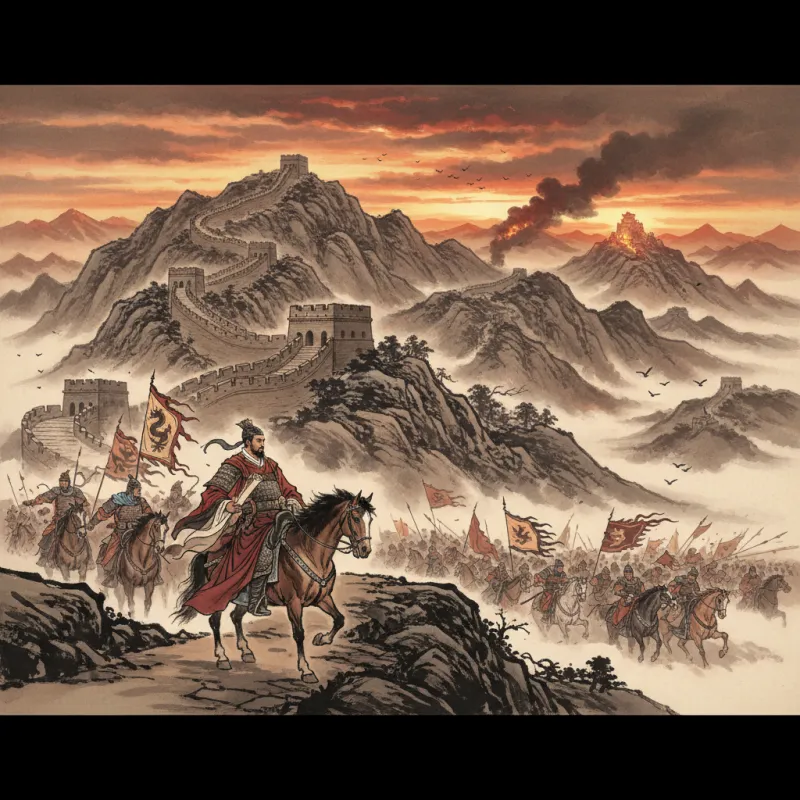
The desert wind carries sand that cuts like knives, and somewhere beyond the crumbling watchtower, a flute plays a melody that makes hardened soldiers weep for homes they'll never see again. This is the world of frontier poetry (边塞诗 biānsài shī) — Tang dynasty verse written from the empire's bleeding edge, where Chinese civilization met the vast unknown and young men died far from the plum blossoms of home.
War Poetry That Refuses Simple Answers
Here's what makes frontier poetry fascinating: it doesn't give you easy moral clarity. These aren't patriotic recruiting songs or anti-war manifestos. They're something stranger and more honest — poems that hold contradictory truths simultaneously. The frontier is glorious and pointless. The soldiers are heroes and victims. The landscape is sublime and murderous. Wang Changling (王昌龄, 698-757 CE) captures this perfectly in his most famous couplet: "But if the Flying General of Dragon City were still here, / He would never let the Hu horses cross the Yin Mountains." It's simultaneously a complaint about incompetent leadership and a celebration of military prowess, wrapped in imagery so sharp you can feel the wind off those mountains.
The Tang dynasty's frontier wars weren't abstract. From roughly 640-790 CE, the empire was locked in constant conflict with Tibetan, Turkic, and other Central Asian powers over control of the Silk Road and the Western Regions. Real soldiers — often conscripts from farming villages — spent years in garrisons along the Hexi Corridor, in modern Gansu and Xinjiang. The poetry emerged from this grinding reality, and it shows.
The Poets Who Went There
Wang Changling wrote over 70 frontier poems, more than any other Tang poet, and he actually served in military positions on the frontier. This matters. When he describes the "yellow sand wearing through golden armor in a hundred battles," he's not romanticizing from a comfortable study in the capital. He knew what sand in your eyes for months felt like, what it meant when supply caravans didn't arrive, how the isolation could break men's minds.
Gao Shi (高适, 704-765 CE) also served in frontier regions and rose to become a military governor. His poem "Song of Yan" (燕歌行 Yàn Gē Xíng) is brutally specific about military incompetence: "The general's strategy was to capture the enemy king, / But the soldiers froze to death before they could string their bows." No glory here — just frozen corpses and failed plans. Yet the same poem contains lines of startling beauty about the landscape and camaraderie between soldiers. This is the complexity that makes frontier poetry endure.
Then there's Cen Shen (岑参, 715-770 CE), who made two extended trips to the Western Regions and wrote poetry so vivid about the alien landscape that you can practically taste the dust. His "Song of White Snow in Farewell to Field-Clerk Wu Going Home" describes a snowstorm in the Tianshan Mountains with surreal imagery: "Suddenly, as if a spring breeze came overnight, / Ten thousand pear trees burst into bloom." Except those aren't pear blossoms — it's ice coating every branch. The beauty and the danger are inseparable.
The Landscape as Character
Frontier poetry obsesses over geography in ways that nature poetry from the interior doesn't. The desert, mountains, and steppes aren't just backdrop — they're active forces that shape human fate. The poems are full of specific place names: Yumen Pass (玉门关 Yùmén Guān), the Jade Gate where the Silk Road entered China proper; Yanran Mountain (燕然山 Yānrán Shān), where a famous Han dynasty general carved his victory inscription; the Qinghai Lake (青海 Qīnghǎi), marking the frontier with Tibet.
These places had mythic weight. To be sent "west of Yangguan Pass" (阳关 Yángguān) meant leaving civilization itself. Wang Wei's (王维, 701-761 CE) famous line "West of Yangguan, there are no old friends" became proverbial — it meant you were going somewhere you might never return from. The geography wasn't just difficult; it was existentially threatening.
The frontier poems are full of specific environmental details that double as emotional states. The "autumn wind" (秋风 qiūfēng) that constantly blows through these poems isn't just weather — it's the sound of time passing, of youth wasted, of letters from home that never arrive. The "border moon" (边月 biān yuè) that appears in dozens of poems is always cold, always distant, always reminding soldiers of the moon rising over their villages a thousand miles away.
The Sound of Homesickness
Music runs through frontier poetry like a wound that won't close. Specifically, the sound of the Qiang flute (羌笛 Qiāng dí), a reed instrument played by the Qiang people of the northwest. Wang Zhihuan's (王之涣, 688-742 CE) "Liangzhou Ci" contains the most famous lines about this: "Why should the Qiang flute blame the willow? / The spring wind never crosses Jade Gate Pass."
The "willow" here refers to a parting song called "Breaking Willow Branches" (折杨柳 Zhé Yángliǔ), traditionally played when friends separated. The poem's logic is devastating: don't blame the flute for playing sad songs about spring and home, because spring itself — renewal, life, hope — doesn't exist out here beyond the Jade Gate. The frontier is a place where even the seasons abandon you.
This musical imagery connects frontier poetry to the broader tradition of parting poetry, but with a darker edge. In typical parting poems, friends separate but expect to reunite. In frontier poetry, the parting might be permanent. The flute music isn't just sad — it's potentially fatal, because homesickness could break a soldier's will to survive.
Women Waiting, Men Dying
A significant subset of frontier poetry is written from the perspective of women left behind — the "boudoir lament" (闺怨 guīyuàn) subgenre. These poems imagine wives and lovers waiting in Chang'an or other interior cities, watching for letters that don't come, growing old while their men fight wars that never end.
Wang Changling's "Boudoir Lament" is a masterpiece of compressed anguish: "Her lord went off to fight at the frontier long ago, / Still she hasn't heard when he'll return to Liangzhou." The poem doesn't tell us if he's dead or alive — the not-knowing is the torture. Li Bai (李白, 701-762 CE) wrote multiple poems in this mode, including "Midnight Wu Songs: Autumn Song," where a woman in Chang'an thinks of her husband at the Jade Gate Pass: "When will the barbarians be pacified, / So my lord can end his far campaign?"
These poems complicate the masculine glory narrative. They insist that war's cost isn't just measured in battles won or lost, but in decades of separation, in children who don't know their fathers, in women who become widows without ever receiving confirmation. The frontier poets understood that every garrison fort represented hundreds of broken households back home.
The Ambiguous Glory
What makes frontier poetry endure is its refusal to resolve into simple messages. Yes, these poems contain genuine admiration for military valor and sacrifice. Wang Changling's lines about soldiers who "vow not to return until the Loulan are destroyed" express real martial pride. The poems celebrate the "Flying General" Li Guang (李广 Lǐ Guǎng), the legendary Han dynasty warrior whose skill with a bow became the standard for frontier heroism.
But this glory is always shadowed by waste and futility. Gao Shi writes about soldiers whose bones bleach in the desert sand, forgotten by the empire they died for. Li Qi (李颀, 690-751 CE) describes how "year after year, we fight over the same ground, / And the horses all know the way to the battlefield." The repetition is the horror — these wars don't end, they just consume generation after generation.
The best frontier poems hold both truths without flinching. They acknowledge that defending the empire matters, that there's genuine courage in enduring the frontier's hardships, that the landscape has a terrible beauty. And simultaneously, they insist on the human cost, the strategic incompetence, the question of whether any of it achieves anything lasting.
Why We Still Read Them
Frontier poetry speaks to anyone who's experienced the gap between official narratives and lived reality. These poems were written 1,300 years ago about conflicts most readers know nothing about, yet they feel contemporary because they capture something permanent about how states send young people to die in distant places for complex reasons that may or may not make sense.
The Tang poets found a form that could contain contradiction without resolving it. Their poems are simultaneously beautiful and brutal, celebrating and mourning, specific to their moment and universal. When Cen Shen writes about snow in the Tianshan Mountains or Wang Changling describes the moon over a frontier garrison, they're not just recording scenes — they're creating a language for talking about what happens to humans at the edge of empire, where glory and horror become impossible to separate.
That's why frontier poetry remains vital. Not because it answers questions about war and sacrifice, but because it asks them with such precision and beauty that the questions themselves become a kind of truth.
Related Reading
- Patriotic Poetry in Chinese History: From Qu Yuan to Modern Times
- Du Fu's War Poems: Poetry as Witness to Catastrophe
- The Resonance of War in Chinese Classical Poetry: Analyzing Tang, Song, and Yuan Poets
- War Poetry of the Tang Dynasty: Beauty in the Midst of Slaughter
- War Poetry of the Tang Dynasty: When Soldiers Became Poets
- Regulated Verse (律诗): The Strictest Form in World Poetry
- Zen Poetry: Enlightenment in Seventeen Syllables
- The Four Great Classical Novels of Chinese Literature
Explore Chinese Culture
- Explore the Tang dynasty's golden age
- Explore Daoist themes in classical poetry
- Explore Chinese literary traditions