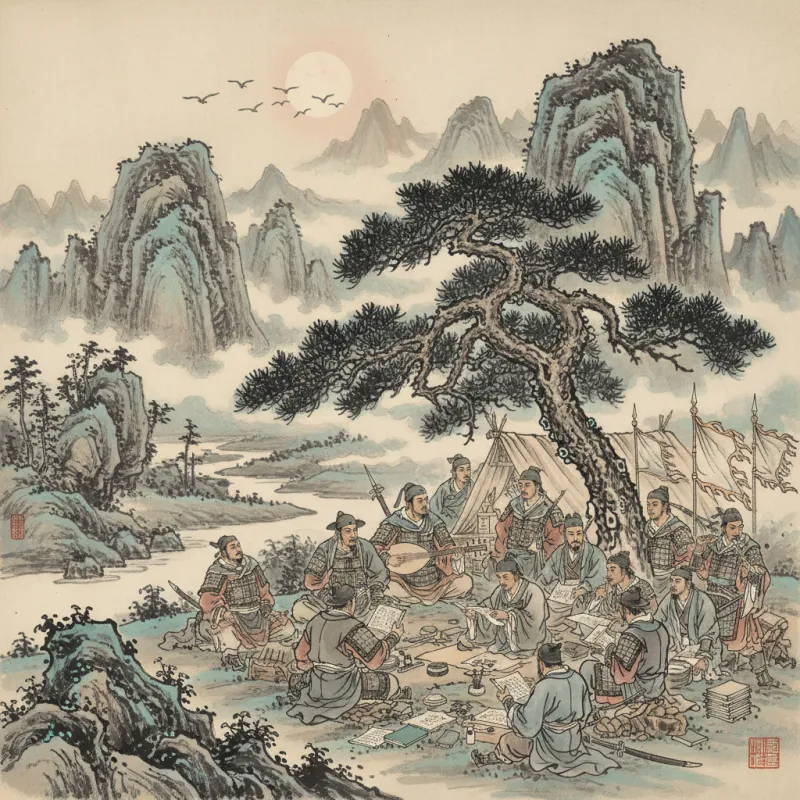
The wine cup trembles in your hand. Beyond the city gates, the Silk Road stretches westward into dust and silence. Your friend is leaving for a garrison post in Anxi, and you both know what the statistics whisper: many who ride west through Yang Pass never return. So you pour another cup, and another, because wine is the only honest response to impossible goodbyes. This is the emotional landscape of Tang Dynasty war poetry—not glory, not conquest, but the terrible human cost of empire.
The Empire's Bloody Expansion
The Tang Dynasty didn't just happen to write great war poetry. It earned that poetry through relentless military campaigns that stretched from the Korean peninsula to the edges of Persia. Between 618 and 755 CE, Tang armies fought nearly continuously, establishing protectorates, crushing rebellions, and defending trade routes. The government maintained a complex system of frontier garrisons (边防, biānfáng) staffed by rotating troops, career soldiers, and exiled officials. These weren't short deployments—men served for years in places where summer heat could kill as efficiently as winter cold, where supply lines stretched thin, and where the nearest Chinese settlement might be a month's hard ride away.
This created a unique literary phenomenon. Educated men—poets, scholars, minor officials—found themselves stationed in these remote outposts with nothing but time, homesickness, and the raw material of human suffering. They wrote. And because they were trained in the classical tradition, they wrote brilliantly.
Wang Changling: The Voice of Soldiers
Wang Changling (王昌龄, 698-756) understood something most court poets missed: soldiers aren't abstractions. His "Out of the Frontier" (《出塞》) opens with a line that cuts through centuries of military propaganda:
秦时明月汉时关 / The moon of Qin times, the pass of Han times 万里长征人未还 / Ten thousand li campaigns, men who never return
Notice what he does here. The moon and the mountain pass are eternal—they witnessed the Qin Dynasty, the Han Dynasty, and now the Tang. But the soldiers? They're gone. All of them. The poem isn't celebrating military glory; it's documenting an endless cycle of death. Wang Changling spent years in frontier posts himself, demoted and exiled for political reasons. He knew these men. He drank with them, watched them scan the horizon for dust clouds that might signal attack, heard them wake from nightmares calling for mothers and wives they'd never see again.
His poetry refuses to look away. In "Marching from the Army" (《从军行》), he writes about soldiers who've been fighting so long they can't remember their own faces, whose armor has rusted onto their bodies. This isn't metaphor—it's reportage.
Gao Shi: The Bureaucrat's Guilt
Gao Shi (高适, 704-765) came to war poetry from a different angle. He was a successful official who rose to high military command, which means he sent men to die. His poem "Song of Yan" (《燕歌行》) is one of the longest and most devastating war poems in Chinese literature. It describes a disastrous campaign where soldiers freeze to death, where officers are incompetent, where the court back in Chang'an has no idea what's actually happening at the front.
The poem's power comes from Gao Shi's insider knowledge. He knew how military decisions were made, how politics trumped strategy, how casualty reports were doctored before reaching the emperor. When he writes about soldiers' blood turning to ice on the battlefield, he's not being poetic—he's describing the actual fate of men he commanded. The guilt in his poetry is palpable, and it makes his work almost unbearable to read. He can't undo what he's done, so he writes it down with forensic precision.
The Aesthetics of Desolation
Tang war poetry developed its own visual vocabulary. Certain images recur obsessively: the frontier willow (边柳, biān liǔ) that marks the edge of Chinese civilization, the jade gate pass (玉门关, Yùmén Guān) beyond which lies the unknown, the barbarian flute (胡笳, hújiā) whose alien music haunts the night. These aren't decorative details—they're psychological markers of displacement and loss.
The willow is particularly significant. In Chinese culture, breaking a willow branch is a farewell gesture, a wish for safe return. But frontier willows are stunted, twisted things that barely survive in the harsh climate. When poets describe them, they're really describing the men stationed there: transplanted, struggling, unlikely to thrive. The symbolism of natural imagery in these poems operates on multiple levels simultaneously.
The color palette is equally deliberate. Tang war poetry is dominated by whites, grays, and blacks—snow, dust, smoke, darkness. When color appears, it's usually red (blood) or yellow (desert sand). This isn't accidental. The poets are stripping away the decorative language of court poetry to show war's actual face.
Li Qi and the Moment of Battle
Most Tang war poetry focuses on departure, waiting, or aftermath. Li Qi (李颀, 690-751) did something different in "An Old War-Song" (《古从军行》)—he tried to capture combat itself. The poem describes a night attack, the confusion of battle, the moment when you realize you might die in the next few seconds. It's chaotic, fragmented, almost impossible to follow, which is exactly the point. Battle isn't heroic narrative; it's sensory overload and terror.
Li Qi also understood the economics of war. His poems mention the cost of horses, the price of armor, the bribes required to avoid frontier service. The Tang military machine consumed enormous resources, and someone had to pay. Usually it was peasant families who sold everything to equip a son for service, then received nothing when he died except a bureaucratic notification.
The Women Left Behind
War poetry isn't just about soldiers. Wang Changling's "Resentment in the Women's Quarters" (《闺怨》) and other poems give voice to wives and mothers waiting for men who will never return. These poems are technically classified as "palace complaint" poetry (宫怨诗, gōngyuàn shī), but they're really war poems from a different angle. The women watch seasons change, grow old waiting, eventually accept that their husbands are dead even though no official confirmation arrives.
The cruelty is bureaucratic as much as military. Families often received no notification of death, no body to bury, no closure. They just waited, year after year, hope slowly curdling into certainty. The poetry captures this suspended grief with devastating precision. The role of women in Tang poetry deserves more attention than it typically receives.
Why This Poetry Still Matters
Tang war poetry refuses every comfortable lie about military conflict. It doesn't glorify sacrifice, doesn't pretend death is meaningful, doesn't suggest that empire is worth its human cost. Instead, it documents what war actually does: separates families, kills young men, enriches officials, and grinds on regardless of individual suffering.
This is why these poems still feel contemporary. We're still sending people to remote places to fight wars that serve abstract political goals. We're still writing letters and poems to process the grief. We're still pouring that extra cup of wine before saying goodbye, knowing it might be the last one.
Wang Wei's "Seeing Off Yuan Er on a Mission to Anxi" became so famous that it was set to music and sung in wine shops across China for centuries. Everyone knew the words. Everyone had said that kind of goodbye. The poem's final line—"West of Yang Pass, there are no old friends" (西出阳关无故人)—became proverbial, a way of acknowledging that some journeys erase the person who takes them.
The Tang poets knew this. They wrote it down. And because they were masters of their craft, they made it beautiful even as they documented its horror. That's the paradox of great war poetry: it transforms suffering into art without diminishing the suffering. It makes you feel the loss while giving you language to contain it. Eight hundred years before Wilfred Owen wrote "the old Lie: Dulce et decorum est / Pro patria mori," Tang poets were already dismantling the same mythology, one precise image at a time.
Related Reading
- War Poetry of the Tang Dynasty: Beauty in the Midst of Slaughter
- Exploring the Depths of Chinese War Poetry from Tang to Yuan Dynasties
- The Resonance of War in Chinese Classical Poetry: Analyzing Tang, Song, and Yuan Poets
- Patriotic Poetry in Chinese History: From Qu Yuan to Modern Times
- Frontier Poetry (边塞诗): War and Glory at the Empire's Edge
- Exile Poetry: When Banishment Produced China's Greatest Literature
- Exploring Love in Chinese Classical Poetry: Tang, Song, and Yuan Poets’ Romantic Artistry
- Li Bai: The Life of China's Most Legendary Poet
Explore Chinese Culture
- Explore the Tang dynasty's golden age
- Explore Daoist themes in classical poetry
- Explore Chinese literary traditions