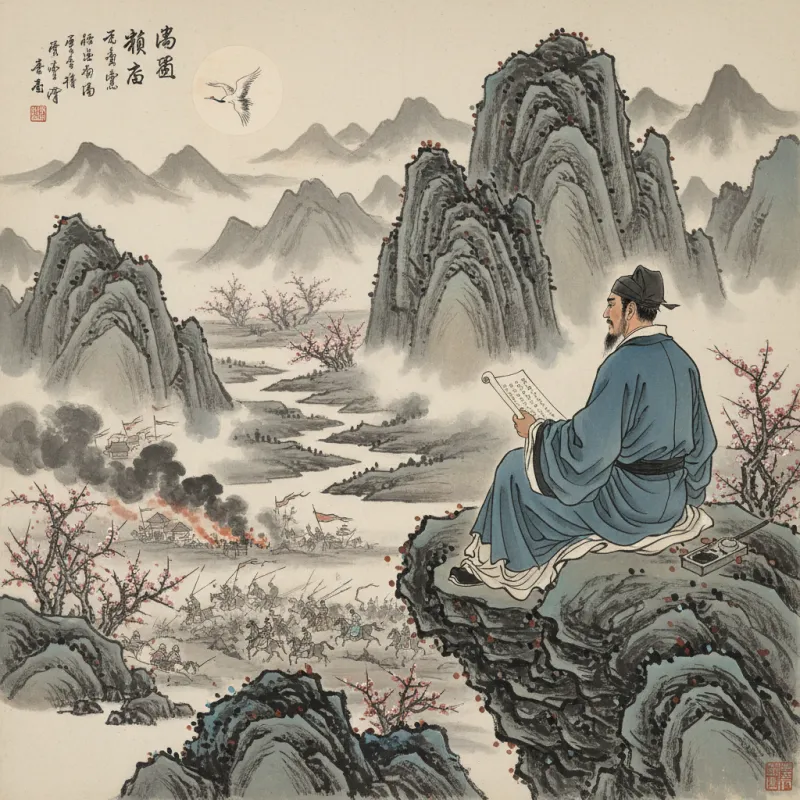
The moon rises over the Qilian Mountains, and somewhere beneath it, a soldier is freezing to death. He's been stationed at the frontier for three years. His armor hasn't been removed in months. The metal has fused with his skin in places. Back home, his wife is remarrying. He doesn't know this yet. He's watching the moon, the same moon she's watching, and thinking about how beautiful it is. This is the emotional landscape of Tang Dynasty war poetry—a place where aesthetic rapture and human suffering occupy the same breath, the same line, sometimes the same word.
The Paradox at the Heart of Border Poetry
Tang Dynasty (唐朝 Tángcháo) war poetry shouldn't work. By every reasonable standard, it should collapse under its own contradictions. How can you write beautifully about ugliness? How can you be simultaneously patriotic and devastated by patriotism's cost? How can you admire military glory while documenting its waste? Yet poets like Wang Changling (王昌龄 Wáng Chānglíng), Gao Shi (高适 Gāo Shì), Cen Shen (岑参 Cén Shēn), and Du Fu (杜甫 Dù Fǔ) managed exactly this impossible balance. They created a body of work that refuses to choose between beauty and horror, that insists—against all our modern instincts—that these things can coexist.
The key is that these poets weren't writing propaganda. They were writing what they actually saw, or what they could vividly imagine, with the same aesthetic attention they brought to love poetry or landscape verse. Wang Changling spent years at the frontier. Gao Shi served in military campaigns. Cen Shen was secretary to a military governor in the Western Regions. They knew the texture of military life—the boredom, the sudden violence, the strange camaraderie, the soul-crushing distance from home. And they knew that none of this canceled out the fact that a desert sunset could still stop your heart.
When Aesthetics Meets Atrocity
Consider Wang Changling's most famous quatrain, "Out of the Frontier" (出塞 Chū Sài):
In the Qin era, the bright moon; in the Han era, the frontier pass
Ten thousand li of征途, men have not returned
But if the Flying General of Dragon City were still here
He would not permit the Hu horses to cross the Yin Mountains
The poem opens with pure aesthetic observation—the moon, the mountain pass, the vast distance rendered in clean, visual terms. Then it pivots to human cost: ten thousand li of征途 (zhēngtú, military campaigns), and men who never came home. The final couplet invokes Li Guang, the legendary "Flying General," but even this gesture toward military heroism is undercut by its conditional mood. If he were here. But he's not. The Hu cavalry keeps coming. The men keep dying. The moon keeps rising, beautiful and indifferent.
This is the aesthetic strategy of Tang war poetry: it places beauty and suffering in immediate proximity, refusing to subordinate one to the other. The moon doesn't redeem the deaths. The deaths don't negate the moon's beauty. Both are true. Both matter. This is what makes the poetry so uncomfortable and so honest.
The Frontier as Aesthetic Space
The northwestern frontier—the borderlands where Tang China met the Tibetan Empire, the Turkic Khaganates, and various other powers—was a landscape of extremes. Deserts, mountains, sudden storms, crystalline air, distances that could swallow armies. For the frontier poets, this landscape wasn't just a backdrop. It was an active participant in the poetry, a force that shaped both the military campaigns and the emotional register of the verse.
Cen Shen, who spent years in the Western Regions, became the master of frontier landscape. His poems are full of snow in May, winds that could knock a man off his horse, nights so cold that ink froze in its well. But he doesn't present these hardships as mere suffering. There's a strange exhilaration in his descriptions, a sense that the frontier's extremity makes everything more vivid, more real. In "Song of White Snow Sending Judge Wu Back to the Capital" (白雪歌送武判官归京 Báixuě Gē Sòng Wǔ Pànguān Guī Jīng), he describes a snowstorm with the enthusiasm of a man who's genuinely amazed by what nature can do:
Suddenly, overnight, spring wind comes
As if ten thousand pear trees have blossomed
This is snow described as flowering trees—a transformation of hardship into beauty through sheer force of aesthetic attention. The soldiers are still freezing. The war is still happening. But the snow is also genuinely, impossibly beautiful.
Du Fu's Counter-Vision
Du Fu (杜甫 Dù Fǔ) approached war poetry from a different angle. While the frontier poets wrote from within the military world, Du Fu wrote as a civilian caught in war's machinery. His war poems, particularly those written during and after the An Lushan Rebellion (755-763), strip away the aesthetic consolations that the frontier poets allowed themselves. In "Spring View" (春望 Chūn Wàng), written while Chang'an was occupied by rebel forces, he writes:
The nation shattered, mountains and rivers remain
City in spring, grass and trees grow deep
The landscape persists, but its beauty is now a form of accusation. The grass grows deep because no one is maintaining the city. The mountains and rivers remain because they don't care about human political structures. Du Fu's war poetry is less ambiguous than the frontier poets'—he's clear about war's cost—but he shares their refusal to look away from what's actually there. The spring is still spring. The city is still ruined. Both facts demand acknowledgment.
His "Ballad of the Army Carts" (兵车行 Bīngchē Xíng) is even more direct, depicting conscription as a scene of mass grief: parents clinging to sons, wives to husbands, the sound of crying so loud it "reaches the clouds." Yet even here, Du Fu's aesthetic precision doesn't waver. He describes exactly what he sees, in language that's both beautiful and devastating.
The Problem of Patriotism
Modern readers often struggle with Tang war poetry's patriotic elements. How can we admire poems that celebrate military campaigns, that invoke the glory of defending the empire, that treat enemy peoples as threats to be repelled? The answer is that we probably can't, at least not without significant discomfort. But that discomfort is part of the poetry's value.
Tang Dynasty poets weren't writing for us. They were writing within a specific historical and ideological context, one in which defending the empire was understood as a moral duty, and in which the frontier wars were seen as necessary (even if their human cost was also recognized as tragic). The poetry's patriotism isn't simple jingoism—it's complicated by the poets' simultaneous awareness of war's waste and suffering. But it's still there, and we can't simply edit it out.
What we can do is recognize that the poetry's honesty extends to its patriotism. These poets believed in the empire they served, even as they documented its failures and its costs. That contradiction—between belief and disillusionment, between duty and horror—is part of what makes the poetry so powerful. It refuses the easy out of either pure celebration or pure condemnation.
Beauty as Survival Strategy
There's another way to read the aesthetic beauty in Tang war poetry: as a survival strategy. When you're stationed at a frozen frontier outpost, thousands of miles from home, with no clear end to your service in sight, the ability to find beauty in your surroundings might be the only thing keeping you sane. The moon rising over the mountains, the way snow transforms the landscape, the sound of a flute at night—these aren't distractions from the war. They're what make the war bearable.
This reading doesn't make the poetry less honest. If anything, it makes it more so. The frontier poets weren't aestheticizing war from a safe distance. They were finding ways to survive it, and one of those ways was to remain capable of aesthetic response. The beauty in their poetry isn't a lie about war. It's a truth about human resilience, about our stubborn capacity to notice and care about beauty even in the worst circumstances.
The Legacy of Ambiguity
Tang war poetry's refusal of easy answers has made it lastingly relevant. We keep returning to these poems because they don't tell us what to think about war. They show us war's complexity—its horror and its strange attractions, its waste and its occasional moments of transcendence, its capacity to destroy and its capacity to reveal what people are capable of enduring.
This ambiguity is especially valuable now, when our discourse about war tends toward the simplistic. We want war to be either glorious or purely evil, either necessary or completely avoidable. Tang war poetry suggests that war is all of these things simultaneously, and that any honest account must hold these contradictions in tension rather than resolving them.
The frontier poets wrote from within that tension. They were patriots who saw their empire's failures. They were aesthetes who witnessed atrocity. They were men who believed in military glory and who counted its cost in frozen corpses and abandoned wives. They wrote it all down, with the same careful attention to language and image that they brought to every other subject. The result is poetry that's beautiful and terrible in equal measure—which is to say, poetry that tells the truth about war as well as any art form can.
Related Reading
- Exploring the Depths of Chinese War Poetry from Tang to Yuan Dynasties
- Frontier Poetry (边塞诗): War and Glory at the Empire's Edge
- War Poetry of the Tang Dynasty: When Soldiers Became Poets
- The Resonance of War in Chinese Classical Poetry: Analyzing Tang, Song, and Yuan Poets
- Du Fu's War Poems: Poetry as Witness to Catastrophe
- Bai Juyi: The Song of Everlasting Sorrow
- Discovering the Rich Legacy of Tang, Song, and Yuan Poetry
- Nature in Chinese Poetry: Mountains, Rivers, and the Mirror of the Soul
Explore Chinese Culture
- Explore the Tang dynasty's golden age
- Explore Daoist themes in classical poetry
- Explore Chinese literary traditions