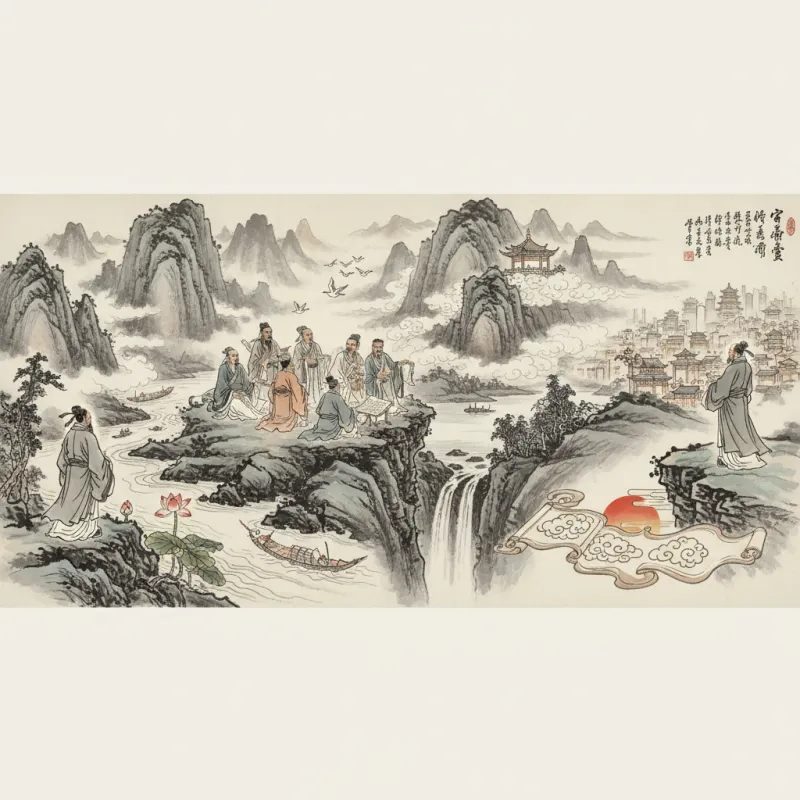
When Qu Yuan (屈原 Qū Yuán) waded into the Miluo River in 278 BCE, weighted down with stones, he wasn't making a dramatic gesture. He was making a statement that would echo through Chinese literature for the next two thousand years: sometimes loving your country means dying for it, not in battle, but in protest. His suicide wasn't defeat—it was the ultimate act of loyalty to a kingdom that had exiled him, ignored his warnings, and was about to fall to the Qin armies. Every Dragon Boat Festival, Chinese families still eat zongzi (粽子 zòngzi) and race boats to commemorate this moment, turning a poet's drowning into a national ritual. That's the power of patriotic poetry in China: it doesn't celebrate victory. It consecrates heartbreak.
The Qu Yuan Template: Loyalty as Tragedy
Qu Yuan's "Encountering Sorrow" (離騷 Lí Sāo) established the DNA of Chinese patriotic poetry: the loyal minister, ignored by a foolish ruler, watching his country slide toward disaster. The poem runs to 373 lines of dense, allusive verse—part political manifesto, part spiritual journey, part lover's complaint. Qu Yuan casts himself as a rejected lover, his king as the beloved who's fallen for scheming courtesans (read: corrupt officials). The metaphor is so powerful that it became the standard template: patriotism as unrequited love, the poet as the faithful partner watching their beloved destroy themselves.
What makes Qu Yuan's model so durable is its emotional complexity. He's not angry at his country—he's angry for it. He doesn't curse the King of Chu; he mourns what the king has become. This sets Chinese patriotic poetry apart from the martial triumphalism you find in, say, Horace's Roman odes or Tennyson's "Charge of the Light Brigade." Chinese poets don't celebrate their country's power. They grieve its failures. Readers exploring this tradition should also see Frontier Poetry (边塞诗): War and Glory at the Empire's Edge, which takes a different approach to military themes.
Du Fu: Patriotism in the Ruins
If Qu Yuan established the template, Du Fu (杜甫 Dù Fǔ, 712-770 CE) perfected it. Writing during and after the An Lushan Rebellion—a civil war that killed an estimated 36 million people and nearly destroyed the Tang Dynasty—Du Fu created a body of work that reads like a real-time documentary of national collapse. His "Spring View" (春望 Chūn Wàng) opens with one of the most devastating lines in Chinese poetry: "The nation is broken; mountains and rivers remain" (國破山河在 guó pò shān hé zài). The capital is in ruins, but nature doesn't care. The disconnect between the eternal landscape and the temporary human disaster is almost unbearable.
Du Fu's patriotic poetry is granular and specific. He doesn't write about "the people"—he writes about the old man conscripted at seventy, the family separated by war, the abandoned villages he passes on the road. In "Ballad of the Army Carts" (兵車行 Bīng Chē Xíng), he records the actual words of conscripts being marched off to die in pointless frontier wars: "At fifteen, I went north to guard the river; at forty, I'm still farming military colonies in the west." This is patriotic poetry as witness testimony, preserving the voices of people crushed by their own government's incompetence.
What's remarkable is that Du Fu never stops loving the Tang Dynasty, even as he documents its failures. He's like a family member watching a loved one spiral into addiction—horrified, exhausted, but unable to look away or give up hope. This emotional stance becomes the default mode for Chinese patriotic poets: love mixed with rage, loyalty mixed with despair.
Song Dynasty: Patriotism Against Foreign Conquest
The Song Dynasty (960-1279 CE) produced a different flavor of patriotic poetry because the threat was external: first the Khitan Liao, then the Jurchen Jin, finally the Mongols who conquered everything. Song poets wrote from a position of military weakness, watching their territory shrink, their emperors captured, their capitals sacked. The poetry is less about internal corruption and more about the humiliation of losing to "barbarians."
Lu You (陸游 Lù Yóu, 1125-1210) spent his entire life advocating for military campaigns to recover the north from the Jin Dynasty. He never got his wish. His poetry is full of frustrated martial energy—he writes about practicing swordsmanship in his sixties, dreaming of cavalry charges, imagining the reconquest that will never happen. His deathbed poem instructs his sons: "When the royal armies reconquer the Central Plains, don't forget to tell me at my grave sacrifice." He died at 85, still waiting for a victory that wouldn't come for another seventy years (and then only because the Mongols conquered everyone).
Xin Qiji (辛棄疾 Xīn Qìjí, 1140-1207) was even more bitter. He actually fought the Jin in his youth, led guerrilla raids, captured a traitor and dragged him back to Song territory. Then the Song court sidelined him for forty years, afraid his aggressive stance would provoke war. His ci (詞 cí) poems—song lyrics set to popular tunes—are masterpieces of suppressed rage. "Broken Array" (破陣子 Pò Zhèn Zǐ) describes military glory in vivid detail, then ends with the poet drunk and alone, his talents wasted. The contrast between the martial imagery and the pathetic reality is crushing.
The Ming-Qing Transition: Patriotism as Resistance
The fall of the Ming Dynasty (1644) and the Manchu conquest created a crisis of identity. Were you patriotic to the Ming, now defeated? To China as a cultural entity? To the new Qing Dynasty, which was foreign but claimed the Mandate of Heaven? Poets split in different directions.
Some, like Qu Dajun (屈大均 Qū Dàjūn, 1630-1696), spent their lives in resistance, refusing to serve the Qing, keeping alive the memory of the Ming. His poetry is full of coded references to Ming loyalism, disguised as nature poetry or historical reflection. Others, like Wang Shizhen (王士禎 Wáng Shìzhēn, 1634-1711), served the Qing but wrote poetry that subtly questioned the new order. The ambiguity was necessary—open Ming loyalism could get you executed.
The most interesting case is Gu Yanwu (顧炎武 Gù Yánwǔ, 1613-1682), who distinguished between "the fall of a state" (亡國 wáng guó) and "the fall of civilization" (亡天下 wáng tiānxià). A dynasty could fall—that was just politics. But if Chinese civilization itself was threatened, that was everyone's responsibility. This distinction allowed later patriots to criticize the Qing government without being accused of treason: they weren't opposing the dynasty, they were defending Chinese culture.
Modern Patriotic Poetry: From Reform to Revolution
The twentieth century forced Chinese poets to reimagine what patriotism meant. Was it loyalty to the Qing Dynasty? To the Republic? To the Communist Party? To some abstract idea of "China"? The confusion produced some of the most powerful patriotic poetry in Chinese history.
Qiu Jin (秋瑾 Qiū Jǐn, 1875-1907) wrote revolutionary poetry calling for the overthrow of the Qing and the liberation of women. She was executed at 31 for her role in an anti-Qing uprising. Her poetry mixes classical forms with radical content—she uses the language of traditional patriotic poetry to argue for completely untraditional goals. "Don't say women aren't heroic material," she writes, positioning herself in the tradition of warrior-poets while simultaneously breaking it open.
Wen Yiduo (聞一多 Wén Yīduō, 1899-1946) wrote "Dead Water" (死水 Sǐ Shuǐ) in 1926, describing China as a stagnant ditch that might as well be decorated with garbage since it's already ruined. The poem is viciously sarcastic—he suggests throwing in copper to turn the water green, adding peach blossoms to make it look festive. It's patriotic poetry as savage mockery, loving the country by refusing to pretend it's anything but a disaster. He was assassinated by Nationalist agents for his political activism, proving that patriotic poetry in China remains dangerous.
The Emotional Architecture of Chinese Patriotism
What unites these poets across two millennia is a specific emotional structure: love for the country, rage at its rulers, grief over its suffering, and an inability to look away or give up. Chinese patriotic poetry is never triumphalist because Chinese history is a long series of disasters punctuated by brief golden ages. The poets know this. They've read the histories. They know every dynasty falls, every reform fails, every hope gets crushed.
But they keep writing anyway. That's the real patriotism: not the naive belief that your country is great, but the stubborn insistence on loving it even when it breaks your heart. Qu Yuan drowning himself, Du Fu documenting the ruins, Lu You dreaming of reconquest on his deathbed, Wen Yiduo mocking the stagnant water—they're all doing the same thing. They're refusing to let their country's failures be the last word.
This tradition continues today, though often in coded or indirect forms. Contemporary Chinese poets still write about official corruption, social injustice, and national humiliation, though they have to be careful about how they phrase it. The language changes, the political context shifts, but the emotional core remains: patriotism as a form of grief, loyalty as a kind of suffering, love for a country that keeps disappointing you but that you can't stop caring about. For more on how Chinese poets approached military themes, see War Poetry in Classical Chinese Literature.
The Western reader might find this depressing. Where's the pride? The celebration? The "my country, right or wrong"? But Chinese poets would argue that their version is more honest. Countries fail. Governments betray their people. Empires collapse. The question isn't whether your country deserves your love—it's whether you can keep loving it anyway, through all the disasters, all the betrayals, all the heartbreak. That's what Chinese patriotic poetry teaches: loyalty isn't about blind faith. It's about open-eyed grief, and the refusal to look away.
Related Reading
- War Poetry of the Tang Dynasty: Beauty in the Midst of Slaughter
- Du Fu's War Poems: Poetry as Witness to Catastrophe
- Exploring the Depths of Chinese War Poetry from Tang to Yuan Dynasties
- War Poetry of the Tang Dynasty: When Soldiers Became Poets
- Xin Qiji: The Warrior Poet
- Unveiling the Essence of Chinese Classical Poetry: Insights from Tang, Song, and Yuan Poets
- Women Poets of China: The Voices That Were Almost Lost
Explore Chinese Culture
- Explore the Tang dynasty's golden age
- Explore Daoist themes in classical poetry
- Explore Chinese literary traditions