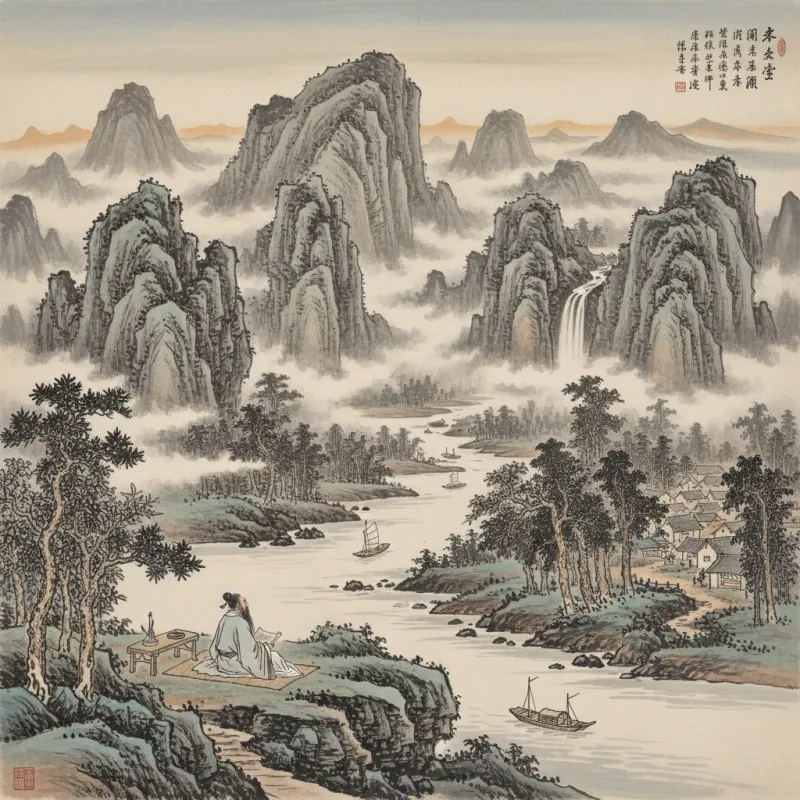
The mountain is empty, but not silent. Voices echo through the trees, though no human form appears. Sunlight filters through the canopy, illuminating patches of moss in the forest depths. This is Wang Wei's vision — a world where absence speaks louder than presence, where nature reveals truths that human society obscures.
The Philosophical Foundation
Chinese nature poetry emerged from a worldview fundamentally different from Western landscape traditions. Where European Romantics would later position humanity against nature, Tang and Song poets saw no such division. The concept of tianren heyi (天人合一, "heaven and humanity united") meant that observing nature was observing oneself, and vice versa.
This wasn't mere metaphor. Daoist philosophy taught that the same qi (氣, vital energy) animated mountains, rivers, and human beings. Buddhist thought, which deeply influenced Tang poetry, emphasized the interconnection of all phenomena. When Du Fu wrote about a broken nation, he described grass growing thick — the natural world continuing its cycles regardless of human catastrophe. When Wang Wei depicted an empty mountain, he was simultaneously describing the emptiness (kong, 空) that Buddhist practice cultivates in the mind.
Wang Wei: Painting with Words
Wang Wei (王維, 701-761) didn't just write about nature — he dissolved the boundary between observer and observed. A painter as well as poet, he pioneered the shanshui (山水, "mountain-water") aesthetic that would dominate Chinese art for centuries. His poem "Deer Enclosure" (Lu Zhai, 鹿柴) demonstrates this mastery:
空山不見人 / kong shan bu jian ren / Empty mountain, no one in sight
但聞人語響 / dan wen ren yu xiang / Only the echo of voices heard
返景入深林 / fan jing ru shen lin / Returning light enters the deep forest
復照青苔上 / fu zhao qing tai shang / And shines again on the green moss
Twenty characters. Four lines. An entire philosophy of perception. The mountain is "empty" not because it lacks life, but because it transcends the human presence that briefly passes through it. The voices echo and fade. The light — fan jing, "returning light," suggesting both sunset and Buddhist enlightenment — penetrates the forest to illuminate moss, the humblest of plants. Wang Wei directs our attention downward, inward, to what persists when human noise subsides.
The Seasons as Emotional Language
Tang and Song poets developed an intricate vocabulary of seasonal imagery, where each natural element carried specific emotional and philosophical weight. Spring blossoms meant both beauty and impermanence — their brief flowering a reminder of life's transience. Autumn leaves suggested melancholy, aging, and the approach of death, but also harvest and fulfillment. Winter snow could represent purity, isolation, or the blank slate of potential.
This wasn't arbitrary symbolism. It emerged from centuries of agricultural society attuned to seasonal rhythms, combined with the Buddhist concept of wuchang (無常, impermanence). When Li Bai wrote about falling petals, his readers immediately understood layers of meaning that required no explanation. The seasonal imagery functioned as a shared emotional language, refined across generations.
Exile and Distance: Nature as Consolation
Many of China's greatest nature poems were written in exile. The imperial examination system and court politics meant that officials could be banished to remote provinces for minor infractions or political shifts. Suddenly, a sophisticated urbanite found himself in wild mountains or frontier regions. Nature poetry became a way to process displacement, find meaning in isolation, and maintain dignity in disgrace.
Su Shi (蘇軾, 1037-1101), repeatedly exiled during his career, transformed his banishments into opportunities for profound nature observation. His "Red Cliff Odes" (Chibi Fu, 赤壁賦), written during exile in Huangzhou, contemplate the Yangtze River and the site of an ancient battle. The river flows on, indifferent to human glory and defeat. Su Shi finds not despair in this, but liberation — if the river continues regardless, then his personal misfortunes are equally transient.
Liu Zongyuan (柳宗元, 773-819), exiled to the remote south, wrote "River Snow" (Jiang Xue, 江雪):
千山鳥飛絕 / qian shan niao fei jue / A thousand mountains, birds vanished
萬徑人蹤滅 / wan jing ren zong mie / Ten thousand paths, human traces gone
孤舟蓑笠翁 / gu zhou suo li weng / Lone boat, an old man in straw cape and hat
獨釣寒江雪 / du diao han jiang xue / Alone fishing the cold river snow
The poem's extreme isolation — no birds, no people, just one fisherman in vast whiteness — reflects Liu's political isolation. Yet there's dignity in that solitary figure, persisting in his task despite the cold. The imagery of solitude became a way for exiled poets to reframe their circumstances as chosen withdrawal rather than forced banishment.
The Technique of Observation
What distinguishes Chinese nature poetry is its precision. These poets weren't describing generic landscapes — they observed specific moments with painterly attention to detail. Wang Wei's moss isn't just green; it's illuminated by fan jing, returning or reflected light, suggesting a particular time of day and angle of sun. Du Fu doesn't write about birds in general; he specifies egrets against blue sky, orioles in green willows, creating exact color contrasts.
This precision came from practice. Literati culture encouraged youshan wanshui (遊山玩水, "roaming mountains and playing in waters") — extended trips to famous scenic sites where poets would compose, compare their work, and refine their observations. The best nature poems emerged from this combination of direct observation and literary tradition, where each poet tried to see freshly while remaining aware of how predecessors had described similar scenes.
Mountains and Rivers: The Core Symbols
If Chinese nature poetry has a center, it's shanshui — mountains and waters. These weren't just common landscape features; they represented fundamental cosmic principles. Mountains embodied yang energy — solid, permanent, reaching toward heaven. Waters embodied yin — flowing, changing, seeking the lowest places. Together they formed the complete world.
The great shanshui poets understood this symbolism but transcended it through specific observation. When Xie Lingyun (謝靈運, 385-433), the pioneer of landscape poetry, described climbing mountains, he recorded the physical experience — the exhaustion, the changing views, the moment of reaching the summit. When Wang Wei painted mountains in words, he captured their stillness and the way they frame emptiness. Each poet found their own way into the tradition.
The Legacy: Seeing Through Poetry
Chinese nature poetry teaches a way of seeing. Not nature as resource, not nature as backdrop for human drama, but nature as teacher and mirror. The poets trained themselves to notice — the specific quality of light on moss, the sound of voices echoing in an empty valley, the persistence of a fisherman in snow. Through their poems, they invite us to develop the same attention.
This tradition continues to influence how Chinese culture relates to landscape. The classical garden design that emerged in the Song dynasty attempted to recreate the experiences described in poetry — the sense of depth, the interplay of solid and void, the revelation of views through careful framing. Contemporary Chinese poetry still draws on this vocabulary of mountains, rivers, and seasons, though often with ironic awareness of how industrialization has transformed the landscapes the Tang poets knew.
To read these poems is to see the world as Wang Wei saw it — not as separate from ourselves, but as the larger body we inhabit, the mirror that shows us what we are when we stop insisting on our own importance. The mountain is empty. The light returns. The moss grows in the forest depths, whether anyone sees it or not.
Related Reading
- The Four Seasons in Chinese Poetry: A Seasonal Reading Guide
- The Harmony of Nature in Chinese Classical Poetry: Tang, Song, and Yuan Dynasties
- Nature Poetry in the Tang Dynasty: Mountains, Rivers, and the Art of Seeing
- Mountain and Water Poetry (山水诗): When Landscape Becomes Literature
- The Moon in Chinese Poetry: 50 Ways to Say 'I Miss You'
- Confucian Values in Classical Chinese Poetry: Duty, Loyalty, and the Weight of the World
- The Timeless Art of Song Poets: A Deep Dive into Classical Chinese Poetry
- Sun Tzu's Art of War: The Complete Guide for Modern Readers
Explore Chinese Culture
- Explore the Tang dynasty's golden age
- Explore Daoist themes in classical poetry
- Explore Chinese literary traditions