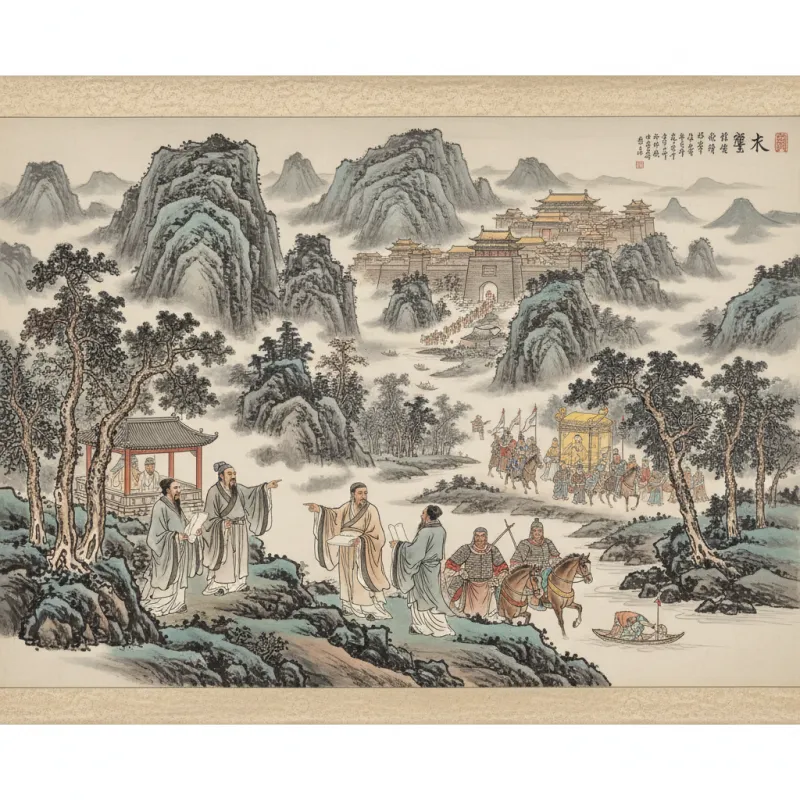
In 845 CE, the poet Du Mu (杜牧 Dù Mù) wrote a poem about a beautiful woman picking flowers in a palace garden. It was actually about government corruption. Everyone knew it. The censors knew it. The emperor probably knew it. Nobody could prove it, because the poem was technically about flowers.
This is how political poetry worked in China for over two thousand years — through metaphor, allusion, and plausible deniability. And it was one of the most dangerous games a writer could play.
The Tradition of Remonstrance
The roots go back to the Book of Songs (诗经 Shījīng), compiled around 600 BCE. Confucius himself supposedly said that poetry could be used to "criticize indirectly" (怨 yuàn). The idea was baked into Chinese political philosophy from the start: a good ruler should listen to poetry, because poets spoke for the people.
This wasn't just theory. The Han Dynasty (206 BCE–220 CE) established the Music Bureau (乐府 Yuèfǔ), which collected folk songs partly to gauge public sentiment. If farmers were singing about corrupt officials or heavy taxes, the emperor was supposed to pay attention. Poetry was intelligence gathering.
But here's the catch: criticizing the emperor directly could get you killed. So poets developed an elaborate system of coded language. They wrote about ancient tyrants when they meant current ones. They described natural disasters as metaphors for political chaos. They praised virtuous ministers from history to shame incompetent ones in the present.
The technical term for this was "using the past to criticize the present" (借古讽今 jiè gǔ fěng jīn). Every educated reader knew how to decode it. The game was seeing how far you could push before someone decided your metaphor was too transparent.
When Metaphors Became Weapons
Take Qu Yuan (屈原 Qū Yuán), the third-century BCE poet who basically invented Chinese political poetry. He served the King of Chu, got slandered by rivals, and was exiled. His response? He wrote "Encountering Sorrow" (离骚 Lí Sāo), a 373-line masterpiece that's ostensibly about wandering through mystical landscapes and meeting goddesses.
But everyone understood what it really meant. The "fragrant herbs" he gathered represented virtuous policies. The "foul weeds" choking the garden were corrupt officials. The beautiful woman who rejected him was the king who wouldn't listen to good advice. The entire poem was a 2,400-year-old subtweet.
Qu Yuan eventually drowned himself in the Miluo River. The Dragon Boat Festival commemorates his death. He became the patron saint of principled officials who spoke truth to power and paid the price.
During the Tang Dynasty, this tradition reached its peak sophistication. Bai Juyi (白居易 Bái Jūyì) wrote "new yuefu" poems (新乐府 xīn yuèfǔ) that looked like folk songs but were actually scathing social commentary. His "The Old Charcoal Seller" described an elderly man whose entire winter's work — a cart of charcoal — gets confiscated by palace eunuchs who pay him with a few yards of silk. The poem never mentions the emperor. It doesn't need to. The system speaks for itself.
Bai Juyi got demoted for poems like this. He spent years in provincial posts, which is how we got some of the greatest exile poetry in Chinese literature. The government tried to silence him by sending him away. Instead, they gave him more material.
The Art of Plausible Deniability
Du Fu (杜甫 Dù Fǔ) mastered a different technique: he wrote about his own suffering and let readers connect the dots. "A Song of My Thatched Hut Damaged by Autumn Wind" describes his roof blowing off during a storm. But the poem ends with him imagining a massive shelter that could house "all the poor scholars under heaven."
Is this about housing policy? About the government's failure to care for its people? About the An Lushan Rebellion that had just torn the country apart? Yes, yes, and yes. Du Fu never says any of this explicitly. He just describes his cold, wet house and lets the political implications radiate outward.
The genius is that you can't arrest someone for describing their own leaky roof. But everyone reading the poem in 760 CE knew that Du Fu's personal misery reflected a larger national catastrophe. The emperor had fled the capital. The bureaucracy had collapsed. Millions had died. And here's this poet, shivering in the rain, writing about it by not writing about it.
Li Shangyin (李商隐 Lǐ Shāngyǐn) took this even further. His poems are so densely allusive that scholars still argue about what they mean. "Brocade Zither" mentions the mythical zither with fifty strings, the butterfly dream of Zhuangzi, the cuckoo that cried blood, the mermaid's tears that became pearls. Is it about lost love? Political disillusionment? The futility of trying to serve a corrupt court?
The ambiguity was the point. Li Shangyin wrote during the late Tang, when factionalism at court had become vicious. Being too clear about your political allegiances could get you purged. So he developed a style so allusive that his poems could mean almost anything — which meant they couldn't be used as evidence against him.
The Price of Speaking Out
Not everyone was so careful. In 1079, Su Shi (苏轼 Sū Shì) — better known as Su Dongpo — was arrested for writing poems that allegedly mocked the New Policies of Wang Anshi. The charges were absurd. Prosecutors combed through his poetry looking for hidden meanings. They claimed that a poem about catching fish was really about opposing salt monopolies. A poem about rain was supposedly criticizing flood control projects.
Su Shi spent months in prison expecting execution. He was eventually exiled instead, which gave us some of the most profound reflections on exile in Chinese literature. But the message was clear: even the most famous poet in China could be destroyed for metaphors that someone decided were too pointed.
The "Crow Terrace Poetry Trial" (乌台诗案 Wūtái Shī'àn) had a chilling effect. Poets became more cautious. The Song Dynasty produced brilliant lyric poetry (词 cí), but much of it retreated into private emotions and aesthetic refinement. Political commentary didn't disappear — it just became even more coded.
Yuan Haowen (元好问 Yuán Hàowèn), writing during the Mongol conquest of northern China in the thirteenth century, perfected the art of saying everything by saying nothing. His poems describe empty cities, abandoned temples, overgrown roads. He never mentions the Mongol armies. He doesn't need to. The landscape itself is a political statement.
The Double-Edged Sword of Tradition
Here's the paradox: the same tradition that allowed poets to criticize power also gave the government tools to suppress them. Because everyone knew poetry could be political, authorities scrutinized it constantly. The literary inquisitions (文字狱 wénzì yù) of the Qing Dynasty took this to extremes.
In 1711, a scholar named Dai Mingshi was executed for including essays by Ming loyalists in an anthology. In 1755, a poet named Hu Zhongzao was beheaded because a line in his poem — "clear winds don't recognize characters" (清风不识字 qīng fēng bù shí zì) — could be read as insulting the Qing Dynasty (清 Qīng). The word for "clear" and the dynasty name were the same character.
This wasn't paranoia. It was the logical endpoint of a system where everyone understood that poetry was never just poetry. If a poem about flowers could mean government corruption, then a poem about wind could mean dynastic illegitimacy. The metaphorical richness that made Chinese poetry so powerful also made it incredibly dangerous.
Poets responded by going even deeper into allusion. Gong Zizhen (龚自珍 Gōng Zìzhēn), writing in the nineteenth century as the Qing Dynasty crumbled, filled his poems with references to Buddhist sutras, Daoist alchemy, and obscure historical incidents. You needed a classical education just to parse the surface meaning, let alone the political subtext.
His most famous poem describes falling flowers: "Fallen blossoms are not heartless things / They turn to spring mud to nourish new blooms." On one level, it's about the cycle of nature. On another, it's about his own retirement from government service. On yet another, it's about the need for reform and renewal in a dying dynasty. The poem works on all these levels simultaneously.
Why It Still Matters
This tradition didn't end with imperial China. When Mao Zedong launched the Hundred Flowers Campaign in 1956, inviting intellectuals to criticize the Communist Party, poets responded with the same techniques their ancestors had used. They wrote about historical injustices that paralleled contemporary ones. They used classical allusions to make modern points.
Then came the Anti-Rightist Campaign, and hundreds of thousands were persecuted for what they'd written. The pattern repeated: invite criticism, punish critics, drive poetry underground. During the Cultural Revolution, poets like Gu Cheng and Bei Dao developed "Misty Poetry" (朦胧诗 ménglóng shī) — deliberately obscure verse that couldn't be pinned down to specific political meanings.
The game continues. In 2020, a Chinese professor was fired for comparing a government policy to the Qin Dynasty's book burning. He was using a 2,200-year-old metaphor. Everyone understood it. That was the problem.
What the tradition of political poetry reveals is this: when you can't speak directly, you learn to speak beautifully. The constraints that made Chinese political poetry dangerous also made it sophisticated. Poets developed an arsenal of techniques — allusion, metaphor, historical parallel, natural imagery — that could convey complex political ideas while maintaining plausible deniability.
But there's a cost. When everything is metaphor, meaning becomes slippery. When every poem might be political, reading becomes an act of paranoid interpretation. The same ambiguity that protected poets also made their messages harder to receive. Du Mu's poem about flowers might have been about corruption — or it might have just been about flowers.
That uncertainty is built into the form. Chinese political poetry works because it operates in the space between saying and not-saying, between the literal and the figurative, between what's written and what's understood. It's a tradition born from necessity, refined over millennia, and still alive wherever people need to speak truth to power without quite speaking it.
The poets who challenged emperors knew they were playing a dangerous game. They played it anyway, because some things need to be said even when they can't be said directly. They left us a body of work that's both beautiful and subversive, that works as poetry even when you miss the politics, but rewards you when you catch the hidden meanings.
And sometimes, when the metaphor was too transparent and the poet too bold, they paid with exile, imprisonment, or death. But the poems survived. That was the point.
Related Reading
- Exile Poetry: When Banishment Produced China's Greatest Literature
- The Melancholy of Exile: A Journey Through Tang, Song, and Yuan Poetry
- Su Shi in Exile: How Banishment Produced China's Greatest Prose
- Qu Yuan: The First Named Poet in Chinese History
- Su Shi in Exile: Making the Best of Banishment
- Exploring Chinese Classical Poetry: Tang, Song, and Yuan Poets’ Literary Legacy
- Du Fu: The Conscience of Chinese Poetry
- The Four Great Classical Novels of Chinese Literature
Explore Chinese Culture
- Explore the Tang dynasty's golden age
- Explore Daoist themes in classical poetry
- Explore Chinese literary traditions